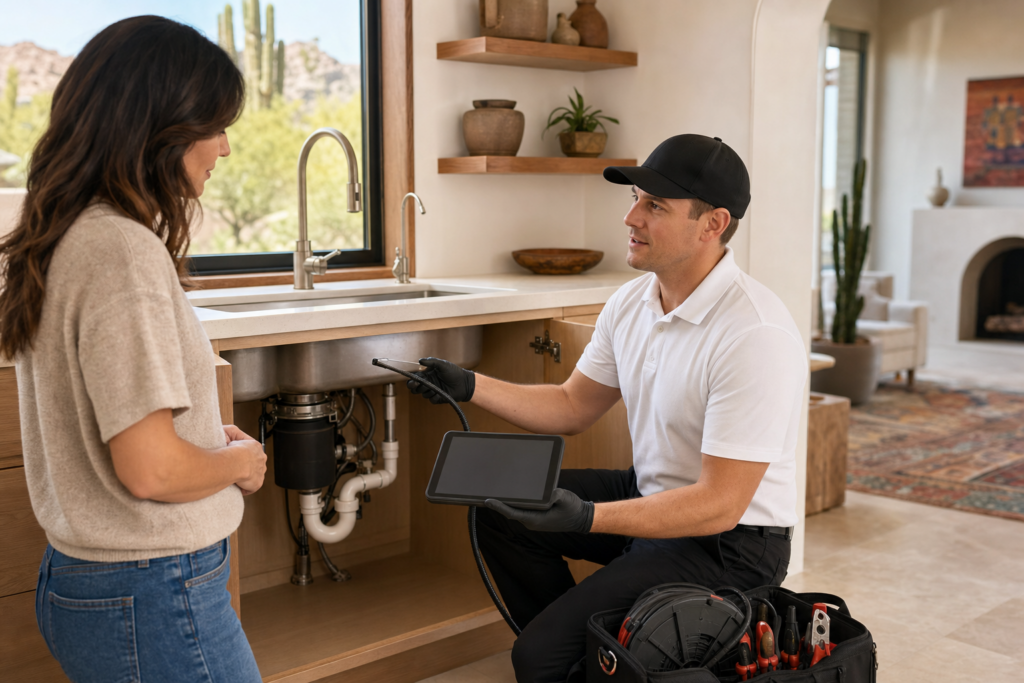
How to Compare Drain Cleaning Services in Phoenix Without Getting Fooled by the Lowest Price
The cheapest drain cleaning quote in Phoenix is not always the best deal — and the most expensive one is not always the most thorough. Price alone tells you very little about whether your drain problem will actually be resolved or whether you will be calling someone else next week for the same issue.
What matters more than the number on the quote is what that number includes: what method the company plans to use, whether they inspect the problem before recommending a solution, how they structure their pricing, and what happens if the clog comes back. If you compare drain cleaning services using those criteria instead of cost alone, you are far more likely to hire someone who fixes the problem the first time — and that is always the most affordable outcome.
This guide walks through the five questions that separate a good deal from a cheap one, so you can evaluate any drain cleaning company in Phoenix with confidence before you book.
Why Price Is the Least Useful Number to Compare
When you call three Phoenix plumbing companies and get three different quotes, it can feel like you are comparing the same service at three different markups. But in most cases, those quotes describe different things entirely.
One company may quote a flat rate that includes a camera look at the line after clearing it. Another may quote a lower base price for basic snaking — but if that does not clear the blockage, the next step costs extra. A third may quote an hourly rate that sounds reasonable until the job takes longer than expected.
The dollar amount only makes sense when you understand what is behind it. Two identical-sounding quotes can lead to very different experiences and very different results. Chasing the lowest number is not the point. What you actually want to know is what you are paying for — and whether it is the right solution for your situation.
The Five-Question Framework for Comparing Drain Cleaning Services
Before you book with any company, ask these five questions. The answers will tell you more about the quality and reliability of the service than the price ever could.
Question 1: What Method Are You Planning to Use — and Why?
There are two primary methods most Phoenix drain cleaning companies use: snaking and hydro jetting. They solve different problems, and the right choice depends on what is actually happening in your line.
Snaking (cable auger) uses a flexible metal cable to physically break through a clog and restore flow. It works well for straightforward blockages — hair buildup in a bathroom drain, a kitchen clog from grease and food debris, or a single obstruction in the line. For many common household clogs, snaking is exactly the right tool. It tends to cost less and handles the job effectively when the issue is a contained, localized blockage.
Hydro jetting sends pressurized water through the pipe to scour the interior walls, clearing away accumulated grease, mineral deposits, scale, and roots that have built up over time. It delivers a more comprehensive clean and is often the better choice when a drain backs up repeatedly, when debris has collected across a longer section of pipe, or when root intrusion has taken hold in a way that snaking cannot fully resolve.
What to listen for: A company that asks about your symptoms, the age of your home, and whether this is a first-time or recurring issue before recommending a method is showing you that they are trying to match the solution to the problem. A company that immediately recommends the more expensive option without asking questions may not be diagnosing — they may be upselling.
It is also worth knowing that sometimes a basic snake is genuinely all you need. Not every clog requires hydro jetting, and an honest company will tell you that.
Question 2: Do You Inspect the Problem Before You Recommend a Solution?
This is the single biggest quality separator between drain cleaning companies, and it is the one most homeowners never think to ask about.
A company that inspects first — whether that means running a camera into the line, assessing the type and location of the clog, or simply asking detailed questions about your symptoms and plumbing history — is making a diagnosis before prescribing a fix. That matters because the wrong method does not just waste money. It can leave the underlying problem untouched, which means you end up paying twice.
What a good diagnostic conversation sounds like: The technician wants to evaluate what is happening inside the line before recommending anything. They describe what they are finding and walk you through the options in plain language before any work begins.
What a red-flag conversation sounds like: The company quotes a fixed price for a specific method over the phone before asking anything about your situation, or they immediately recommend the most expensive option without any assessment.
A camera inspection can be especially useful when a drain problem keeps coming back. It shows the inside of the pipe and can reveal cracks, sections affected by root intrusion, low spots in the line, or heavy buildup that a surface-level clearing would not address. Ask whether a camera inspection is included in the service, available as an add-on, or not offered at all. That answer tells you a lot about how thorough the company’s approach is.
Question 3: How Is Your Pricing Structured?
The way a company bills can affect your total cost just as much as the base price. There are three common pricing structures in Phoenix drain cleaning, and each one carries different risks for the homeowner.
Flat-rate pricing means you are quoted a specific price for the service before work begins, and that price does not change based on how long the job takes. This is the easiest structure to compare because you know the total before you say yes.
Hourly pricing means the cost depends on how long the technician is on-site. If the job goes quickly, you may pay less. If complications arise or the clog is harder to reach than expected, the cost climbs. Ask for an estimate of how long the job is expected to take so you have a realistic sense of the range.
Base price plus add-ons is the structure behind many of the very low advertised prices you may see online. The base price covers a basic attempt — often a simple snake — but if that does not clear the blockage, every additional step costs extra. Trip fees, equipment fees, after-hours charges, and “difficult access” surcharges can turn a low initial quote into a much higher final bill.
What to ask: Once the technician has looked at your drain, can they give you a complete price before starting the work? A company that provides a firm total after evaluating the situation — rather than a low teaser figure over the phone — is being straightforward about what you will actually owe.
Question 4: What Happens If the Problem Comes Back?
This question matters more than most homeowners realize, especially if you are on a tight budget. A drain cleaning that costs less upfront but fails within a few weeks is not a deal — it is a down payment on a second service call.
Ask what kind of follow-up support or warranty the company provides after the work is done. Specifically, find out: if the same drain backs up again within the next 30 days, will that return visit cost you anything, or is it covered under the original service?
Also ask whether the company documents what they found during the service. Photos, camera footage, or even a written summary of the condition of the line can be helpful if you need service again in the future or if the issue turns out to be part of a larger problem.
A company that stands behind its work and explains what it found is demonstrating confidence in the quality of the service. A company that avoids these questions or gives vague answers may not be planning to be around if the problem returns.
Question 5: Are You Licensed and Insured?
This is a quick check, but it is an important one — even for a routine drain cleaning. In Arizona, plumbing contractors are required to hold a license through the Arizona Registrar of Contractors (AZ ROC). You can verify any company’s license status through the AZ ROC public lookup.
A licensed, insured company has met baseline professional standards and carries liability protection. If something goes wrong during the job — a pipe is damaged, a fitting is broken, water gets where it should not — insurance covers the repair. An unlicensed operator leaves you responsible.
This does not need to be a long conversation. Simply confirm that the company holds an active AZ ROC license and carries liability insurance. A clear, immediate answer is all you need. Hesitation or deflection is worth noting.
What Phoenix Homeowners Should Know About Local Drain Conditions
Phoenix is not like every other city when it comes to drain problems, and understanding a few local factors can help you evaluate whether a company actually knows your area or is giving you generic advice.
Hard water and mineral buildup: Phoenix has notably hard water. Over time, mineral deposits can accumulate inside drain lines and reduce flow, which means clogs may form more easily and more frequently than in areas with softer water. A company familiar with Phoenix plumbing understands this and may recommend methods that address buildup rather than just punching through a single blockage.
Older pipe materials: Many homes built in central Phoenix from the 1950s through the 1980s may still have original cast-iron or clay sewer lines. These materials are more susceptible to corrosion, joint separation, and intrusion from tree roots than modern PVC. If your home falls in that age range, it is worth asking whether the company has experience working with older pipe materials and whether they recommend a camera inspection to evaluate the condition of the line.
Desert soil movement: The clay-heavy soil in parts of the Phoenix metro area expands and contracts with moisture changes. Over time, this can shift or settle pipes, creating low spots where debris collects and blockages form. A recurring clog in the same spot may not be a cleaning issue — it may be a pipe issue. A company that recognizes this and checks for it is saving you from paying for repeated cleanings that never solve the root cause.
How to Read Reviews for Drain Cleaning Companies
Most people check reviews before calling a company, but star ratings alone do not tell you much. What matters is the content of the reviews — the patterns that show up when multiple customers describe their experience.
Patterns that suggest quality:
- Customers mention that the technician explained what was causing the problem
- The final price matched the estimate given before work started
- The drain stayed clear after the service
- The technician showed up on time and communicated clearly
- The work area was cleaned up after the job
Patterns that suggest caution:
- Multiple customers mention surprise charges or fees added after the quoted price
- Complaints about the same problem returning shortly after service
- Descriptions of pressure to upgrade to a more expensive service
- Mentions of technicians who did not explain what they were doing or what they found
- Repeated reports of no-shows or missed appointment windows
A company with a mix of star ratings but consistently detailed, specific positive reviews is often a better choice than one with a perfect score but vague, short reviews. Look for substance, not just numbers.
A Comparison Checklist You Can Use Before Booking
Use this checklist when you are comparing two or more drain cleaning companies in Phoenix. It works whether you are getting quotes over the phone or evaluating companies online.
| Question to Ask | What a Strong Answer Looks Like | What a Concerning Answer Looks Like |
|---|---|---|
| What method will you use, and why? | They ask about your situation first, then recommend a method based on what they learn | They recommend the most expensive option immediately without asking about your problem |
| Do you inspect the drain before recommending a fix? | They assess the clog first and explain what they find before starting work | They quote a fixed method over the phone without asking about symptoms or history |
| Is your pricing flat-rate or hourly? | They explain their pricing structure clearly and offer an all-in estimate after assessment | They give a very low starting price but cannot confirm the total until after the work is done |
| What happens if the drain backs up again soon? | They explain their follow-up support or warranty policy clearly | They avoid the question or say each visit is a separate charge regardless of timing |
| Are you licensed and insured in Arizona? | They confirm immediately and can provide their AZ ROC license number | They hesitate, deflect, or say licensing is not necessary for drain work |
| Will you explain what you find before you start work? | They commit to showing or telling you what the issue is and giving you options | They say they will just take care of it without discussing what they find |
If a company gives you strong answers across all six questions, the price becomes much easier to evaluate — because you know exactly what you are getting for it.
When the Cheapest Option Costs You More
If your budget is tight — and many Phoenix homeowners are working within a fixed budget — it is natural to lean toward the lowest quote. But the real risk of choosing only by price is not that the service will be bad. It is that the service may not last.
A drain cleaning that clears the symptom but misses the cause can leave you paying for the same service again in a few weeks. A company that uses the wrong method for the wrong problem may restore flow temporarily without addressing the buildup, root intrusion, or pipe condition that caused the blockage in the first place.
The most affordable outcome is almost always the one where the problem is correctly diagnosed and properly handled the first time. That does not mean you need to pay the highest price. It means you need to pay for the right service — and the five questions above help you figure out which company is offering that.
FAQ
What is the average cost of drain cleaning in Phoenix?
Drain cleaning costs in Phoenix vary widely depending on the method used, the location and severity of the clog, and the company’s pricing structure. A basic snaking service generally costs less than hydro jetting, which involves more specialized equipment. Rather than comparing based on a general average, ask each company for an all-in estimate after they have assessed your specific situation.
When is snaking enough, and when do I need hydro jetting?
Snaking is often sufficient for a single, localized clog — a hair blockage in a bathroom drain, a kitchen sink backup from grease and food debris, or a straightforward obstruction in the line. Hydro jetting may be more appropriate when the problem is recurring, when buildup has accumulated along a longer section of pipe, or when root intrusion is involved. A qualified technician can evaluate which method matches your situation after assessing the line.
What is a camera inspection, and do I need one?
A camera inspection involves inserting a small waterproof camera into the drain or sewer line to see the interior condition of the pipe in real time. It can reveal cracks, sections affected by root intrusion, heavy buildup, low spots in the line, or other issues that are not visible from the surface. A camera inspection is especially useful when a drain problem keeps returning, when you want to understand the overall condition of your line, or when a technician needs to determine the right repair approach.
How do I verify that a plumber is licensed in Arizona?
You can verify a plumbing contractor’s license through the Arizona Registrar of Contractors (AZ ROC) public license lookup tool on their website. Search by company name or license number to confirm that the license is active and in good standing. This is a quick check that confirms the company meets Arizona’s baseline professional and insurance requirements.
What should a drain cleaning warranty cover?
A reasonable drain cleaning warranty or follow-up policy typically covers the same drain and the same issue for a defined period after service. The specific terms vary by company, so ask directly: if the same drain backs up again within 30 days, what does that mean for you financially? A clear, straightforward answer to that question is one of the strongest signals of service quality you can find.
Why do plumbers say not to use chemical drain cleaners?
Most licensed plumbers discourage chemical drain cleaners because they can corrode pipes over time — especially older cast-iron or clay pipes common in many Phoenix homes. Chemical cleaners may dissolve part of a clog temporarily, but they rarely clear the full blockage and can cause damage to the pipe walls with repeated use. Professional drain cleaning uses mechanical or water-pressure methods that clear the line without harming the pipe.
Does Fast Layne Plumbing offer follow-up support after drain cleaning?
Fast Layne Plumbing believes in standing behind the work. If you have questions about follow-up support or what is included after a drain cleaning service, the best step is to call directly and ask. A member of the team can walk you through what to expect. Call 480.485.4659.
How Fast Layne Plumbing Approaches Drain Cleaning in Phoenix
Fast Layne Plumbing is a family-owned plumbing company serving Phoenix, AZ. When you call about a drain issue, here is what you can expect.
We answer the phone. We schedule promptly. We show up when we say we will.
When a technician arrives, the first step is to evaluate what is actually happening with your drain — not to jump straight to the most expensive option. We assess the situation, explain what we are seeing in plain English, and walk you through the options so you can make an informed decision before any work begins.
Our pricing is upfront. We tell you what the service will cost after we have assessed the problem, not after the work is already done. No surprise fees. No add-ons you did not agree to.
We use professional equipment — including motorized drain snaking, hydro jetting, and camera inspection — and we match the method to the problem. If a snake is the right tool, we use a snake. If jetting is the right call, we explain why and let you decide. We do not upsell services you do not need.
We treat your home with respect. We clean up after the job. And we focus on finding the real problem — not just clearing the symptom — so you are not calling again next month for the same issue.
If you are comparing drain cleaning services in Phoenix right now, we welcome the comparison. Use the checklist in this guide. Put the same questions to us that you are putting to everyone else. We are confident in how we answer them.
Call Fast Layne Plumbing at 480.485.4659 to schedule drain cleaning service or to talk through what you are dealing with. We are happy to help you figure out the right next step.