Main Sewer Line Cleanout Cost in Phoenix: What Homeowners Actually Pay and Why It Varies
Most Phoenix homeowners pay somewhere between $265 and $620 for a professional main sewer line cleaning, depending on the method used and the condition of the line. A standard snaking or cabling job typically falls on the lower end of that range, while hydro jetting — which uses high-pressure water to clear tougher blockages like tree roots or heavy buildup — tends to land higher. The final cost depends on what the plumber finds once they assess the line, which is why an honest diagnosis matters more than a number on a website.
If you are a Phoenix homeowner trying to figure out whether a quote you received is fair, or you just want to know what to budget before you call, this guide walks through the real factors that affect pricing in the Phoenix area — not national averages pulled from an aggregator site.
What Does a Main Sewer Line Cleanout Actually Mean?
Before talking about cost, it helps to clarify what this service actually involves, because the terminology trips people up.
Your main sewer line is the single pipe that carries all the wastewater from your home — every toilet, sink, shower, and washing machine — out to the city sewer connection. When that line gets blocked, it can affect multiple fixtures in the house at once.
A sewer cleanout refers to two different things, and the difference matters for pricing:
- The cleanout access point — a capped pipe, usually located in the yard or near the foundation, that gives a plumber direct access to the main sewer line. Most Phoenix homes have one, though some older homes may not.
- The cleaning service itself — the actual work of clearing the blockage from the main sewer line using professional equipment.
When most homeowners search for “sewer line cleanout cost,” they are asking about the cleaning service. If your home needs a new cleanout access point installed, that is a separate and more involved job with a different cost range. This guide focuses on the cleaning service — clearing the blockage and restoring proper flow through your main sewer line.
Phoenix Main Sewer Line Cleaning Costs at a Glance
These are typical ranges Phoenix homeowners can expect. Actual quotes vary based on factors covered in the next section, and a plumber should assess the situation before giving a final price.
| Service | Typical Phoenix Range | Best For |
|---|---|---|
| Standard snaking or cabling | $265–$475 | Soft blockages, grease buildup, moderate clogs |
| Hydro jetting | $362–$620+ | Tree root intrusion, heavy scale, stubborn or recurring clogs |
| Sewer camera inspection (add-on) | $150–$400 | Diagnosing the cause and condition of the line |
| Service call or trip fee | Varies by company | Some companies charge a separate visit fee; others include it |
These ranges reflect typical Phoenix-area pricing and are not a quote from Fast Layne Plumbing. Actual cost depends on conditions a licensed plumber evaluates on-site.
Standard Snaking and Cabling
Snaking — also called cabling or augering — uses a motorized cable with a cutting head to break through or pull out a blockage inside the pipe. It is the most common method for standard clogs caused by grease, soap buildup, paper products, or light debris. For most straightforward main line clogs in Phoenix, snaking is the appropriate first step and falls in the $265–$475 range depending on the severity and how deep the blockage sits in the line.
Hydro Jetting
Hydro jetting uses a high-pressure water stream to scour the inside of the pipe, removing not just the blockage but also the buildup along the pipe walls. Phoenix plumbers often recommend hydro jetting when tree roots have entered the line, when grease or mineral scale has built up significantly, or when the homeowner has had recurring clogs that snaking alone has not resolved long term.
The cost is higher — typically $362–$620 or more — because the equipment is more specialized and the service is more thorough. For severe root intrusion, costs can climb higher depending on the extent of the problem. A plumber may recommend a camera inspection first to determine whether hydro jetting is the right approach or whether the pipe has damage that needs to be addressed differently.
Sewer Camera Inspection
A camera inspection involves feeding a small video camera through the sewer line to see the interior condition of the pipe in real time. This helps the plumber identify the type and location of the blockage, check for cracks or damage, and determine whether cleaning alone will solve the problem or whether the line needs repair.
Camera inspections typically run $150–$400 as an add-on service. Not every cleanout requires one, but for recurring problems, older homes, or situations where the plumber suspects pipe damage, a camera inspection can prevent you from paying for a cleaning that will not hold because the real issue is a broken or collapsed section of pipe.
Service Call Fees and Promotional Specials
Some plumbing companies charge a separate service call fee or trip fee just to come to your home, while others roll that into the total cost of the service. It is worth asking about this upfront so you are not surprised.
You may also see promotional drain clearing specials advertised in the $93–$150 range. These can be legitimate, but before you book based on a promotional price, ask a few questions:
- Does the price cover the main sewer line, or only secondary drain lines like a kitchen sink or bathtub?
- Is there a time limit on the service, or does the technician stay until the line is clear?
- What happens if the clog requires hydro jetting or additional work beyond basic snaking?
- Is there a separate diagnostic or trip fee on top of the promotional price?
The goal is not to avoid promotional pricing — it is to understand what you are actually getting before you schedule. A clear, upfront quote that accounts for your actual situation is more valuable than a low advertised number that changes once the technician arrives.
What Affects the Cost of a Main Sewer Line Cleaning in Phoenix
The reason pricing varies is not arbitrary. Several real factors influence what a main line cleaning costs in the Phoenix area, and some of them are specific to the kinds of homes and conditions common here.
- Severity and type of blockage. A soft grease clog that responds to standard snaking costs less than a dense root mass that requires hydro jetting or multiple passes. The plumber cannot always determine severity until they begin working.
- Tree root intrusion. This is one of the most common causes of main sewer line problems in Phoenix. Mesquite, Palo Verde, and citrus trees — all extremely common in Phoenix landscaping — send roots deep into the soil looking for moisture. Those roots can find their way into clay or cast iron sewer pipes through joints and small cracks. Root intrusion typically requires hydro jetting or specialized root-cutting equipment, which raises the cost.
- Pipe material and age. Many Phoenix homes built in the 1950s through the early 1980s have clay or cast iron sewer lines. These older pipe materials are more susceptible to root intrusion, corrosion, and joint separation than modern PVC. Cleaning an older line sometimes requires more care and more time, and the plumber may recommend a camera inspection to check the pipe’s condition after clearing the blockage.
- Access point availability. If your home has a ground-level cleanout access point — typically a capped white or black pipe in the yard or near the foundation — the plumber can access the sewer line quickly and directly. If there is no cleanout, or if the access point is obstructed or difficult to reach, the job takes longer and may cost more. Some older Phoenix homes were built without an exterior cleanout, which can complicate service.
- Emergency versus scheduled service. A cleanout scheduled during normal business hours typically costs less than one performed as an emergency call on a weekend or holiday. If multiple drains in your home are backing up or sewage is coming up through a floor drain, you may not have the luxury of waiting — but if the problem is less urgent, scheduling during regular hours can help with cost.
- Whether a camera inspection is needed. If the plumber suspects pipe damage, recurring root intrusion, or a blockage that is not responding to standard methods, they may recommend a camera inspection to understand what is happening inside the line before proceeding. This adds to the total cost but can save money in the long run by identifying the right repair the first time.
Cleaning a Sewer Line Versus Installing a New Cleanout Access Point
This distinction matters because the cost difference is significant, and the two are sometimes confused in online search results.
Cleaning a sewer line means clearing a blockage from the existing main sewer pipe. This is what most homeowners need when they search for sewer line cleanout cost. Typical range: $265–$620 depending on the method.
Installing a new cleanout access point means adding a physical access pipe to your sewer line where one does not currently exist, or replacing a damaged or buried one. This involves excavation and plumbing work, and the cost is substantially higher — often in the $1,400–$3,600 range or more depending on location and depth. If your home does not have a cleanout and your plumber recommends installing one, that is a separate conversation and a separate scope of work from a standard cleaning.
A plumber can tell you whether your home has a usable cleanout during a service visit and help you understand your options if one needs to be added.
How to Tell If It Is a Main Line Problem or Just One Clogged Drain
Not every slow drain means your main sewer line is blocked. Here is a simple way to start narrowing it down before you call:
Signs It May Be a Main Sewer Line Issue
- Multiple drains in the house are slow or backing up at the same time
- Water backs up in one fixture when you use another — for example, the toilet gurgles when you run the kitchen sink
- Sewage odor is coming from floor drains, the yard, or multiple areas of the house
- The toilet bubbles or the water level changes unexpectedly
- Every drain in the house seems sluggish, not just one
Signs It May Be a Single Drain Clog
- Only one fixture is affected — one sink, one shower, or one tub
- No odor from other drains or fixtures
- The problem started recently after a specific use, like a kitchen disposal backup
- Other fixtures in the house drain normally
If you are not sure which situation applies, a plumber can assess the situation quickly during a service visit. The distinction matters because a single drain clog is usually a simpler and less costly fix than a main line blockage.
How Often Should Phoenix Homeowners Clean Their Main Sewer Line
For most homes, scheduling a main sewer line cleaning every 18 to 24 months is a reasonable baseline for preventive maintenance. However, several Phoenix-specific conditions may call for more frequent service:
- Mature desert trees near the sewer line. If your yard has established Mesquite, Palo Verde, or citrus trees — and especially if your home has older clay or cast iron pipes — annual or every-18-month service can help catch root intrusion before it causes a full backup.
- A history of recurring clogs. If you have had your main line cleaned more than once in the past few years, that pattern may indicate an underlying issue worth investigating with a camera inspection.
- Older homes with original plumbing. Homes built before the 1980s in many Phoenix neighborhoods may have pipe materials that are more prone to buildup and root penetration. More regular maintenance helps extend the life of those pipes.
A plumber who has inspected your line can give you more specific guidance based on what they find.
What to Expect During a Main Sewer Line Cleaning Service Visit
If you have never had your main sewer line cleaned before, or if a past experience left you unsure about the process, here is what a typical service visit looks like:
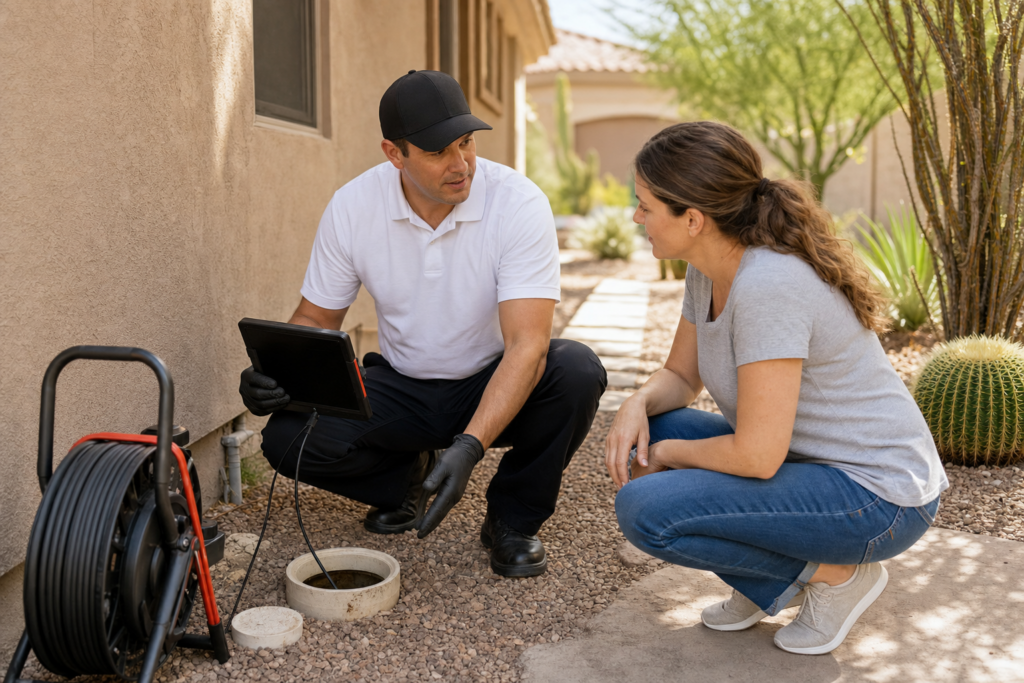
- The plumber arrives and locates the cleanout access point. This is usually a capped pipe in the yard, near the foundation, or sometimes inside the house. If your home does not have a visible cleanout, the plumber will discuss alternative access options with you.
- They assess the situation. Before starting any work, a good plumber will ask about the symptoms you have been experiencing — which drains are affected, how long the problem has been happening, and whether this has occurred before. This conversation helps them choose the right approach.
- They recommend a method and explain the cost upfront. Whether the job calls for standard snaking or hydro jetting, you should know what the service will cost before work begins. If the plumber recommends a camera inspection first, they should explain why and what it costs.
- They perform the cleaning. The technician uses professional equipment to clear the blockage and restore flow. Depending on the method and severity, this typically takes anywhere from 30 minutes to a couple of hours.
- They tell you what they found. After the cleaning, the plumber should explain what caused the blockage — grease, roots, debris, or something else — and whether the line appears to be in good condition or may need further attention. If they ran a camera, they can show you the footage.
- They clean up. The work area should be left clean and the cleanout properly capped when the job is finished.
A service visit should feel straightforward, not stressful. You should walk away understanding what was wrong, what was done, and whether any follow-up is needed.
What a Fair Quote Looks Like
One of the biggest frustrations homeowners mention is not knowing whether a quote is fair. A few things to look for:
- The price is explained before work starts. You should not find out what the service costs after it is already done. Upfront pricing means the plumber tells you the cost, you agree, and then work begins.
- The plumber explains why they are recommending a particular method. If they recommend hydro jetting instead of snaking, they should be able to tell you why in plain language — not just say it costs more.
- There are no surprise add-ons. If additional work is needed beyond the original scope, a trustworthy plumber will stop and discuss it with you before proceeding.
- You do not feel pressured. A fair quote comes with an explanation, not a sales pitch. If you feel like you are being pushed toward a more expensive service without a clear reason, trust that instinct.
Frequently Asked Questions
What is the difference between a sewer cleanout and a sewer line?
The sewer line is the pipe itself — the underground pipe that carries wastewater from your home to the city sewer system. The cleanout is an access point, usually a capped pipe in the yard, that gives a plumber a way to reach the sewer line for cleaning or inspection. You clean the sewer line through the cleanout.
Is snaking or hydro jetting better for tree roots?
Hydro jetting is generally more effective for tree root intrusion because the high-pressure water can cut through roots and clear the pipe more thoroughly than a standard cable. However, the right method depends on the condition of the pipe. If the pipe is old or fragile, a plumber may need to assess it with a camera before deciding. A licensed technician can evaluate your situation and recommend the appropriate approach.
How much does it cost to install a sewer cleanout in Phoenix if my home does not have one?
Installing a new cleanout access point is a separate job from cleaning the line. It typically costs significantly more — often in the range of $1,400 to $3,600 or more — because it involves excavation and plumbing work. If your plumber recommends a cleanout installation, they should explain why and provide an upfront quote for that specific work.
What should I ask a plumber before booking a drain clearing special?
Ask whether the promotional price covers the main sewer line or only secondary drains. Ask if there is a trip fee or diagnostic charge on top of the advertised price. Ask what happens if the clog requires more than basic snaking. And ask whether the price is truly upfront or if it can change once the technician arrives.
Does homeowners insurance cover sewer line cleaning?
Routine sewer line cleaning is typically not covered by standard homeowners insurance policies. Some policies may cover damage caused by a sudden sewer backup, and some homeowners purchase separate sewer line coverage. This is general information — check your specific policy or contact your insurance provider for details about your coverage.
What happens if the cleanout does not fix the problem?
If a main sewer line cleaning does not resolve the issue, it may indicate a more serious problem such as a cracked, collapsed, or offset pipe section. A camera inspection can help identify the underlying cause. Depending on what the inspection reveals, the next step could be a targeted sewer line repair or, in some cases, a section of pipe may need replacement. A plumber can walk you through the options based on what the inspection shows.
Why Phoenix Homeowners Call Fast Layne Plumbing
When your main sewer line backs up, you want a plumber who answers the phone, shows up when they say they will, explains what they find in plain English, and gives you an honest price before any work starts. That is how Fast Layne Plumbing operates on every call.
We are a family-owned plumbing company serving Phoenix, AZ. We provide professional drain cleaning, sewer line clearing, hydro jetting, and camera inspection services. Every recommendation we make is based on what your line actually needs — nothing more. We give you straightforward pricing before a single tool comes out, so there are no surprises when the job is done. If the inspection shows that your line needs more than a cleaning, we will explain your options clearly so you can make an informed decision.
If you are dealing with a backed-up sewer line, multiple slow drains, or you just want to schedule preventive maintenance before a problem starts, we are here to help.
Call Fast Layne Plumbing at 480.485.4659 to schedule service or talk with a local Phoenix plumber about what is going on with your sewer line.