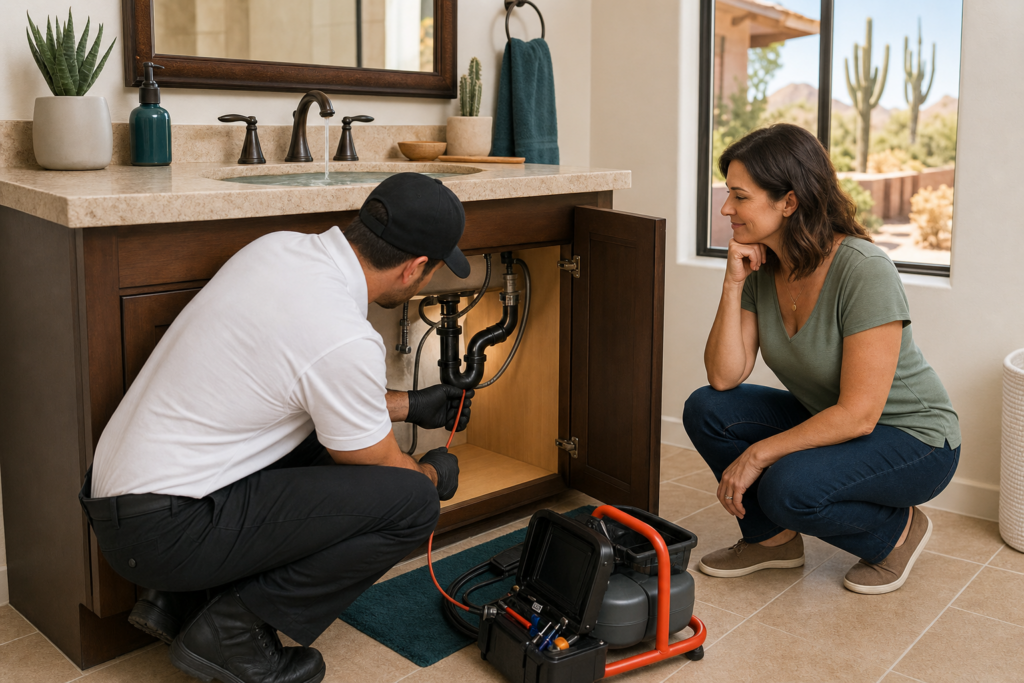
Plumber or Handyman for a Backed-Up Bathroom Sink? How to Decide Before You Spend a Dollar
If your bathroom sink is backed up, the right answer depends on where the clog is sitting and how bad it has gotten. A straightforward blockage near the drain opening — hair tangled around the stopper, soap residue collecting in the P-trap — may be something a handyman or even a careful homeowner can take care of. But if the sink has stopped draining entirely, the same clog keeps returning, or more than one drain in the house is giving you trouble, calling a licensed plumber is the right move.
This article will help you figure out which situation you are actually in. We will walk through the most common causes, a few safe things to check before calling anyone, and the specific signs that tell you it is time for a licensed professional with the right tools and training. We wrote this as Phoenix plumbers who would rather help you make a confident decision than pressure you into a service call you may not need.
What Usually Causes a Bathroom Sink to Back Up
Not every backed-up sink means the same thing. The cause — and where it sits within your drain system — determines who should handle it.
Hair and Soap Scum at the Pop-Up Stopper
The pop-up stopper is the small plug mechanism in your sink drain that you push down to hold water. Over time, hair, soap scum, and toothpaste residue collect around it. This is the most common reason a bathroom sink starts draining slowly. It is also the easiest to address because the buildup is right at the surface.
Buildup Inside the P-Trap
The P-trap is the curved section of pipe directly beneath your sink. It keeps a small reservoir of water in place at all times, which prevents sewer gases from making their way into your living space. Because of its curved shape, debris tends to accumulate there — particularly in homes with hard water, which is widespread throughout the Phoenix area. Mineral deposits from hard water can speed up that accumulation and cause clogs to develop more quickly than they would where water is naturally softer.
Deeper Clogs in the Branch Drain Line
If the stopper is clean and the P-trap is clear but the sink still will not drain, the blockage may be deeper in the branch drain line — the pipe that runs from your sink through the wall and connects to the rest of your home’s plumbing. These clogs are not visible or accessible without professional tools.
Main Sewer Line Issues
If multiple drains in your home are backing up or draining slowly at the same time — bathroom sink, shower, toilet, kitchen — the problem may not be in the sink at all. The source could be a blockage in the main sewer line, the pipe responsible for moving all wastewater away from your home and into the municipal system. That is an entirely different situation, and it calls for a licensed plumber equipped with proper diagnostic tools.
Safe First Steps to Try Before Calling Anyone
Before you spend money on a service call, there are a few things you can check yourself. These are not repair instructions — they are simple observations and minor actions that can help you understand whether the problem is something basic or something that needs professional attention.
Check and Clean the Pop-Up Stopper
Pull the stopper out of the drain and look at it. In many bathroom sinks, the stopper lifts out directly or unscrews. If it is wrapped in hair and coated in soap buildup, clean it off, put it back, and run the water. If the sink drains normally, the stopper was the issue.
Try a Plunger
A flat-bottomed cup plunger — not the flanged type used for toilets — can sometimes clear a minor blockage near the drain opening. Fill the sink with a few inches of water to create a seal, then plunge firmly several times. If the water drains, you may have dislodged the clog.
Look at the P-Trap
If you are comfortable placing a bucket under the sink and loosening the slip nuts on the P-trap, you can inspect it for buildup. This is a straightforward check, but if you are unsure about reassembling it or notice any corrosion or damage, stop and call a professional. Forcing old or corroded fittings can cause leaks.
A Note About Chemical Drain Cleaners
Products like Drano and Liquid-Plumr are widely available, but they are not a reliable solution for most bathroom sink clogs. Chemical drain cleaners can struggle with hair-based blockages, which are the most common type in bathroom sinks. With repeated use, they can also damage older pipes — particularly the galvanized steel or cast iron drains found in many Phoenix homes built between the 1950s and 1980s. If a chemical cleaner does not work on the first attempt, pouring more of it into a standing drain creates a caustic pool that a technician then has to work around. Most licensed plumbers recommend avoiding them.
When a Handyman Is a Reasonable Choice
A handyman can be a practical option when the problem is clearly visible, clearly minor, and does not involve anything beyond basic fixture-level work. That generally includes situations like these:
- The stopper was clogged with hair and cleaning it solved the problem, but you want someone to replace a worn or broken stopper mechanism
- The drain is slow but still flowing, and the issue appears to be surface-level buildup
- You need minor hardware work on the sink — a loose faucet handle, a cosmetic drain cover replacement, or similar tasks
If the scope is clear and limited, a handyman can often handle it at a lower hourly rate. The key word is scope. A handyman’s value is in general maintenance tasks. What they typically do not carry is the specialized equipment or licensing needed to diagnose and resolve plumbing problems that go deeper than the visible fixture.
When You Need a Licensed Plumber
There are specific situations where a licensed plumber is the right first call — not because the job is automatically expensive, but because the problem requires tools, training, and diagnostic capability that a handyman does not have. Call a licensed plumber if you notice any of the following:
- The sink is completely stopped and will not drain at all after basic attempts
- The clog keeps coming back — you clear it, and within days or weeks the sink backs up again
- Multiple drains in your home are slow or backed up at the same time, which can indicate a main sewer line issue
- You notice sewer odors coming from the drain or from under the sink
- Water is backing up into other fixtures when you run the bathroom sink
- There are visible leaks or water damage under the sink cabinet or along the wall behind it
- The home is older and you suspect the pipes may be corroded, deteriorating, or previously patched
- A handyman already tried and could not resolve the problem
Any of these signs can indicate that the blockage is deeper than the trap, that the drain line itself may be damaged, or that the issue involves the main sewer line. A licensed plumber can evaluate the situation accurately and explain what is actually happening before any work begins.
What a Licensed Plumber Does That a Handyman Cannot
The difference between a plumber and a handyman is not just the title. It is the tools, the training, and the scope of what they can legally and practically do.
A licensed plumber uses a motorized drain auger — sometimes called a drain snake — that can reach far deeper into your drain system than a consumer-grade zip-it tool or hand snake. For stubborn or recurring clogs, a plumber may use hydro jetting, which clears buildup with high-pressure water rather than just punching a hole through the blockage.
When the cause of a backup is not obvious, a plumber can run a camera inspection — a small waterproof camera fed through the drain line to show exactly where the clog is, what it is made of, and whether the pipe itself is damaged. This is especially useful in older Phoenix homes where root intrusion, pipe deterioration, or mineral scale may be contributing to recurring problems.
A licensed plumber can also perform pipe repairs, access the main sewer line, and handle situations that involve pressurized water or gas connections nearby. In Arizona, plumbing work beyond basic fixture-level tasks requires proper licensing. A handyman working outside that scope may not be insured for the damage that can result from a drain repair gone wrong.
How Phoenix Water Conditions Affect Your Drains
Phoenix has notably hard water. The mineral content — primarily calcium and magnesium — leaves deposits inside pipes over time. In bathroom sinks, this mineral buildup combines with soap scum and hair to create clogs that are denser and more difficult to clear than what homeowners in softer-water areas typically deal with.
If your home is in an older Phoenix neighborhood and your bathroom sink seems to clog more often than it should, hard water scale may be a contributing factor. A licensed plumber can evaluate whether the buildup is routine or whether it may be a sign of a larger condition inside your drain lines.
A Quick Note for Landlords and Renters
If you are a renter, a backed-up bathroom sink is typically the landlord’s responsibility to repair — especially if the problem is beyond a surface-level clog. Contact your landlord or property manager before hiring anyone yourself. If you are a landlord or property owner managing rentals in the Phoenix area, recurring drain problems in older units can signal deeper issues that a one-time snake will not resolve. A professional evaluation can help you understand the actual condition of the drain lines and make a more informed decision about repair versus ongoing maintenance.
What to Expect When You Call Fast Layne Plumbing
When you call Fast Layne Plumbing for a backed-up bathroom sink, here is what happens. Someone answers the phone. We schedule a time that works for you and we show up when we say we will. Our technician looks at the drain, evaluates what is going on, and explains it to you in plain English — not in jargon designed to make the problem sound worse than it is.
Before any work begins, you get upfront pricing. No surprises on the bill. If the issue turns out to be something minor, we will tell you. If it is something more involved — a deeper clog, a damaged section of pipe, a main line concern — we will explain exactly what we found, what the options are, and what each option costs. You decide what happens next.
We are a family-owned plumbing company serving Phoenix, and we built this business on the idea that people deserve a plumber who actually shows up, tells the truth, and treats their home with respect. We clean up after ourselves and we do not push services you do not need.
If your bathroom sink is backed up and you are not sure whether it is a simple fix or something more, give us a call. We are happy to help you figure it out.
Call Fast Layne Plumbing at 480.485.4659 to schedule service.
Frequently Asked Questions
What does a plumber charge to unclog a bathroom sink?
The cost to clear a backed-up bathroom sink depends on where the clog is located, how severe it is, and what tools or methods are needed to resolve it. Fast Layne Plumbing provides upfront pricing before any work begins, so you will know exactly what to expect before you commit. Call us at 480.485.4659 and we can talk through what you are seeing and give you an honest assessment.
Can a handyman fix a clogged drain?
A handyman can often address a surface-level clog — cleaning a stopper, clearing a P-trap, or handling basic fixture hardware. However, if the clog is deeper in the drain line, recurs frequently, or involves multiple fixtures, a licensed plumber is better equipped to diagnose and resolve it. In Arizona, plumbing work above a certain scope requires proper contractor licensing.
How do I know if my bathroom sink clog is serious?
A few signals can indicate a more serious issue: the sink is completely stopped and will not drain at all, the clog comes back within days of clearing it, other drains in the home are also slow or backing up, or you notice sewer odors. Any of these may point to a deeper blockage or a problem in the main sewer line. A licensed plumber can evaluate it with the right diagnostic tools.
What causes a bathroom sink to keep clogging?
Recurring clogs in a bathroom sink are often caused by buildup deeper in the drain line than a basic cleaning can reach. In Phoenix, hard water mineral deposits can compound the problem by narrowing the inside of older pipes over time. Root intrusion, pipe damage, or partial collapses in the drain line can also cause repeat blockages. A camera inspection can help identify the root cause.
Should I use Drano or chemical drain cleaners?
Most licensed plumbers recommend against chemical drain cleaners for bathroom sink clogs. They are generally ineffective against hair-based blockages, and repeated use can damage older pipes — particularly galvanized steel or cast iron drains common in many Phoenix homes. If a chemical cleaner does not work on the first try, it is better to call a professional than to keep adding chemicals to a standing drain.
How long does it take a plumber to unclog a bathroom sink?
A straightforward drain clearing — where the clog is accessible and does not involve pipe damage — often takes under an hour. More involved situations, such as clogs deep in the branch line or main sewer line issues requiring camera inspection, may take longer. Your plumber should be able to give you a realistic time estimate after the initial evaluation.