How to Choose a Trustworthy Drain Cleaning Company in Phoenix
Choosing a trustworthy drain cleaning company in Phoenix comes down to three things: verified credentials you can check yourself, an honest diagnostic approach that looks at your pipes before recommending work, and clear communication about what the problem is and what it will cost — before anything starts.
That sounds simple, but most homeowners in the Phoenix area have learned the hard way that not every company operates this way. Maybe a plumber never showed up. Maybe a quote came in far higher than expected once the work was underway. Maybe the technician recommended an expensive repair without explaining why it was necessary. These experiences are common, and they make the next call harder to make.
This guide walks you through how to evaluate any drain cleaning company in Phoenix using practical steps you can follow right now. It covers how to verify licensing in Arizona, what a trustworthy diagnostic process looks like, how to read reviews with a critical eye, what questions to ask before scheduling, and why Phoenix-specific conditions matter more than most homeowners realize. Whether you are dealing with a slow kitchen drain or something more serious, this will help you make a confident decision.
Start With the Arizona Registrar of Contractors
In Arizona, plumbing contractors are required to be licensed through the Arizona Registrar of Contractors (ROC). This is the single most reliable way to verify that a drain cleaning company is legitimate, bonded, and in good standing before you let anyone into your home.
How to Look Up a License in Under Two Minutes
- Go to the Arizona ROC website at roc.az.gov.
- Click on the contractor search tool.
- Enter the company name, or if you have it, the ROC license number (typically a six-digit number the company should be able to provide when you ask).
- Review the results for the company’s license status, license type, bond information, and any recorded complaints or disciplinary actions.
This takes less time than reading a single online review and gives you far more reliable information.
What to Check Once You Find the Listing
- Active status: The license should show as active, not expired, suspended, or revoked.
- License classification: For drain cleaning and plumbing work, the company should hold the appropriate plumbing classification.
- Bond information: A bonded contractor has financial protection in place. This matters if something goes wrong during the work.
- Complaint and disciplinary history: The ROC tracks formal complaints. A clean record is a positive signal. A pattern of complaints is a warning sign worth taking seriously.
Why Licensing Matters Beyond Legality
Licensing is not just a regulatory checkbox. If an unlicensed or improperly licensed contractor damages your plumbing, your options for recourse are limited. A properly licensed contractor is accountable to the state, which means there is a real mechanism for resolving disputes. When you are letting someone work on the pipes in your home, that accountability matters.
If any company hesitates to provide their ROC license number when you ask, that is worth noting before you go further.
Understand What Phoenix Conditions Do to Your Pipes
Phoenix is not like other cities when it comes to plumbing. The local environment puts specific stress on drain and sewer lines that a trustworthy company should understand and factor into their diagnosis. If a company gives you advice that sounds like it could apply to any city in the country, they may not be accounting for what is actually happening in your pipes.
Hard Water and Mineral Buildup
Phoenix has notably hard water. Over time, the dissolved minerals in the water supply — primarily calcium and magnesium — can leave deposits inside pipes. In drain lines, this mineral scale narrows the interior diameter of the pipe gradually, which can contribute to slower drainage, more frequent clogs, and buildup that a simple snaking may not fully address. A company familiar with Phoenix plumbing should recognize hard water-related buildup when they see it and explain what they are finding.
Caliche Soil and Underground Pipe Stress
Caliche is a dense, calcium-rich layer of soil common throughout the Phoenix area. It is extremely hard, and it creates unique challenges for underground pipes, including sewer lines. Caliche does not shift or settle the same way softer soils do, but it can make excavation difficult and affect how pipes are accessed during repairs. A drain cleaning company with local experience will understand this and factor it into their recommendations — particularly if your drain issue points to a deeper problem in the sewer line.
Older Neighborhoods and Cast Iron Pipes
Many Phoenix homes built from the 1950s through the early 1980s were plumbed with cast iron drain and sewer pipes. Cast iron is durable, but over decades it can corrode from the inside, develop scale buildup, and eventually crack or deteriorate. If you own an older home in Phoenix, the material of your pipes may affect what cleaning method is appropriate and whether a recurring drain problem is a symptom of pipe deterioration rather than a simple clog.
A trustworthy company should be able to explain how your home’s age and pipe material factor into what they are recommending.
Evaluate the Diagnostic Approach Before Anyone Starts Work
How a company diagnoses your drain problem tells you a lot about how they operate. A trustworthy company wants to understand what is causing the issue before choosing a solution. A less trustworthy company may skip diagnosis and go straight to a recommendation — sometimes an expensive one.
What Camera Inspection Is and When to Ask for It
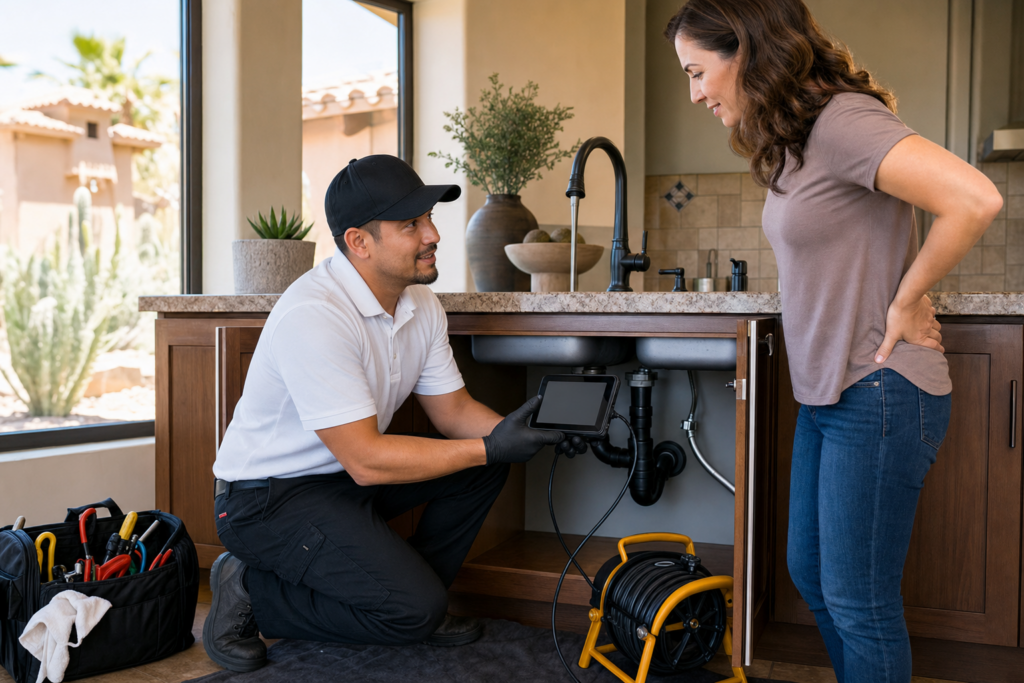
A video camera inspection involves inserting a small, waterproof camera into the drain or sewer line to see the interior condition of the pipe in real time. This allows the technician to identify the location and nature of a blockage, check for cracks or root intrusion, and assess the overall condition of the line.
Camera inspection is not always necessary for a straightforward drain clog, but for recurring problems, main sewer line issues, or situations where the cause is unclear, it is one of the most reliable diagnostic tools available. A good company will offer camera inspection when it is appropriate and explain what the footage shows in plain language.
If a company recommends major work — such as sewer line repair or full line replacement — without offering to show you camera footage of the problem, that is a significant red flag.
The Difference Between Snaking and Hydro Jetting
These are the two most common professional drain cleaning methods, and understanding the difference helps you evaluate what a company is recommending.
- Motorized drain snaking uses a flexible metal cable to physically break through a clog and restore flow. It works well for many common blockages — hair, soap buildup, minor obstructions. It is typically the first approach for a standard clogged drain.
- Hydro jetting uses high-pressure water to scour the interior walls of the pipe, removing grease, mineral scale, tree root intrusion, and heavy buildup. It is a more thorough cleaning method and is typically used for more stubborn problems, recurring clogs, or main sewer line clearing.
Neither method is universally better. The right choice depends on what is causing the problem and the condition of the pipe. A company that always recommends hydro jetting without checking the pipe first may be upselling. A company that only offers snaking may not have the equipment or expertise for more serious issues.
Symptom Triage: One Slow Drain vs. Multiple Backups
Before you call anyone, it helps to understand what your symptoms may suggest — not as a diagnosis, but as context for the conversation.
| What You Are Experiencing | What It May Suggest |
|---|---|
| One drain is slow or clogged (kitchen sink, bathroom sink, shower) | A localized blockage in that specific branch drain — often addressable with standard drain cleaning |
| Multiple drains are slow or backing up at the same time | A possible issue deeper in the main drain or sewer line — may require camera inspection and more thorough evaluation |
| Sewage smell inside the home or near cleanout access | Could indicate a sewer line issue, a dry trap, or a venting problem — a licensed technician can evaluate |
| Water backing up into a floor drain, tub, or shower when other fixtures are used | Often points to a main sewer line blockage rather than a single drain issue |
This is not a substitute for professional evaluation. But understanding the general pattern helps you have a more informed conversation when you call and makes it easier to assess whether the company’s recommendation matches the scope of what you are seeing.
Understand Pricing Before You Agree to Anything
Financial uncertainty is one of the most common reasons homeowners hesitate before calling a plumber. The worry that the final bill will be significantly higher than expected is real, and it is often based on past experience. A trustworthy company should remove that uncertainty, not add to it.
What Upfront Pricing Looks Like
Upfront pricing means the company tells you what the work will cost before the work begins — and that number does not change unless the scope of work changes, with your approval. This is different from a vague estimate or an open-ended approach where the final cost only becomes clear after the job is already underway.
A company that provides upfront pricing is making a commitment. They are telling you they have enough experience to assess the job accurately and enough integrity to stand behind the number they give you.
What a Written Estimate Should Include
- A clear description of the work being performed
- The total cost, including any service call fees
- What is included in the price and what is not
- What happens if the scope changes — how will you be notified and what approval is needed before additional charges apply
If a company cannot give you a clear, written estimate before starting work, that is a meaningful signal about how the rest of the experience is likely to go.
Pricing Red Flags
- A very low phone quote that increases once the technician arrives. If the price changes significantly after they show up, the original number may have been designed to get them in the door rather than to reflect the actual cost.
- Pressure to approve work immediately without time to consider. A legitimate company will give you space to think, especially for higher-cost work.
- Cash-only demands or reluctance to provide written documentation. Professional companies document their work and provide clear records.
- No breakdown of what the charges cover. You should be able to understand what you are paying for.
How to Read Reviews Like a Local
Every company will tell you to check their reviews. But not all reviews tell the same story, and knowing what to look for matters more than scanning star ratings.
What to Look for in Review Text
Star ratings give you a general direction. The text of the reviews gives you the real picture. Look for:
- Specific details about the service experience. Reviews that mention what the technician did, how they communicated, and how the problem was resolved are more informative than generic praise.
- Mentions of the same positive qualities across multiple reviews. If different customers independently describe the same experience — clear explanations, on-time arrival, honest pricing — that pattern is meaningful.
- Descriptions of how the company handled problems. The best signal of trustworthiness is not a perfect review record but how a company responds when something does not go as planned.
How the Company Responds to Negative Reviews
Every company gets negative reviews eventually. What matters is the response. A company that responds calmly, takes responsibility where appropriate, and offers to make things right is demonstrating the same qualities you want when they are in your home. A company that ignores negative reviews, responds defensively, or blames the customer is showing you something important about how they handle conflict.
Where to Look Beyond Google
Google reviews are the most visible, but they are not the only source. Consider checking:
- Yelp for additional customer perspectives
- The Better Business Bureau (BBB) for complaint history and accreditation status
- Local community forums and neighborhood groups for unfiltered, real-world recommendations from Phoenix residents
- Reddit communities like r/phoenix where homeowners often share candid plumber recommendations
Cross-referencing across multiple platforms gives you a fuller picture than relying on any single source.
Questions to Ask Before You Schedule
The phone call before you book is one of the most useful tools you have. A trustworthy company should be able to answer these questions clearly and without hesitation.
- “Are you licensed with the Arizona Registrar of Contractors, and can you provide your ROC number?” — This is the most basic verification. A legitimate company will give this to you immediately.
- “Do you provide a written estimate before starting work?” — If the answer is anything other than yes, keep calling.
- “What is included in the price you quote?” — You want to know whether the estimate covers the full scope of work or whether there are common additions that could change the total.
- “Do you offer camera inspection, and will you show me the footage?” — For recurring problems or potential sewer line issues, this matters. A company that uses camera inspection and shares the findings with you is showing transparency.
- “What happens if you find something unexpected during the job?” — You want to hear that they will stop, explain, and get your approval before proceeding with additional work or charges.
- “How do you determine whether I need a basic drain cleaning or something more involved?” — This tells you whether the company takes a diagnostic approach or defaults to a one-size-fits-all recommendation.
- “Do you have same-day or next-day availability?” — Turnaround time matters, especially when a backed-up drain is disrupting your home. A company that can respond quickly and communicates a clear arrival window respects your time.
How a company handles these questions on the phone often mirrors how they will handle the job in your home. If they are clear, patient, and straightforward on the call, that is a positive signal. If they are vague, rushed, or evasive, pay attention.
What Trustworthy Drain Cleaning Service Should Look Like
Once you have verified credentials, asked your questions, and decided to schedule, here is what a professional, trustworthy drain cleaning experience typically involves — not as a guarantee, but as a reasonable expectation for how a well-run company operates.
- The technician arrives within the communicated window and identifies themselves and the company clearly.
- They ask about the problem — what you have been experiencing, which drains are affected, how long it has been happening.
- They assess the situation before recommending a solution. This might involve running water, checking multiple drains, or recommending a camera inspection if the situation warrants it.
- They explain what they found in plain language — not jargon, not vague reassurances, but a clear description of the issue and what they recommend.
- They provide a written estimate before starting work and explain what is included.
- They complete the work, confirm the problem is resolved, and answer any remaining questions.
- They clean up after themselves. Your home should look the same as it did before they arrived, minus the plumbing problem.
This is not an extraordinary standard. It is what professional, respectful service looks like. But if your past experiences have not matched this, you are not alone — and you are right to hold the next company to this standard.
Trustworthy vs. Concerning Signals: A Quick Comparison
| Trustworthy Signal | Concerning Signal |
|---|---|
| Provides ROC license number without hesitation | Avoids the question or says licensing is not needed |
| Gives a written estimate before work begins | Quotes a vague range and says the final cost depends on what they find |
| Explains the diagnosis in plain English | Uses jargon without clarification or rushes through the explanation |
| Offers camera inspection when appropriate and shows you the footage | Recommends sewer line repair or replacement without showing evidence |
| Explains the difference between cleaning options and recommends based on your situation | Defaults to the most expensive option without discussing alternatives |
| Answers questions patiently and gives you space to decide | Pressures you to commit immediately or uses urgency to prevent comparison |
| Cleans up the work area and confirms the issue is resolved before leaving | Rushes out without confirming results or leaves a mess |
Frequently Asked Questions
How do I verify a plumber’s license in Arizona?
Visit the Arizona Registrar of Contractors website at roc.az.gov and use the contractor search tool. Enter the company name or their ROC license number. Check that the license is active, that the company holds the appropriate plumbing classification, and that there are no unresolved complaints or disciplinary actions on record.
What is the Arizona Registrar of Contractors?
The ROC is the state agency responsible for licensing, regulating, and investigating complaints against contractors in Arizona. All plumbing companies performing work in Arizona are required to hold an active ROC license. The ROC provides a public search tool that allows homeowners to verify any contractor’s status.
Should I always get a camera inspection before drain cleaning?
Not always. For a straightforward, single-drain clog, a camera inspection may not be necessary. However, for recurring drain problems, multiple drains backing up, suspected sewer line issues, or situations where the cause of the blockage is unclear, camera inspection is one of the most reliable ways to understand what is happening inside the pipe before committing to a cleaning method or repair.
What is the difference between drain cleaning and sewer line repair?
Drain cleaning removes blockages and buildup from the interior of a pipe to restore flow. Sewer line repair addresses physical damage to the pipe itself — cracks, breaks, root intrusion that has caused structural issues, or sections of pipe that have deteriorated beyond what cleaning can address. A trustworthy company will help you understand which situation applies to your home based on what they find during diagnosis.
What are signs that my main sewer line may be involved, not just one drain?
If multiple fixtures are draining slowly at the same time, if water backs up in one fixture when you use another, or if you notice sewage smells near your cleanout access or inside the home, these may indicate a main sewer line issue rather than a localized clog. A licensed technician can evaluate whether the problem is in a branch drain or the main line.
Is it normal to pay a service call fee before getting an estimate?
Some companies charge a service call or dispatch fee to cover the cost of sending a technician to your home for an initial assessment. This is not unusual in the plumbing industry. What matters is whether the company discloses the fee upfront when you call, whether they explain what it covers, and whether you receive a clear written estimate before any additional work begins.
Why Fast Layne Plumbing Approaches Drain Cleaning This Way
We are a family-owned plumbing company serving Phoenix, Arizona. We wrote this guide because we hear from homeowners regularly who have had frustrating experiences — plumbers who did not show up, quotes that changed once work started, recommendations that felt more like a sales pitch than an honest assessment.
At Fast Layne Plumbing, we answer the phone, show up when we say we will, and explain what we find in plain English. Every job is quoted clearly before any work gets started. We use camera inspection when the situation calls for it, and we show you what we see. We do not recommend work you do not need, and we do not leave until the job is done and your home is clean.
Whether you choose to work with us or another company, use the criteria in this guide. Ask the questions. Verify the license. Pay attention to how the conversation feels. The right plumber should make you feel informed and respected — not pressured or confused.
If you have a drain problem in Phoenix and want to talk with a local plumber who will give you a straight answer, call Fast Layne Plumbing at 480.485.4659.