How to Choose a Trustworthy Drain Cleaning Company in Phoenix
Choosing a trustworthy drain cleaning company in Phoenix comes down to three things: verifying credentials before anyone arrives, understanding exactly what you are paying for before work begins, and knowing what honest diagnosis looks like during the service call. If you can evaluate a company on those three points, you can make a confident decision — whether your kitchen sink is backing up right now or you are planning ahead for a home you just purchased.
This guide walks through each of those areas in practical terms, with specific questions you can ask any drain cleaning company before you agree to service. Everything here is written from the perspective of what we believe good service looks like at Fast Layne Plumbing — and what we think every Phoenix homeowner deserves, regardless of who they hire.
Start with Credentials, Not the Price
Price matters. But it should not be the first thing you evaluate. A low quote from an unlicensed contractor can cost far more in the long run than a fair price from a properly credentialed company. In Arizona, plumbing contractors are regulated by the state, and verifying a company’s status takes only a few minutes.
How to Verify an Arizona Contractor License Through the AZ ROC
The Arizona Registrar of Contractors (AZ ROC) is the state agency that licenses, bonds, and regulates contractors in Arizona. Any company performing plumbing work in Phoenix should hold an active AZ ROC license.
Here is how to check:
- Go to roc.az.gov.
- Use the “Find a Contractor” search tool on the homepage.
- Enter the company name or license number.
- Review the license status — it should show as active.
- Check for any complaints, disciplinary actions, or unresolved disputes listed on the profile.
If a company cannot provide a license number when you ask, or if the license shows as expired, suspended, or revoked, that is a clear signal to keep looking. A valid license means the company has met Arizona’s requirements for competency, carries the required bond, and is subject to state oversight if something goes wrong.
What Bonding and Insurance Actually Mean for You
Bonding provides a layer of financial protection for you as the homeowner. If a licensed contractor fails to complete work properly or violates Arizona contracting standards, the bond can help cover the cost of correcting the issue. It is required as part of Arizona’s contractor licensing process.
Insurance — specifically general liability insurance and workers’ compensation — protects you if a technician is injured on your property or if the work causes damage to your home. Without insurance, you could be held financially responsible for accidents that happen during the service call.
When you call a drain cleaning company, feel free to ask directly: whether they hold an active AZ ROC license and whether they carry general liability insurance. A trustworthy company will answer that question without hesitation.
Understand Pricing Before Anyone Touches Your Drains
One of the most common frustrations Phoenix homeowners share is receiving a final bill that looks nothing like the original estimate. Pricing confusion is not always intentional — but it is always avoidable when a company is upfront about how they charge.
Flat-Rate Pricing vs. Hourly Pricing: What the Difference Means in Practice
Flat-rate pricing means the company tells you the cost of the service before work begins. The price covers the job, not the clock. If the work takes longer than expected, you pay the same amount. This model removes the guesswork and protects you from surprise charges.
Hourly pricing means the company charges based on how long the work takes. This can work fine for straightforward jobs, but it creates uncertainty for anything that turns out to be more involved than expected. A stubborn clog that takes an extra thirty minutes can change the bill significantly.
Neither model is inherently dishonest. What matters is whether the company explains their pricing clearly before the work starts — and whether you feel comfortable with how they have laid it out.
At Fast Layne Plumbing, we use upfront pricing. We tell you what the service costs before we begin, and we do not change the number after the work is done. We believe that is the only way pricing should work when someone invites you into their home.
Questions to Ask Before Work Begins
Before you agree to any drain cleaning service, ask these questions. A trustworthy company will answer all of them clearly:
- What is the full price for this service, and is that a fixed rate or a rough estimate?
- Is the diagnostic or inspection included in that price, or will it appear as a separate charge?
- If the drain cannot be cleared on the first attempt, what is the next step — and will the cost go up?
- Under what conditions might the final price be higher than what you quoted at the start?
- Will you walk me through any additional issues you find before proceeding with more work?
- Is there a trip charge or service call fee for coming out to the property?
You should never feel pressured to agree to work before you understand the cost. If a company cannot answer these questions directly, that tells you something important about how they operate.
Know What Honest Diagnosis Looks Like
A drain clog can be a simple fix — or it can be a symptom of something deeper in the line. How a company handles that distinction is one of the strongest indicators of whether they are trustworthy.
Why Camera Inspection Matters and What It Should Show You
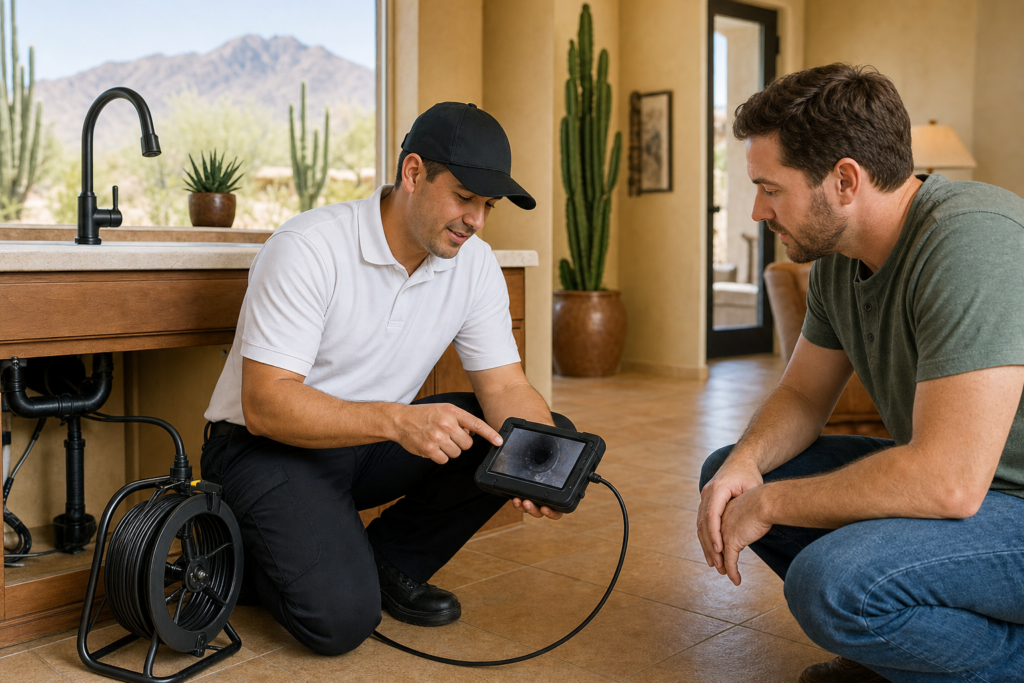
A camera inspection (sometimes called a sewer scope) uses a small, waterproof camera fed into the drain or sewer line to show the inside condition of the pipe in real time. It can reveal blockages, root intrusion, cracks, pipe deterioration, scale buildup, and bellied or misaligned pipe sections.
Camera inspection matters because it takes the guesswork out of diagnosis. Instead of speculating about what might be wrong, the technician can show you exactly what the camera sees. A trustworthy company will:
- Offer to show you the camera footage during or after the inspection.
- Explain what you are looking at in plain language.
- Point out the specific issue and where it is located in the line.
- Let the footage guide the recommendation — not the other way around.
If a company recommends expensive work like sewer line repair or replacement without offering a camera inspection first, that is worth questioning. At Fast Layne Plumbing, we use camera inspection when needed to help identify the real issue — because accurate diagnosis protects both the homeowner and the quality of the repair.
The Difference Between Snaking and Hydro-Jetting
These are the two most common professional drain cleaning methods, and they serve different purposes.
Drain snaking (also called augering) uses a motorized cable with a cutting head to break through or pull out a blockage. It works well for common clogs caused by hair, soap buildup, food waste, or minor obstructions. Snaking is often the right first step for a typical household drain clog.
Hydro-jetting uses high-pressure water to scour the inside of the pipe, removing grease, mineral scale, root intrusion, and heavy buildup. It is a more thorough cleaning method and is typically used when snaking alone is not enough — or when the goal is to restore full flow to a line that has been narrowing over time.
A trustworthy company will recommend the method that fits the actual problem, not the one that costs more. Not every clog needs hydro-jetting. And not every hydro-jetting recommendation is an upsell — sometimes the buildup is severe enough that snaking alone will not restore proper flow. The key is whether the technician explains why they are recommending one method over the other.
What Should Happen If They Find a Bigger Problem
This is the moment that causes the most anxiety for homeowners — and the moment where trust matters the most.
Sometimes a technician clears a drain and discovers that the real issue is a cracked pipe, root intrusion that has compromised the sewer line, or a section of deteriorated pipe that needs repair or replacement. When that happens, here is what a trustworthy company should do:
- Stop and explain. The technician should describe what they found in plain language, without jargon or scare tactics.
- Show you the evidence. Camera footage, if available, should be shared with you so you can see the issue for yourself.
- Separate the immediate fix from the larger recommendation. A trustworthy company will tell you what they have already done (clearing the drain) and what they are now recommending (additional repair) as two distinct things.
- Give you time to decide. Unless the situation is an active emergency — like sewage backing up into the home — you should have the option to get a second opinion, ask questions, or take time before agreeing to a larger scope of work.
- Provide upfront pricing for the additional work. The recommendation should come with a clear cost, not a vague estimate that could change later.
If a technician pressures you into agreeing to a major repair on the spot, uses fear-based language to rush your decision, or cannot clearly explain what they found and why the additional work is necessary, you have every right to pause.
At Fast Layne Plumbing, we explain everything in plain English. If we find something bigger during a drain cleaning visit, we walk you through what the camera shows, explain your options clearly, and give you the space to make a decision that feels right. We would rather earn your trust than rush a sale.
Phoenix-Specific Conditions That Affect Drain Cleaning
Not every drain cleaning company understands the specific challenges that come with Phoenix plumbing. The desert climate, local soil conditions, and the age of many Phoenix neighborhoods create plumbing situations that are different from what you would find in other parts of the country. A company with real Phoenix experience will understand these factors and how they affect diagnosis and treatment.
Hard Water Scale and Mineral Buildup
Phoenix has some of the hardest water in the United States. Over time, dissolved minerals — primarily calcium and magnesium — can build up inside drain lines, narrowing the pipe diameter and reducing flow. This buildup looks different from a grease clog or a hair blockage, and it often requires a different approach to clear effectively. A company familiar with Phoenix water conditions will recognize mineral scale and recommend the appropriate cleaning method rather than treating it like a standard clog.
Caliche Soil and Underground Pipe Movement
Caliche is a naturally occurring calcium carbonate layer found in desert soils throughout the Phoenix area. It is extremely hard and can affect how underground pipes settle over time. In some cases, shifting soil or caliche deposits can cause pipes to misalign, develop low spots (called bellies), or crack under pressure. These issues can look like a recurring drain clog but may actually be a structural pipe problem that drain cleaning alone will not resolve. A technician with local experience will know to check for these conditions.
Tree Root Intrusion in Desert Landscaping
Even in the desert, tree roots seek out moisture — and sewer lines are one of the most reliable moisture sources underground. Mature trees, especially species commonly planted in older Phoenix neighborhoods, can send roots into small cracks or joints in sewer pipes. Root intrusion can cause persistent clogs, slow drains, and eventually pipe damage if not addressed. A company experienced with Phoenix properties will recognize root intrusion patterns and know when clearing the roots is enough versus when the pipe itself may need attention.
Aging Pipes in Older Phoenix Neighborhoods
Many Phoenix homes built from the 1950s through the early 2000s still have their original drain and sewer lines. Depending on the era, these pipes may be cast iron, clay, Orangeburg, or early PVC. Each material ages differently and presents different challenges. Cast iron can corrode and develop internal scale. Clay can crack at the joints. Orangeburg can collapse entirely. A drain cleaning company working in older Phoenix neighborhoods should understand these materials and adjust their approach accordingly — because a technique that works well on modern PVC can damage a fragile cast-iron line.
How to Read Reviews Without Being Misled
Online reviews are one of the first places most homeowners look when choosing a drain cleaning company. That is reasonable — but reviews are more useful when you know how to read them critically rather than just counting stars.
Here is what to look for:
- Patterns over individual reviews. A single negative review may not mean much. But if multiple reviews mention the same problem — unexpected charges, no-show appointments, pressure to approve expensive work — that pattern is worth paying attention to.
- Specific details. Reviews that describe what actually happened during the service call are more reliable than reviews that only say “great service” or “terrible company.” Look for reviews that mention what the problem was, what the technician did, and how the pricing was handled.
- How the company responds to criticism. Every company gets a negative review eventually. What matters is whether the company responds professionally, acknowledges the concern, and offers a path to resolution — or whether they get defensive, dismiss the complaint, or do not respond at all.
- Recency. A company with excellent reviews from three years ago but recent complaints may have changed ownership, staffing, or standards. Focus on the most recent twelve to eighteen months of feedback.
- Review platform diversity. Check more than one platform. Google, the Better Business Bureau, and Yelp can each give you a different picture. A company that looks great on one platform but has unresolved BBB complaints is worth investigating further.
Reviews are a helpful starting point — but they work best when you combine them with the credential verification and pricing questions described earlier in this guide.
Red Flags That Should Make You Pause
Not every warning sign means a company is dishonest. But these patterns are worth taking seriously, especially when more than one shows up at the same time:
- No license number provided when asked. A licensed company will share this without hesitation.
- Refusal to give a price before starting work. If a company will not tell you what the service costs until after the work is done, that creates unnecessary financial risk for you.
- High-pressure tactics on the spot. Urgent language implying your home is in immediate danger — without clear evidence or a calm explanation — is a red flag.
- Recommending major repairs without a camera inspection. If a technician says you need sewer line replacement but has not looked inside the pipe, the recommendation is based on assumption rather than evidence.
- A quote that seems dramatically lower than everyone else. Extremely low pricing can indicate that the company plans to add charges once work has started, or that they are cutting corners on materials, licensing, or insurance.
- No written estimate or documentation. Any reputable company should be willing to put the scope of work and the price in writing before the job begins.
- Vague answers to direct questions. If you ask how the pricing works and the answer is unclear, that lack of transparency is unlikely to improve once work begins.
- A technician who will not explain what they are doing or why. You have the right to understand the work being performed in your home. A trustworthy technician will explain the process without making you feel like you are asking too many questions.
What to Do When It Is Not an Emergency
If your drain issue is not an active emergency — meaning water is not flooding your home or sewage is not backing up — you have the advantage of time. Use it.
- Get at least two opinions. Call two or three companies and ask about their pricing model, what the service includes, and how they handle the situation if the clog turns out to be something bigger.
- Compare how they communicate, not just what they charge. The company that takes time to answer your questions clearly on the phone is often the company that will treat you well in person.
- Verify credentials before scheduling. Use the AZ ROC portal to check license status and complaint history before a technician shows up at your door.
- Pay attention to scheduling reliability. A company that gives you a clear appointment window and shows up within it is demonstrating the kind of reliability that matters during the service itself.
Choosing a drain cleaning company does not have to feel like a gamble. With a few minutes of research and a few direct questions, you can make a decision that gives you confidence before anyone arrives at your home.
What to Expect When You Call Fast Layne Plumbing
We are a family-owned plumbing company serving Phoenix, AZ. We built Fast Layne Plumbing around the kind of service we would want in our own home: someone who answers the phone, shows up when they say they will, explains the issue in plain English, provides upfront pricing before any work begins, and does not recommend services you do not need.
Our drain cleaning services include clearing kitchen sink clogs, bathroom drain clogs, shower and tub drain clogs, floor drains, and main sewer line blockages. When the situation calls for it, we use professional equipment including motorized drain snakes, hydro-jetting, and camera inspection to find the real problem — not just treat the symptom.
If we find something bigger during a drain cleaning visit, we explain what we see, show you the evidence, present your options clearly, and let you decide how to move forward. We do not pressure, and we do not upsell.
Every home we enter gets treated with respect. We clean up after every job, and we do not leave until the work is done right.
Call Fast Layne Plumbing at 480.485.4659 to schedule drain cleaning service or to talk with a local Phoenix plumber about what is going on with your drains.
Frequently Asked Questions
Is professional drain cleaning worth it?
For most homeowners, yes. Professional drain cleaning uses equipment and techniques that are significantly more effective than store-bought drain cleaners, which can sometimes damage pipes without fully clearing the blockage. A professional can also identify whether a clog is a simple buildup or a symptom of a larger issue — something a chemical product cannot do.
What is a drain snake?
A drain snake (also called an auger) is a flexible cable with a cutting or grabbing head that is fed into a drain line to break apart or remove a blockage. Motorized drain snakes used by professionals are more powerful than handheld versions sold at hardware stores and can reach deeper into the line.
What is hydro-jetting and when is it needed?
Hydro-jetting uses a high-pressure stream of water to clean the inside walls of a drain or sewer pipe. It is typically used when buildup is too heavy for snaking alone — such as grease accumulation, mineral scale from hard water, or root intrusion. A licensed technician can evaluate whether hydro-jetting is appropriate based on the pipe material and the severity of the buildup.
How do I look up a plumber’s license in Arizona?
Visit roc.az.gov and use the “Find a Contractor” search tool. You can search by company name or license number. The listing will show the license status, license type, and any complaints or disciplinary actions on file.
What should I do if a company says I need a full sewer replacement?
Ask to see the camera inspection footage. Ask the technician to explain exactly what they found, where the damage is, and why replacement is the recommended option rather than repair or cleaning. If the recommendation feels rushed, unclear, or high-pressure, it is reasonable to get a second opinion from another licensed plumber before agreeing to the work.
What are signs I may need drain cleaning vs. a bigger repair?
Slow-draining sinks, gurgling sounds from drains, recurring clogs in the same fixture, or water backing up into tubs or showers can all indicate a drain blockage that professional cleaning may resolve. However, persistent issues that return shortly after cleaning, sewage smells in the yard, or multiple fixtures draining slowly at the same time could indicate a deeper sewer line issue that may require inspection and repair. A licensed technician can evaluate the situation and help determine the right next step.
Do Phoenix homes have specific drain problems?
Yes. Hard water mineral buildup, tree root intrusion from desert-adapted landscaping, caliche soil causing underground pipe movement, and aging cast-iron or clay pipes in older neighborhoods are all conditions common in the Phoenix area that can affect drain performance. A drain cleaning company with local experience will understand these factors and adjust their approach accordingly.