Main Sewer Line Cleaning Cost in Phoenix: What Homeowners Typically Pay in 2025
Most Phoenix homeowners pay somewhere between $150 and $600 for main sewer line cleaning, with the majority of standard jobs landing in the $300 to $500 range. That spread exists because the final number depends on the cleaning method used, how accessible your sewer line is, and what the technician finds once work begins.
If you have received a quote or you are trying to figure out what to budget before calling a plumber, this article breaks down what drives the price in Phoenix specifically — not national averages pulled from an estimator tool, but the factors that actually matter for homes in this city. We will cover the different cleaning methods and what each one costs, the Phoenix-specific conditions that push prices higher or lower, and what to ask any plumber before you authorize work.
What Main Sewer Line Cleaning Actually Involves
Your main sewer line is the single pipe that carries all wastewater from your home — every sink, toilet, shower, and appliance drain — out to the city sewer connection. It is different from the individual drain lines inside your walls and floors. When a main line gets partially or fully blocked, you may notice multiple drains slowing down at once, water backing up in unexpected places, or a sewage smell that will not go away.
Main sewer line cleaning is the process of clearing that blockage and restoring normal flow. Depending on the method and the severity, a technician may use a motorized cable, high-pressure water, or a combination of tools. In some cases, a camera inspection is recommended before or after cleaning to understand the condition of the pipe itself.
This is different from sewer line repair or replacement, which involves fixing or replacing damaged sections of pipe. Cleaning addresses blockages and buildup. Repair addresses structural damage like cracks, breaks, or collapsed sections. Sometimes a cleaning reveals a problem that goes beyond what cleaning alone can solve — a good plumber will explain that distinction honestly rather than pushing you toward work you may not need.
Price Breakdown by Cleaning Method
The biggest factor in your final cost is the method used. Here is what each approach typically costs in the Phoenix area, along with when it is usually the right choice.
| Method | Typical Phoenix Price Range | Best For |
|---|---|---|
| Cable Snaking / Augering | $150–$450 | Standard clogs from debris, paper buildup, or minor root intrusion |
| Hydro Jetting | $350–$850 | Heavy grease buildup, significant root intrusion, scale accumulation, or recurring clogs |
| Sewer Camera Inspection | $150–$350 | Diagnosing recurring problems, locating the blockage, or assessing pipe condition after cleaning |
Cable Snaking and Augering
A motorized cable with a cutting head is fed into the sewer line to break through the blockage and restore flow. This is the most common method for straightforward clogs — the kind caused by accumulated debris, paper products, or a minor root intrusion. For a routine main line clearing with good access to a cleanout, this is typically the most affordable option.
Hydro Jetting
Hydro jetting uses high-pressure water to scour the inside walls of the pipe, removing grease, scale, mineral deposits, and roots more thoroughly than a cable alone. It costs more because the equipment is specialized and the process is more involved. Hydro jetting is not always necessary — but when a line has heavy buildup or recurring blockages that snaking has not resolved long-term, it may be the more effective approach.
A reputable plumber should explain why hydro jetting is being recommended for your specific situation rather than defaulting to it as the first option.
Sewer Camera Inspection
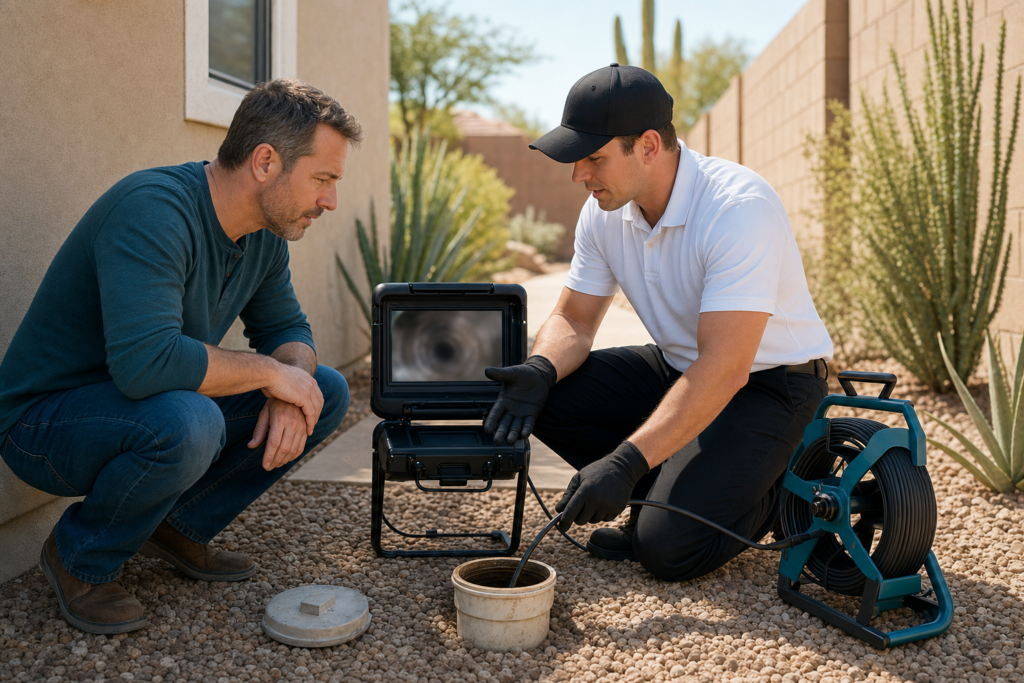
A camera inspection is a diagnostic step, not a cleaning method. A small waterproof camera is fed through the line to give the technician a live view of the pipe’s interior. This helps locate the exact position and nature of a blockage, and it can reveal conditions like root intrusion, pipe deterioration, bellied sections, or offset joints that may be causing recurring problems.
Camera inspection is sometimes bundled with the cleaning service and sometimes billed separately. If your plumber recommends a camera inspection, it is usually because they want to understand what is happening inside the line before deciding on the best approach — which is a good sign, not an upsell.
What Makes Your Price Higher or Lower in Phoenix
The method is the biggest cost variable, but several other factors specific to Phoenix homes can shift your price up or down.
Whether You Have an Accessible Cleanout
A sewer cleanout is a capped pipe fitting, usually located near the exterior of your home, that provides direct access to the main sewer line. When a cleanout is present and accessible, the technician can start work quickly without removing a toilet or finding an alternative entry point.
If your home does not have a cleanout — which is common in older Phoenix homes built before cleanout requirements became standard — the plumber may need to access the line through an interior drain or remove a toilet. This adds time and can increase the cost. Installing a cleanout is a separate service, but it can make future cleanings faster and less expensive.
Tree Roots
This is one of the most significant cost factors for Phoenix homeowners specifically. Despite the dry climate, many of the trees commonly planted across Phoenix neighborhoods — mesquite, palo verde, ficus, and eucalyptus — develop aggressive root systems that actively seek out moisture. Sewer lines are a reliable water source underground, and roots can find their way into joints, cracks, or small openings in the pipe over time.
When roots have entered the line, a simple cable clearing may restore flow temporarily, but the roots tend to grow back. Hydro jetting can clear roots more thoroughly, and a camera inspection can show how extensive the intrusion is. If root intrusion is severe or recurring, the technician may recommend discussing repair options — but that is a separate conversation from cleaning.
Severity and Type of Blockage
A soft clog near the cleanout is a different job than a compacted blockage sixty feet down the line. The nature of the blockage matters too — grease and scale buildup require different treatment than a root mass or a foreign object. More severe blockages generally take longer to clear and may require more aggressive methods, which affects the price.
Pipe Age and Material
Phoenix has a wide range of home ages, and the sewer pipe material in your home depends largely on when it was built. Homes from the 1950s through the 1970s often have clay or cast iron sewer lines. Homes built from the 1980s forward typically have ABS or PVC plastic pipe. Older pipe materials are more susceptible to root intrusion, joint separation, and internal deterioration, which can make cleaning more involved and may require a gentler approach to avoid damaging fragile pipe.
If you live in an established Phoenix neighborhood with mature trees and an older home, your sewer line may need more careful attention than a newer home with plastic pipe and minimal landscaping.
Time of Service
Standard business-hour service calls are typically less expensive than after-hours, weekend, or emergency calls. If your situation allows you to schedule during regular hours, you may pay less. If a backup is actively disrupting your home and you need help immediately, after-hours availability is worth it — just know that the urgency may be reflected in the price.
Service Call and Diagnostic Fees
Many plumbing companies charge a service call or diagnostic fee to send a technician to your home. This fee may be a flat charge, or it may be credited toward the cost of the work if you proceed. Ask about this upfront so it does not surprise you on the bill.
Snaking vs. Hydro Jetting: Which One Do You Need?
This is one of the most common questions homeowners have, and the honest answer is: it depends on what is causing the blockage and whether the problem has happened before.
Snaking is usually the right first step when you are dealing with a straightforward clog that has not happened before, or when the blockage appears to be from debris, paper products, or a minor obstruction. It is faster, less expensive, and effective for the majority of standard clogs.
Hydro jetting may be warranted when snaking has cleared the line before but the problem keeps coming back, when the blockage is caused by heavy grease or scale buildup along the pipe walls, or when a camera inspection shows root intrusion that a cable alone cannot address long-term.
A trustworthy plumber will recommend the method that fits your situation — not the one that costs more. If someone recommends hydro jetting on the first visit for what appears to be a routine clog, it is reasonable to ask why and whether snaking would be an appropriate starting point.
What to Ask Before You Authorize the Work
Whether you are calling Fast Layne Plumbing or any other licensed plumber in Phoenix, these questions can help you understand what you are paying for and whether the recommendation makes sense for your situation.
- What method are you recommending, and why? The plumber should be able to explain in plain English why they are suggesting snaking, hydro jetting, or a camera inspection for your specific situation.
- Is this a flat-rate price or an hourly rate? Know how you will be billed before work starts. Flat-rate pricing gives you a clear number upfront. Hourly billing can change if the job takes longer than expected.
- Is the service call or diagnostic fee included in the total, or is it separate? This varies between companies. Clarifying it upfront avoids a surprise line item.
- What happens if the cleaning reveals a bigger problem? A good plumber will explain what they will do if they discover root damage, a collapsed section, or another issue that cleaning alone cannot fix. You should not be committed to additional work without a separate conversation and a separate quote.
- Does the price include a camera inspection, or is that an additional charge? Some companies bundle it, others bill it separately. Either approach is fine — just know which one you are getting.
- Is there a warranty or follow-up policy on the cleaning? Some companies offer a short-term warranty on drain and sewer cleaning work. Ask what it covers and for how long.
The way a plumber answers these questions tells you a lot. Clear, patient explanations are a good sign. Vague answers, pressure to decide immediately, or reluctance to explain the recommendation are not.
How Often Should Phoenix Homeowners Clean the Main Sewer Line?
For most Phoenix homes, having the main sewer line professionally cleaned every 18 to 24 months as preventive maintenance is a reasonable guideline. This is not a hard rule — some homes may need attention more frequently, and others may go longer without issues.
You may want to consider more frequent cleaning if your home has large, mature trees near the sewer line, if the home was built before the 1980s and has clay or cast iron pipe, or if you have experienced recurring slow drains or backups. Phoenix’s extreme heat can also contribute to soil shifting over time, which may affect pipe alignment and create conditions that allow buildup to accumulate faster in certain sections.
Preventive cleaning costs less and causes less disruption than waiting for a full backup. It also gives a technician the opportunity to identify early signs of root intrusion, pipe deterioration, or other issues before they become urgent.
When Cleaning Is Not Enough
Sometimes a main sewer line cleaning reveals a problem that goes beyond what cleaning can solve. A camera inspection after clearing the line might show a cracked or collapsed section of pipe, significant root damage that has compromised the pipe structure, a bellied section where the pipe has settled and created a low spot that collects waste, or offset joints where pipe sections have shifted apart.
These are repair or replacement issues, not cleaning issues. A responsible plumber will show you the camera footage, explain what they are seeing, and discuss your options — which might include traditional sewer repair, trenchless repair methods like pipe lining or pipe bursting, or in some cases, full sewer line replacement.
The key point is that cleaning and repair are different conversations. If a technician tells you that your line needs more than cleaning, you should have the opportunity to see the evidence, understand the options, and make an informed decision without pressure.
Why Price Ranges Vary Between Sources
If you have been researching online, you have probably noticed that different websites give different numbers. One source may say the average is around $200. Another might say $470. A third might list a range from $150 to $800.
These discrepancies are normal, and they usually come down to differences in what each source is measuring. Some averages reflect only basic cable snaking. Others include hydro jetting, camera inspection, or more complex jobs in the same average. National averages also get blended with local data in ways that can be misleading for a specific city.
The most reliable way to know what your specific job will cost is to get a quote from a licensed local plumber who can assess your situation, explain the recommended method, and give you a clear price before work begins. Published price ranges — including the ones in this article — are useful for setting general expectations, but they are not a substitute for an actual diagnosis.
Frequently Asked Questions
How much does it cost to unclog a main sewer line in Phoenix?
Most Phoenix homeowners pay between $150 and $600, depending on the cleaning method and the complexity of the blockage. A standard cable snaking job with good cleanout access typically falls on the lower end of that range. Jobs requiring hydro jetting or involving difficult access tend to cost more.
What is a sewer cleanout and why does it affect the price?
A sewer cleanout is a capped access point, usually near the exterior of your home, that connects directly to the main sewer line. When a cleanout is present and accessible, the technician can begin work without removing a toilet or finding an alternative entry point. Homes without a cleanout — common in older Phoenix neighborhoods — may require additional steps that add time and cost to the job.
Is hydro jetting worth the extra cost?
It depends on your situation. For a first-time, straightforward clog, snaking is usually effective and less expensive. Hydro jetting may be worth the additional cost when you are dealing with recurring blockages, heavy grease or scale buildup, or root intrusion that snaking has not resolved long-term. A licensed plumber can help you determine which approach fits your specific situation after evaluating the line.
Can I clear a main sewer line clog myself?
Main sewer line work is best left to a licensed plumber with professional equipment. The main line is typically four inches in diameter and runs underground from your home to the city sewer connection. Attempting to clear it without the right tools and training can result in incomplete clearing, damage to the pipe, or exposure to sewage. Chemical drain cleaners are not effective on main line blockages and can damage certain pipe materials.
Does a camera inspection cost extra?
It varies by company. Some plumbers include a camera inspection as part of the cleaning service. Others bill it as a separate charge, typically in the $150 to $350 range. Ask before work begins so you know what is included in your quote.
How do I know if my quote is reasonable?
Compare the quote against the method being used and the factors that affect your specific job. A quote of $200 for basic cable snaking with easy cleanout access is in a normal range. A quote of $600 or more may also be reasonable if the job involves hydro jetting, difficult access, or a particularly stubborn blockage. The important thing is that the plumber explains what method they are recommending, why, and what the price includes — before the work begins.
How Fast Layne Plumbing Handles Main Sewer Line Cleaning in Phoenix
At Fast Layne Plumbing, we approach every sewer cleaning call the same way: we answer the phone, we show up, and we explain what we find in plain English before any work starts. You get upfront pricing so you know exactly what the job will cost before we begin. No surprises on the bill.
We use professional equipment — motorized drain snaking, hydro jetting, and sewer camera inspection — and we recommend the method that fits your situation, not the one that costs the most. If a cable clearing will solve the problem, that is what we recommend. If the line needs hydro jetting or a camera inspection to get to the bottom of a recurring issue, we will explain why and let you make the decision.
We are a family-owned company serving Phoenix, and we treat every home with the same respect we would want in our own. That means clean work, honest diagnosis, and no unnecessary upsells. If a cleaning reveals something that goes beyond what cleaning can fix, we will show you the camera footage, explain your options clearly, and give you a separate quote for any additional work — no pressure.
If you are dealing with a slow main line, a backup, or you just want to schedule preventive maintenance, call Fast Layne Plumbing at 480.485.4659. We will walk you through what to expect and get a technician to your home.