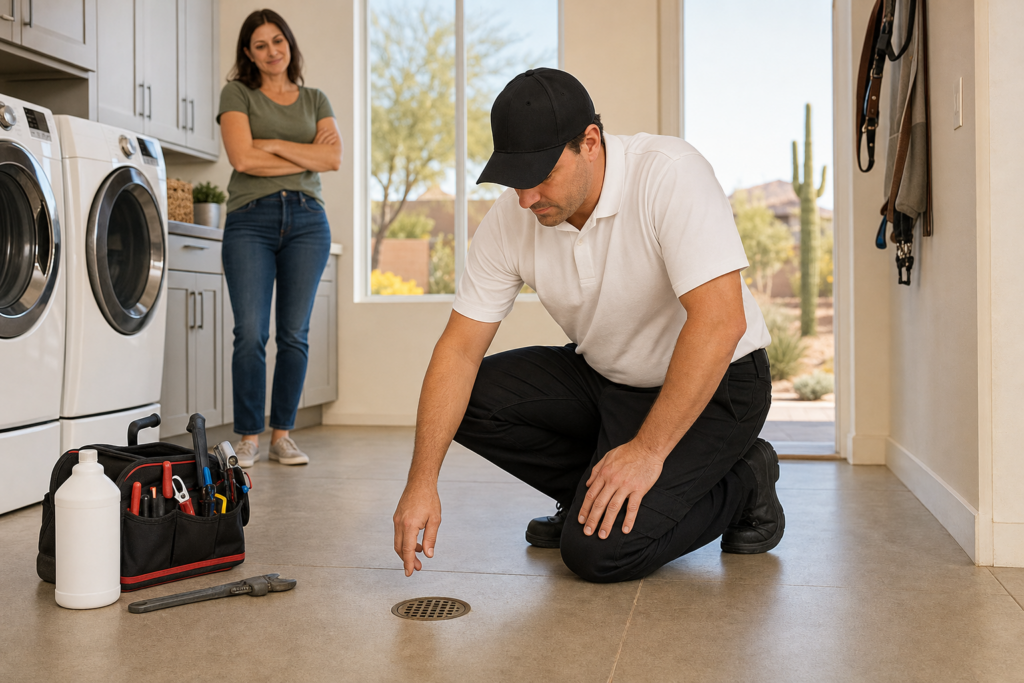
Sewer Smell Near a Floor Drain but No Backup? Here Is What It Means and What to Do
A sewer smell near a floor drain — even when nothing is visibly backed up — usually means sewer gas is escaping through a gap in the drain’s water seal. The most common reason is a dry P-trap, which happens when the small amount of water that normally sits inside the drain and blocks gas from entering your home evaporates. In Phoenix, where the air is dry and many floor drains go months without use, this happens faster than most homeowners expect.
A dry P-trap is not the only possible cause. A blocked plumbing vent, a cracked drain line, or a loose seal around the drain itself can also let sewer gas into your living space. This article walks through each cause in plain language, explains how to tell which one you may be dealing with, and outlines when it makes sense to call a licensed plumber for a closer look.
What the Smell Actually Is
The odor you are noticing is sewer gas — a mixture of gases that forms inside drain and sewer lines as waste breaks down. The distinctive rotten-egg or sulfur smell comes primarily from hydrogen sulfide, one of the gases in that mixture. Methane is also present, though it is odorless on its own.
Under normal conditions, you never smell sewer gas inside your home because every drain has a built-in barrier designed to block it. When that barrier fails — even slightly — the gas finds its way into the room. The key thing to understand is that no visible backup does not mean nothing is wrong. It simply means the issue is with the gas barrier, not with a physical blockage pushing water back into the space.
The Most Common Cause: A Dry P-Trap
What a P-Trap Is and How It Works
A P-trap is the U-shaped section of pipe directly beneath a drain. You can see one under most sinks — it is the curved pipe that dips down and then back up before connecting to the wall. Floor drains have the same component, but it is hidden below the surface.
The P-trap holds a small amount of standing water at all times. That water acts as a seal — it physically blocks sewer gas from traveling up through the pipe and into your home. Think of it like water sitting in a cup turned on its side: as long as the cup has water in it, air cannot pass through. When the water is gone, there is nothing stopping gas from flowing freely.
Why Floor Drains Dry Out Faster Than Other Drains
Sink, shower, and tub drains get used regularly. Every time water runs through them, the P-trap refills. Floor drains are different. Most floor drains in Phoenix homes — especially in garages, laundry rooms, and utility areas — are rarely used. Some go months or even years without water passing through them.
Over time, the standing water in the P-trap evaporates. Once it is gone, sewer gas has a clear path into your home.
Why This Happens Faster in Phoenix
Phoenix’s dry desert climate accelerates evaporation significantly. In a humid climate, a floor drain P-trap might hold its water seal for several months. In Phoenix, especially during the summer when indoor air is heated and cooled constantly, a P-trap in an unused floor drain can dry out in just a few weeks. Garages and utility spaces without climate control dry out even faster.
If the drain in question is in a part of your home that does not see regular water use — a guest bathroom, a secondary laundry area, or a garage — a dry P-trap is the most likely explanation for the smell.
How to Recognize a Dry P-Trap
- The smell is coming from directly inside the drain opening
- The drain has not had water run through it recently
- The odor is noticeable but not overwhelming
- No other drains in the house seem affected
- There is no gurgling, slow drainage, or standing water anywhere
Other Causes Worth Knowing About
A dry P-trap is the most common explanation, but it is not the only one. If the smell persists after adding water to the drain, one of these other causes may be involved.
Trap Siphoning
What it is: When a large volume of water drains quickly from a nearby fixture — such as a washing machine or a bathtub — the fast-moving water can create enough suction in the shared drain line to pull the standing water out of an adjacent floor drain’s P-trap. This is called trap siphoning.
What you might notice: The sewer smell appears or gets worse right after running the washing machine, draining a bathtub, or flushing a toilet. The smell may come and go depending on when those fixtures are used.
Blocked or Clogged Vent Stack
Your plumbing system includes a vent stack — a pipe that runs from the drain system up through the roof. The vent serves two purposes: it allows air into the drain system so water flows smoothly, and it routes sewer gas safely outside above the roofline.
When the vent is partially or fully blocked — by debris, bird nests, or buildup — sewer gas cannot exit through the roof. Instead, it pushes back down through the drain system and can escape through any available opening, including floor drains.
What you might notice: Gurgling sounds when you flush a toilet or drain a sink. The smell is present even when the floor drain appears to have water in the trap. Multiple drains may seem affected. Drains may also empty more slowly than usual.
Cracked or Damaged Drain Line
A crack, break, or joint separation in the underground drain line can allow sewer gas to seep into the surrounding soil or slab gap and enter the room from below. This is less common than a dry P-trap, but it is more serious because the smell will not respond to simple fixes.
What you might notice: The smell is persistent and does not go away after adding water to the drain. You may also notice slow drainage, damp spots near the floor, or an odor that seems to come from the floor itself rather than from inside the drain.
Loose Drain Seal or Floor Flange
Sometimes the smell is not coming through the drain — it is coming around it. If the seal between the drain body and the floor has loosened, cracked, or deteriorated, gas can escape through the gap between the drain fitting and the surrounding surface.
What you might notice: The odor seems to come from the edges of the drain rather than from inside the opening. The drain itself may look slightly raised, shifted, or have visible gaps where it meets the floor.
Failed Trap Primer
Some floor drains — particularly in commercial buildings and newer residential construction — are equipped with a trap primer. This is a small automatic device that periodically sends a trickle of water to the floor drain to keep the P-trap from drying out.
If the trap primer fails or is disconnected, the P-trap will dry out just like any other unused drain — but you may not realize it because you assumed the primer was handling it.
What you might notice: The P-trap dries out repeatedly even though you have been adding water to it. The drain does not seem to hold its water seal for more than a few days.
What to Try First
If you suspect a dry P-trap — which is the most likely cause in most Phoenix homes — here is what to do:
- Pour water into the drain. Slowly pour about one to two gallons of clean water directly into the floor drain. This refills the P-trap and restores the water seal that blocks sewer gas.
- Add a thin layer of mineral oil. After the water, pour a small amount of cooking-grade mineral oil — about two tablespoons — into the drain. The oil floats on top of the water and slows evaporation, which helps the seal last longer in a dry climate.
- Wait and observe. If the smell disappears within a few hours, the P-trap was almost certainly the issue. Check again after three to five days. If the smell has not returned, the problem is resolved.
- Set a reminder. For drains that do not get regular use, pouring a gallon of water down them once a month can prevent the problem from happening again.
Important: This fix only works if the cause is a dry P-trap. If the smell does not go away after adding water, or if it returns within a few days, something else is going on — and that is when a professional evaluation makes sense.
Signs That Point to Something More Serious
Not every sewer smell is a simple dry-trap situation. Here are specific signals that suggest the problem may need professional diagnosis:
- The smell persists after you have added water and waited several hours
- The smell returns within a few days of refilling the trap
- You hear gurgling sounds from other drains or toilets
- The odor is strong rather than faint, or affects multiple rooms
- Other drains in the home are draining slowly at the same time
- The smell gets noticeably worse after heavy rain or monsoon storms
- The smell comes and goes with temperature changes or shifts in weather
- You see damp spots, staining, or moisture near the floor drain area
Any of these patterns can indicate a vent issue, a compromised seal, or a problem deeper in the drain or sewer line that a visual check from above cannot reveal.
Why the Smell Can Come and Go
One of the most confusing things about a floor drain sewer smell is when it appears one day and vanishes the next. This intermittent pattern has a few real explanations:
- Temperature and humidity shifts. Warm, dry conditions speed up P-trap evaporation. The trap may have just enough water to hold a seal during cooler periods but dries out during the hottest part of the day or during a prolonged hot spell.
- Air pressure changes. Shifts in atmospheric pressure — especially during monsoon season in Phoenix — can affect how air moves through your plumbing vent system. A partial vent blockage may only cause a smell when pressure conditions push gas downward instead of upward.
- Nearby fixture use. If trap siphoning is the cause, the smell will correlate with when heavy-use fixtures like washing machines or bathtubs are running.
- Seasonal use patterns. In homes where certain rooms or areas are used less during specific seasons — guest quarters, pool houses, detached casitas — the associated drains may dry out seasonally and refill when the space is used again.
An intermittent smell does not mean the problem is not real. It usually means the cause is borderline — just enough to let gas through under certain conditions — and understanding the pattern helps a plumber narrow down the diagnosis faster.
Is Sewer Gas Something to Worry About?
This is a fair question, and it deserves an honest, measured answer.
Sewer gas contains hydrogen sulfide and methane. At the low concentrations typical of a dry P-trap in a ventilated room, the smell is unpleasant but is generally considered a nuisance rather than an immediate health concern. Most homeowners who notice a faint, occasional sewer smell from an unused floor drain are dealing with exactly this kind of situation.
A strong, persistent smell — especially one that fills a room, does not respond to adding water, or is accompanied by headaches, dizziness, or nausea — is a different matter. In that case, ventilate the area by opening windows or doors and contact a licensed plumber to evaluate the source.
The goal is not to alarm you. The goal is to give you an honest framework: a faint smell from an unused drain is worth addressing but is not cause for panic. A strong or worsening smell deserves prompt professional attention.
When to Call a Plumber
If you have poured water into the drain, waited, and the smell has not resolved — or if you are noticing any of the more serious signs described above — it is time for a professional evaluation.
Here are specific situations where calling a licensed plumber is the right next step:
- The smell does not go away after refilling the P-trap with water
- The smell returns within a few days, even after adding mineral oil
- You hear gurgling in other drains or toilets
- The smell is strong or present in more than one area of the home
- You notice slow drainage in other fixtures at the same time
- You are not sure whether the drain even has a functional P-trap
- The drain is in an older Phoenix home and has not been serviced or inspected in years
What a Plumber Will Typically Do
A licensed plumber evaluating a sewer smell will usually start by inspecting the drain and trap to confirm they are functioning properly. If the trap is intact and holding water but the smell persists, the next steps may include checking the vent system for blockages and running a camera inspection through the drain line to look for cracks, separations, or other damage below the surface.
The diagnostic process is about finding the actual source — not guessing. A good plumber will explain what they find in plain language and walk you through your options before any work begins.
How Fast Layne Plumbing Handles This Kind of Call
At Fast Layne Plumbing, we get calls about sewer smells in Phoenix homes regularly — especially from homeowners with floor drains in garages, laundry rooms, and utility areas that do not get used often. We understand that the smell is disruptive and that you may not be sure whether it is something simple or something serious.
Here is what you can expect when you call us:
- We answer the phone and schedule promptly
- A licensed technician inspects the drain and explains what they find — in plain English, not jargon
- If the issue is a dry P-trap, we will tell you that and show you how to maintain it
- If the issue is deeper — a vent problem, a damaged line, or a failing seal — we will explain what is going on, what your options are, and what each option involves
- Pricing is upfront, before any work begins
- We do not upsell services you do not need
We are a family-owned plumbing company serving Phoenix, and we treat every home the way we would treat our own. If you are dealing with a sewer smell and the water trick did not fix it, we can help you find the real cause.
Call Fast Layne Plumbing at 480.485.4659 to schedule service.
Frequently Asked Questions
Why does my house smell like sewer but there is no backup?
The most common reason is a dry P-trap. The P-trap is a U-shaped pipe section beneath the drain that holds standing water to block sewer gas. When a floor drain goes unused — especially in Phoenix’s dry climate — that water evaporates and gas enters the room. Other possible causes include a blocked vent stack, a cracked drain line, or a loose seal around the drain.
Can sewer smells come and go?
Yes. Intermittent sewer smells are common and can be caused by temperature and humidity changes that affect how quickly a P-trap dries out, air pressure shifts during monsoon season, or occasional trap siphoning from nearby fixtures. A smell that comes and goes does not mean it is not worth addressing.
How long does it take for a P-trap to dry out?
It depends on the climate and conditions. In Phoenix, where the air is dry and indoor temperatures fluctuate between air conditioning and outdoor heat, a floor drain P-trap can dry out in as little as two to three weeks if the drain is not used.
Will pouring water down the drain always fix a sewer smell?
Only if the cause is a dry P-trap. When you add water, it replenishes the trap and re-establishes the liquid barrier that keeps gas from entering the room. If the smell persists after adding water, the cause is likely something else — such as a vent blockage, a cracked pipe, or a seal failure — and a professional evaluation is the right next step.
What does sewer gas smell like?
Sewer gas has a distinctive rotten-egg or sulfur-like odor. The smell comes primarily from hydrogen sulfide, one of the gases produced when waste decomposes inside sewer and drain lines.
Is sewer gas dangerous?
At the low concentrations typical of a dry P-trap in a ventilated room, sewer gas is generally a nuisance rather than an immediate health concern. A strong, persistent, or sudden sewer smell — especially if accompanied by headaches, dizziness, or nausea — warrants ventilating the space and calling a licensed plumber promptly.
How do I prevent my floor drain from smelling?
The simplest prevention method is to pour about a gallon of water down any rarely used floor drain once a month. Adding a small amount of mineral oil on top of the water after each pour helps slow evaporation, which is especially useful in Phoenix’s dry climate.
The Right Next Step
A sewer smell near a floor drain is unpleasant, but understanding what causes it puts you in a much better position to deal with it. If the drain has not been used in a while, start by pouring water into it and giving it a few hours. That simple step resolves the issue for most Phoenix homeowners.
If the smell does not go away — or if you are noticing other signs like gurgling drains, slow drainage, or odors in multiple rooms — the cause is likely beyond the P-trap, and a professional inspection can identify exactly what is going on.
Fast Layne Plumbing serves homeowners across Phoenix with honest diagnosis, clear explanations, and upfront pricing. We would rather tell you the truth about a simple fix than sell you a service you do not need.
Call Fast Layne Plumbing at 480.485.4659 to schedule service or talk with a local Phoenix plumber.