What to Ask About Follow-Up Support After Drain Cleaning Service in Phoenix
If a plumber clears your drain today and the same drain backs up next week, you should not have to start from scratch — calling around, explaining the problem again, and paying a second time for the same issue. Follow-up support after drain cleaning is the difference between a one-time transaction and a service relationship you can actually rely on.
This matters especially in Phoenix, where hard water mineral buildup, desert tree roots, and aging pipe materials can cause drains to slow down again faster than homeowners expect. Knowing what to ask — and understanding what a straight answer sounds like — helps you figure out whether a plumbing company genuinely stands behind its work before the technician drives away.
Here are the specific questions worth asking, organized by when they matter most: before the plumber leaves, in the days after service, and when choosing a company you can call again.
Questions to Ask Before the Technician Leaves
The end of the service call is the single best moment to get clear answers. The technician has just seen your drain firsthand. They know what was in the line, what caused the blockage, and what condition your pipes are in. These questions take less than five minutes and can save you real frustration later.
What caused the clog, and is the underlying issue resolved?
This is the most important question you can ask, and you should expect a specific answer — not a vague response like “all clear.” A technician who found a grease buildup should be able to tell you that. A technician who pulled tree roots out of the line should be able to show you or describe what they found.
The reason this matters: clearing a clog and solving the problem that caused it are not always the same thing. A cable snake can break through a blockage and restore flow, but if the blockage was caused by root intrusion or a partial pipe collapse, the drain may slow down again within weeks. A straightforward answer here tells you whether the cleaning addressed the symptom, the cause, or both.
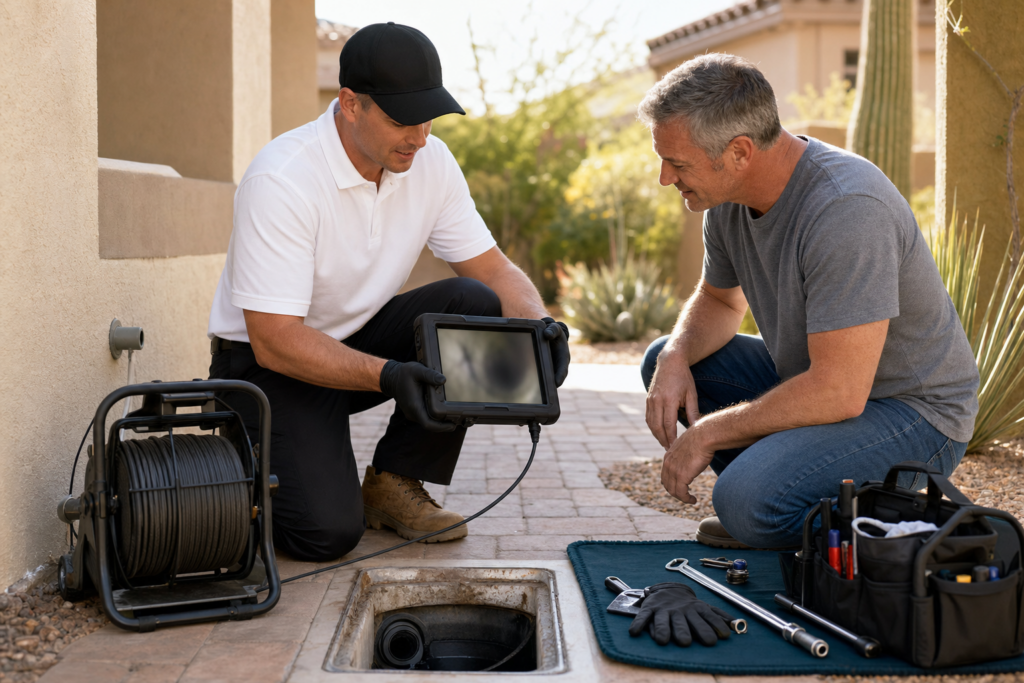
Did you use a camera inspection, and can I see what it showed?
A drain camera inspection lets the technician see the inside of your pipes after the line has been cleared. It can reveal cracks, root intrusion points, heavy scale buildup, bellied sections where the pipe has sagged, or deteriorating pipe material — none of which are visible from a drain opening.
Not every drain cleaning requires a camera inspection, but if your drain has backed up more than once or if the technician encountered something unusual during the cleaning, a camera inspection gives you real information about what is happening below the surface. In Phoenix, this is especially relevant for older homes built in the 1950s through 1980s, where cast iron or Orangeburg pipes may be deteriorating underground or beneath a slab foundation.
If a camera inspection was performed, ask whether you can see the footage or receive a copy. A plumber who is confident in their diagnosis should have no hesitation sharing what the camera found.
Can you run water through the line before you leave?
Before the technician packs up, ask them to run water through the drain — and ideally through multiple fixtures that share the same line — so you can confirm the flow is restored. This is a simple, practical verification step. If the drain is still slow with the technician standing right there, you can address it immediately instead of discovering the problem after the truck is gone.
Understanding the Service Guarantee
Follow-up support starts with understanding what happens if the problem comes back. This is where many homeowners feel uncertain, and it is worth getting clear answers before the invoice is signed.
What does your follow-up support or service guarantee cover?
Ask the plumber to explain, in plain terms, what their follow-up support looks like. Specifically, you want to understand:
- What is covered — the same drain, the same type of blockage, or any drain in the home?
- How long the coverage lasts after the service date
- Whether there is a cost for a return visit within that period
- Whether the coverage applies to the specific method used — for example, a cable snaking service and a hydro-jetting service may carry different follow-up terms because they address different levels of buildup
A company that is confident in its work should be able to explain these terms clearly and without fine print that changes the answer. If the explanation feels vague or keeps shifting, that is worth noticing.
What is the process if the drain backs up again?
This is the question behind the question. You are not just asking whether they will come back — you are asking how easy or difficult it will be to get help if the problem returns. Specifically:
- Do you call the same number?
- Do you need to reference a work order or receipt?
- Is there a waiting period, or can a return visit be scheduled the same way as the original appointment?
- Will the same technician come back, or will someone new need to re-diagnose the issue?
A plumber who makes it easy to call back is telling you something about how they operate. A plumber who makes it complicated is also telling you something.
Does calling another plumber affect my follow-up coverage?
This is a question many homeowners do not think to ask, but it matters. Some service guarantees become void if a different plumber works on the same drain before the original company has a chance to return. If you are considering getting a second opinion or if you have another plumber handle a different issue in the home, it is worth knowing whether that changes your follow-up terms.
What Phoenix Conditions Mean for Your Drains After Cleaning
Phoenix is not a generic plumbing environment. The specific conditions here affect how long a drain cleaning lasts, what causes repeat blockages, and which follow-up questions are most important to ask.
Hard water and mineral scale
Phoenix has some of the hardest water in the country. Calcium and other minerals gradually accumulate along the inner surfaces of drain pipes, reducing the diameter of the opening and leaving behind rough textures that trap grease, soap residue, and other debris. A drain cleaning can clear the current blockage, but if heavy scale is lining the pipe walls, the drain may slow down again sooner than it would in a city with softer water.
Ask your technician whether they noticed significant mineral buildup during the cleaning. If they did, it is worth discussing whether hydro-jetting — which uses high-pressure water to scour the pipe walls — would be more effective than cable snaking for your situation. This is also a good time to ask about water softener options if hard water is contributing to recurring drain problems throughout the home.
Desert tree root intrusion
Mesquite, Ficus, and other desert-adapted trees common in Phoenix neighborhoods send roots deep into the ground seeking moisture. Sewer lines and drain pipes are natural targets. Root intrusion can cause repeated blockages even after a thorough cleaning, because the roots will grow back into any crack or joint they have already penetrated.
If the technician found roots during the cleaning, ask how far the intrusion extends, whether the pipe has been damaged at the entry point, and what the recommended approach is for managing root growth going forward. In some cases, periodic maintenance cleanings on a set schedule are the most practical solution. In other cases, a pipe repair may be the better long-term answer. A technician who has actually seen the inside of your line can help you understand the difference.
Aging pipes and slab foundations
Many Phoenix homes built between the 1950s and 1980s were plumbed with cast iron or, in some cases, Orangeburg pipe — a tar-paper-based material that deteriorates over decades. These older pipe materials can develop internal corrosion, rough spots, partial collapses, and joint separations that make blockages more likely even after a cleaning.
If your home is in this age range, ask the technician about the general condition of the pipe they cleaned. A camera inspection is particularly valuable here because it can show deterioration that affects how long the cleaning will hold and whether a repair or replacement should be planned.
Phoenix’s prevalence of slab foundations adds another layer. When drain pipes run beneath a concrete slab, access for repair is more involved and more expensive. Understanding the condition of those pipes now — while a technician is already on-site — can help you plan ahead instead of facing an emergency later.
What to Watch for in the Days After Service
A drain cleaning should restore normal flow. But “normal” does not always mean perfect, and some post-service observations are worth paying attention to.
Signs that the cleaning worked as expected
- Water drains at a steady pace without pooling
- No sewage smell from the drain or nearby fixtures
- Flushing toilets connected to the same line works normally
- No gurgling sounds from other fixtures when one drain is in use
Signs that may indicate a deeper issue
- The drain slows down again within a few days
- Gurgling sounds return in sinks, tubs, or toilets
- A sewage smell persists or returns after the cleaning
- Water backs up in a different fixture than the one that was cleaned
If any of these signs appear shortly after service, it could indicate that the original blockage was a symptom of a deeper problem — such as a main sewer line issue, a pipe defect, or root intrusion that was not fully addressed. This is exactly the situation where follow-up support matters most, and where knowing the callback process saves you time and stress.
Maintenance Between Professional Cleanings
Ask your technician what you can do between professional cleanings to keep your drains flowing. A good answer should be specific to what they found in your pipes, not a generic list.
Enzyme cleaners versus chemical drain cleaners
Enzyme-based drain cleaners use natural bacteria to break down organic buildup over time. They are generally safe for most pipe materials and are a reasonable maintenance tool between professional cleanings.
Chemical drain cleaners — the kind sold at most hardware stores — use caustic or acidic chemicals that can damage older pipes, especially cast iron. In Phoenix homes with aging plumbing, chemical drain cleaners can accelerate corrosion and create more problems than they solve. Ask your technician which type of maintenance product, if any, they recommend for your specific pipes.
How often should this drain be professionally cleaned?
The honest answer depends on what the technician found. A kitchen drain with a one-time grease clog may not need another professional cleaning for years if the homeowner adjusts their habits. A main sewer line with active root intrusion may benefit from a scheduled cleaning every twelve to eighteen months to stay ahead of regrowth.
Ask for a recommendation based on what the technician actually observed — not a blanket answer. A plumber who has just inspected your line is in the best position to give you a realistic maintenance timeline.
Documentation and Ongoing Access
Good follow-up support is easier when there is a clear record of what was done.
Will I receive a written summary of the service?
A written service report — even a brief one — should describe what was found, what method was used to clear it, the general condition of the pipe, and any recommendations for future service. This matters for your own records, but it also matters if you are a landlord managing a rental property, if you are planning to sell your home, or if you need to reference the work for an insurance claim.
If a camera inspection was performed, ask whether the footage or images can be provided. Visual documentation is especially valuable for sewer line and main drain issues where the condition of the pipe affects future decisions.
How do I reach you if the problem comes back after hours?
Drain problems do not wait for business hours. Ask whether the company offers after-hours or emergency support, and how to access it. Knowing the answer now — while everything is working — is better than searching for it at ten o’clock at night with a backed-up drain.
What a Trustworthy Answer Sounds Like
Asking good questions only helps if you know how to read the answers. Here is a practical framework:
A reassuring answer is specific, calm, and grounded in what the technician actually observed. It names the cause of the blockage, describes the condition of the pipe, explains what the follow-up terms are in plain language, and gives you a realistic picture of what to expect going forward — including honest uncertainty when it applies.
A vague answer avoids specifics. Saying the drain looks fine without describing what was actually found. Telling you to call back if something comes up without walking you through how that process works. Estimating that things should hold for a while without any real basis for that conclusion. Vague answers are not necessarily dishonest, but they do not give you the information you need to make decisions.
You deserve clear answers about what was done in your home, what it means, and what happens next. A plumbing company that communicates that way is one worth calling again.
Why This Matters to Fast Layne Plumbing
At Fast Layne Plumbing, we answer the phone, show up when we say we will, and explain what we find in plain English. We provide upfront pricing so there are no surprises on the bill, and we do not push services you do not need. When we clean a drain, we want you to understand what caused the problem, what we did to fix it, and what to expect going forward.
We are a family-owned plumbing company serving Phoenix, and we treat every home the way we would want our own home treated — with honest diagnosis, clean work, and clear communication. If a drain we cleaned is not flowing the way it should, we want to hear about it. That is what follow-up support means to us.
If you have questions about a drain that has been giving you trouble — or if you want a plumber who will take the time to explain what is actually going on in your pipes — give us a call.
Call Fast Layne Plumbing at 480.485.4659 to schedule service.
Frequently Asked Questions
What should I do if my drain backs up again a few days after cleaning?
Contact the company that performed the cleaning and reference your original service. A drain that backs up again shortly after a professional cleaning may indicate a deeper issue — such as root intrusion, a pipe defect, or a blockage further down the line — that requires further evaluation. A company with follow-up support should be able to schedule a return visit and explain next steps.
Is it normal to hear gurgling sounds after a drain cleaning?
Occasional brief gurgling right after a cleaning can sometimes occur as water and air settle in the line. However, persistent gurgling — especially from fixtures you did not have cleaned — may indicate a venting issue or a blockage elsewhere in the system. If it continues beyond a day or two, it is worth calling your plumber to have it evaluated.
How long do drain cleaning results typically last?
It depends on what caused the blockage and what method was used to clear it. A one-time clog caused by food debris may not recur for years. A blockage caused by tree root intrusion or heavy mineral scale in an older Phoenix home may return within months if the underlying cause is not addressed. Your technician should be able to give you a realistic timeline based on what they found during the cleaning.
What is the difference between snaking and hydro-jetting for follow-up purposes?
Cable snaking breaks through a blockage to restore flow. Hydro-jetting uses high-pressure water to scour the interior walls of the pipe, removing buildup more thoroughly. Because hydro-jetting addresses more of the buildup inside the pipe, the results often last longer — and the follow-up terms a company offers may reflect that difference. Ask your plumber which method they used and what that means for how long the cleaning should hold.
Should I ask for a camera inspection after every drain cleaning?
Not necessarily after every cleaning, but a camera inspection is especially valuable if the drain has backed up more than once, if the home has older pipes, if the technician found roots or unusual debris, or if you want a clear picture of the pipe’s condition for planning purposes. A camera inspection can reveal issues that cleaning alone cannot address, and it gives both you and your plumber better information to work with.
Do plumbers in Phoenix typically offer follow-up support for drain cleaning?
Policies vary by company. Some offer a defined callback period. Some offer maintenance programs. Some provide no formal follow-up terms at all. The best approach is to ask directly — before the service or before the technician leaves — so you understand what you are getting and what to do if the problem returns.