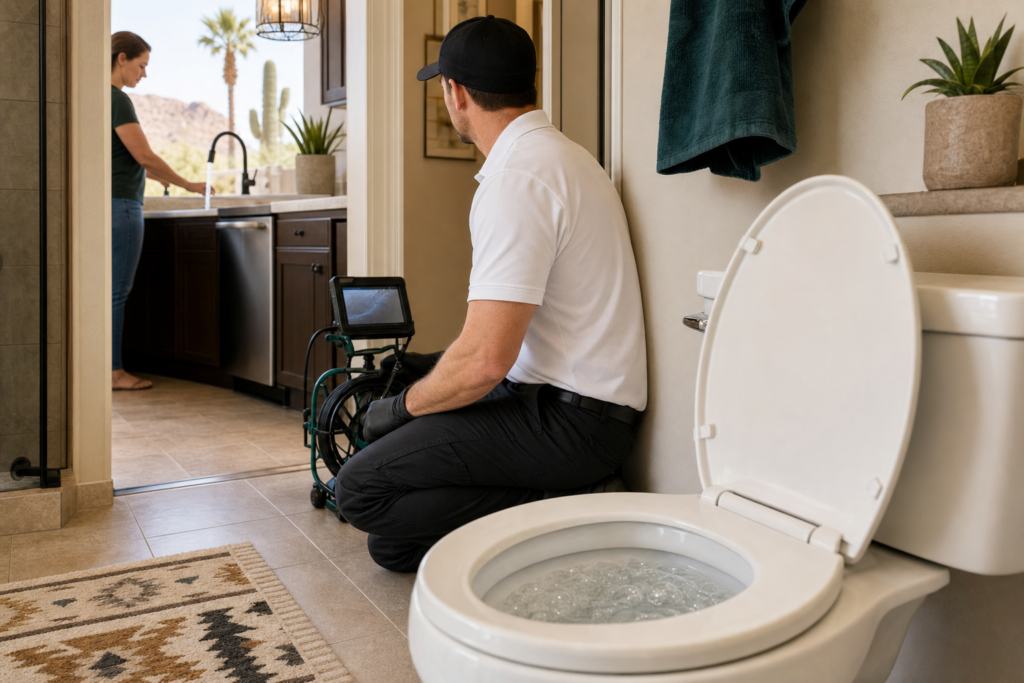
Why Does Your Toilet Bubble When the Kitchen Sink Drains?
When your kitchen sink drains and your toilet starts bubbling, it means air is traveling through your plumbing system in a direction it was never intended to move. The bubbles rising through the toilet bowl are displaced air being pushed through the standing water in your toilet’s trap because something is preventing that air from following its normal exit path out of the drain system.
This symptom is most common in Phoenix homes where a partial blockage has developed in a shared drain line, the plumbing vent on the roof is obstructed, or the main sewer line is restricted. The specific cause determines whether this is a quick fix or a sign of a deeper issue — and the only reliable way to know is to understand what each cause looks like and when a licensed plumber should evaluate the situation.
This article explains the mechanism behind the bubbling, walks through the three most likely causes, helps you observe what is happening in your home, and covers what to expect if a professional diagnosis is needed.
How Your Drain and Vent System Creates This Problem
Every drain in your home — the kitchen sink, the toilets, the showers, the washing machine — connects to a network of pipes that eventually leads to either the city sewer or a septic system. These drain pipes do not work in isolation. In most homes, multiple fixtures share sections of the same drain line before reaching the main sewer line that exits the house.
Your plumbing system also has a vent stack — a pipe that runs vertically through the roof. The vent stack does not carry water. Its job is to allow air into the drain system so that water can flow smoothly downhill through the pipes. When venting is absent or compromised, draining water generates a low-pressure zone inside the pipes — much like placing your thumb over the opening of a water-filled straw. That pressure imbalance prevents water from moving freely through the line.
When everything works correctly, the kitchen sink drains, air enters through the vent stack to keep pressure balanced, and water travels quietly through the shared drain line and out to the sewer. No other fixture is affected.
When something disrupts that balance — a partial clog restricting flow, a blocked vent cutting off the air supply, or a restriction in the main sewer line — the air that normally exits through the vent gets pushed or pulled through the nearest available opening. In most homes, that opening is the toilet. The toilet trap holds a small pool of standing water, and when displaced air is forced through it, you see bubbles.
The toilet is not the source of the problem. It is the messenger. The real issue is happening somewhere else in the system.
The Three Most Likely Causes
A Partial Clog in the Kitchen Branch Line or Shared Drain
Your kitchen sink connects to a smaller pipe called a branch line before joining the larger shared drain that other fixtures also use. Over time, grease, food particles, soap residue, and other kitchen waste can build up inside the branch line or at the point where it connects to the shared drain.
In Phoenix kitchens, grease buildup can be especially persistent. Cooking oils and fats may stay liquid in a warm kitchen but still coat and accumulate inside the pipe over months. This creates a partial blockage — enough pipe is open for the water to drain, but not enough for air to move freely alongside it.
When the kitchen sink drains through a partially clogged line, the moving water pushes air ahead of it. That air cannot escape forward easily because of the restriction, so it travels backward through the shared drain and exits through the toilet trap. The result is bubbling in the toilet that happens right when the sink is draining.
A partial clog in the kitchen branch line is usually the least serious of the three causes. It often affects only the kitchen-to-toilet connection and may not produce symptoms at other fixtures.
A Blocked or Obstructed Vent Stack
The vent stack exits through your roof, which means it is exposed to everything the Phoenix environment can send its way. Desert dust, leaves, bird nests, and small debris can accumulate at the top of the vent opening over time. In some older Phoenix homes, the vent pipe itself may be undersized for the number of fixtures it serves, which makes even a small obstruction enough to cause problems.
When the vent is blocked, the entire drain system loses its air supply. Every time a significant volume of water drains — like emptying a full kitchen sink — it creates a pressure change inside the pipes. The air that should have entered through the vent instead gets pulled from the nearest available water seal. That water seal is usually the toilet.
A blocked vent often produces bubbling that is not limited to just the kitchen sink draining. You may notice it when the shower runs, when the washing machine drains, or even occasionally when no water is running at all. If multiple fixtures trigger the bubbling, the vent stack is a likely suspect.
A Restriction in the Main Sewer Line
The main sewer line is the large pipe that collects drainage from every fixture in your home and carries it out to the city sewer connection or septic system. When this line develops a restriction — from tree root intrusion, heavy buildup, a pipe shift, or deterioration in older pipe materials — it affects the entire plumbing system at once.
Many established Phoenix neighborhoods have homes built between the 1950s and early 2000s. Depending on the era and the original plumbing materials, the main sewer line may be more susceptible to root intrusion, mineral scaling, or joint separation. These conditions develop gradually, and a bubbling toilet can be one of the earlier warning signs before more disruptive symptoms appear.
A main sewer line restriction is the most serious of the three causes because it can progress to a full sewer backup if left unaddressed. The key indicators that the main line may be involved are covered in the next section.
How to Figure Out Which Cause Applies to Your Home
You do not need to diagnose the problem yourself — that is what a licensed plumber and a camera inspection are for. But observing your symptoms carefully before you call can help the technician understand what is happening and get to the root cause faster.
Here is a simple framework based on what you are seeing:
If only the kitchen sink triggers the bubbling, and all other fixtures drain normally with no symptoms, the issue is most likely a partial clog in the kitchen branch line or the shared drain section between the kitchen and the toilet. This is typically the most contained version of the problem.
If multiple fixtures trigger the bubbling — for example, the shower, the bathtub, or the washing machine also cause the toilet to bubble — the issue is more likely a blocked vent stack or a restriction further downstream in the main sewer line. The problem is systemic, not isolated to one branch.
If the toilet bubbles even when no water is running, or if you notice the water level in the toilet bowl rising or dropping on its own, the issue may involve significant pressure changes in the main line. This warrants a call to a licensed plumber sooner rather than later.
If you notice slow drains at multiple fixtures, a sewer odor in the home, or water backing up into a shower or floor drain, the main sewer line is likely involved. In this situation, it is a good idea to minimize water use in the home and contact a plumber promptly. These symptoms together can indicate a blockage that could worsen.
If your home has a septic system rather than a city sewer connection, similar symptoms can appear when the septic tank is full or the drain field is not absorbing properly. The bubbling mechanism is the same — restricted outflow causing air displacement — but the solution involves the septic system rather than the sewer line. A plumber or septic service provider can help determine which applies.
What You Can Safely Observe at Home
Before calling a plumber, there are a few things you can note that will help the technician understand your situation more quickly:
- Run the kitchen sink for 30 seconds and watch the toilet. Does the bubbling start immediately or after a delay? Does it stop as soon as the water stops, or does it continue for a few seconds?
- Check whether the toilet water level changes when the sink drains. If the water level drops noticeably or rises, that may indicate a more significant pressure issue.
- Test other fixtures one at a time. Does the toilet bubble when the shower runs? When the bathtub drains? When the washing machine empties? Write down which fixtures trigger the symptom and which do not.
- Note whether any drains in the home are slower than usual, even if they are not directly connected to the kitchen.
- Note any unusual odors, especially near floor drains, shower drains, or the toilet itself.
These observations help a plumber narrow down the location and severity of the problem before the visit, which can make the diagnostic process more efficient.
One important note: chemical drain cleaners are not recommended for this type of problem. They are designed for simple clogs near the drain opening and are unlikely to reach a blockage in a shared drain line, a vent stack, or a main sewer line. In some cases, they can damage pipes — especially in older Phoenix homes with original plumbing materials.
What a Plumber Does to Diagnose and Address This Problem
A licensed plumber typically starts with a visual assessment and a conversation about the symptoms you have observed. This is where the notes you took about which fixtures trigger the bubbling become useful.
If the symptoms suggest a partial clog in the kitchen branch line or shared drain, the plumber may use a motorized drain snake to clear the blockage. For heavier buildup — especially grease accumulation — hydro jetting may be the better option, as it uses high-pressure water to clean the interior walls of the pipe rather than just punching through the clog.
If the symptoms suggest a vent stack obstruction, the plumber can inspect and clear the vent, restoring the air supply to the drain system.
If the symptoms point to a main sewer line restriction, the plumber will likely recommend a camera inspection. A small camera is fed into the sewer line to see exactly what is causing the restriction — whether it is root intrusion, heavy buildup, a pipe crack, or a collapsed section. The camera inspection allows the plumber to show you what the line looks like and explain what options are available, so you can make an informed decision based on what the inspection actually reveals.
The right repair depends on what the inspection shows. A soft blockage from grease or buildup may be resolved with cleaning. Root intrusion may require more involved clearing and possibly repair. Structural damage to the pipe may require sewer line repair or replacement. A responsible plumber will not recommend major work without showing you the evidence and explaining the options clearly.
At Fast Layne Plumbing, the approach is straightforward: find the real problem, explain it in plain English, provide upfront pricing before any work begins, and let the homeowner make the decision. No pressure, no unnecessary upsells, and no surprises on the bill.
Is a Bubbling Toilet a Plumbing Emergency?
It depends on the severity and what other symptoms are present.
A toilet that bubbles occasionally when the kitchen sink drains — with no other symptoms — is a warning sign, not an emergency. It means something in the system needs attention, and it is worth scheduling a service call before the underlying problem worsens. But it does not typically require stopping all water use or treating the situation as urgent.
A toilet that is actively backing up, a home with sewage odor, water appearing in a shower or floor drain when it should not be, or multiple fixtures showing symptoms simultaneously — those are situations that warrant calling a plumber promptly and reducing water use in the home until the issue is evaluated.
The honest answer is that a bubbling toilet on its own rarely causes damage. But the conditions causing the bubbling — a worsening clog, a deteriorating sewer line, a fully blocked vent — can progress if left unaddressed. The safest approach is to have a plumber evaluate it while it is still a minor symptom rather than waiting for it to become a major disruption.
Frequently Asked Questions
Should I flush a bubbling toilet?
In most cases, yes. A toilet that is bubbling because of air displacement still functions normally. The exception is if water is backing up into the toilet bowl, if the water level is rising on its own, or if flushing causes water to appear at another fixture. In those situations, stop using the toilet and call a plumber.
Can a gurgling or bubbling toilet fix itself?
A temporary air pocket can sometimes clear on its own, but the underlying cause — a partial clog, blocked vent, or sewer line restriction — does not typically resolve without intervention. If the bubbling happens more than once, the problem is likely to continue or worsen until it is addressed.
Why does my toilet bubble when the shower or washing machine runs, not just the kitchen sink?
If multiple fixtures trigger the bubbling, the restriction is likely in a section of the drain system that all of those fixtures share — either the main sewer line or the vent stack. This suggests a more systemic issue than a simple kitchen branch clog and is worth having a plumber evaluate.
What are the signs of a main sewer line problem?
Common indicators may include slow drains at multiple fixtures, gurgling or bubbling sounds from toilets or drains, sewage odor inside or outside the home, water backing up into showers or floor drains, and wet spots in the yard near the sewer line path. Any combination of these symptoms can point to a main sewer line issue, and a camera inspection can help confirm what is happening inside the pipe.
When does a bubbling toilet need a camera inspection?
A camera inspection is most useful when the symptoms suggest a main sewer line issue, when the problem recurs after initial clearing, or when the plumber needs to see the condition of the pipe before recommending a repair approach. It is a diagnostic tool that helps identify the exact location and nature of the problem so the homeowner and plumber can make a well-informed decision together.
Could this be related to my septic system?
If your home uses a septic system rather than a city sewer connection, yes — a full septic tank or a saturated drain field can produce the same bubbling symptom. The cause is the same in principle: restricted outflow creates air displacement. If you suspect a septic issue, a septic service provider or a plumber experienced with septic systems can evaluate the tank and drain field.
What to Do Next
A bubbling toilet is your plumbing system telling you that air is not moving the way it should. The cause may be straightforward or it may point to something deeper — and the only way to know for sure is a proper evaluation by a licensed plumber who will look at the actual condition of your pipes before making any recommendations.
Fast Layne Plumbing is a family-owned plumbing company serving Phoenix, AZ. We answer the phone, show up when scheduled, find the real problem, explain what we find in plain English, and give you upfront pricing before any work begins. No guesswork, no pressure, and no surprises.
If your toilet is bubbling when the kitchen sink drains — or if you are noticing other drainage symptoms in your Phoenix home — call Fast Layne Plumbing at 480.485.4659 to schedule service with a local plumber you can trust.