Toilet Gurgling When the Washing Machine Drains? Here’s What Your Sewer Line May Be Telling You
A toilet that gurgles right after the washing machine finishes draining is almost always a sign of trapped air being forced backward through the plumbing system. Something in the shared drain line or venting system is restricting normal airflow, and the toilet — because it holds the largest water seal in the house — is where that displaced air escapes first.
This does not automatically mean the sewer line is broken. But it does mean something in the system is not flowing the way it should, and the symptom tends to get worse over time rather than better. This article walks through what is physically happening inside the pipes, the most likely causes behind the gurgling, how to figure out which one may apply to your home, and when it makes sense to call a licensed plumber.
Why the Washing Machine Causes the Toilet to Gurgle
A standard washing machine pushes out roughly 15 to 30 gallons of water in a short burst at the end of each cycle. That volume moves fast, and it acts like a piston inside the drain pipe — shoving air ahead of it as it travels toward the main sewer line.
In a system where everything is flowing freely, that air escapes up through the roof vent stack — a pipe that runs from the drain system up through the roof to equalize pressure. You never notice it because the air has somewhere to go.
When the vent is partially blocked, or when there is a restriction somewhere in the drain or sewer line, that air cannot escape the normal way. Instead, it gets pushed backward through the path of least resistance. Most plumbing layouts direct that pressure toward the toilet, since the toilet’s curved base section — which holds standing water and prevents sewer gases from entering — is considerably wider than the equivalent components beneath sinks or showers. Air forces its way up through that standing water, producing the gurgling sound you hear.
The key concept here: gurgling is an air pressure problem. The washing machine creates the pressure event. The restriction somewhere in the system prevents the air from escaping normally. And the toilet is the fixture that reveals the problem first.
The Three Most Likely Causes — And How to Tell Them Apart
Not every gurgling toilet points to the same problem. The cause determines whether this is something minor, something that needs attention soon, or something that warrants a prompt call to a licensed plumber. Here is how the most common causes break down.
A Partial Blockage in the Main Sewer Line
The main sewer line is the single pipe that carries all wastewater from your home to the municipal sewer system. Every drain in the house — kitchen, bathroom, laundry, toilets — eventually feeds into this one line.
When the main line develops a partial blockage from grease buildup, sediment, tree roots, or other debris, it narrows the available space for water and air to pass through. The washing machine’s large, sudden discharge overwhelms the restricted section, and displaced air gets forced backward into the closest fixture.
The distinguishing signal: If the gurgling is not limited to just the toilet near the washing machine — if you also notice slow drains in other parts of the house, gurgling from the kitchen sink, or water backing up in the shower or tub — the restriction is likely in the main sewer line, not in a single branch.
Severity: Moderate to high. A partial blockage in the main line tends to worsen over time as more material accumulates at the restriction point. This is the cause that most commonly warrants professional evaluation sooner rather than later.
In many established Phoenix neighborhoods, especially homes built from the 1950s through the 1980s, the original sewer lines were installed using clay or cast-iron pipe. Over decades, clay joints can shift as desert soil expands and contracts with temperature and moisture changes, and cast iron can develop internal corrosion that catches debris and accelerates buildup. These aging materials make partial main line blockages more common in older Phoenix homes than in newer construction.
A Blocked or Partially Blocked Roof Vent Stack
The vent stack is a pipe that runs vertically from your drain system up through the roof. Its job is straightforward: it lets air into the drain system so water can flow freely, and it lets sewer gases exit safely above the roofline. Think of it like the small hole on the lid of a travel coffee cup — without it, the liquid cannot pour out smoothly.
When the vent stack becomes partially blocked, air cannot enter or exit the system normally. Every time a large volume of water moves through the drain — like a washing machine discharge — the system develops negative pressure. That negative pressure pulls air through fixture traps, producing the gurgling sound. In some cases, the suction is strong enough to actually pull water out of the trap, which can allow sewer gas to enter the home.
The distinguishing signal: Vent blockages tend to affect multiple fixtures, not just one. You may notice gurgling from more than one drain, a faint sewer gas smell near drains or in bathrooms, or the water level in the toilet bowl dropping slightly after the gurgling stops. If you notice a sulfur or rotten-egg odor inside the house, especially after running water or flushing, a vent issue is worth investigating.
Severity: Moderate. A blocked vent is a real problem that affects drainage performance and can allow sewer gases into living spaces, but it is not typically an emergency unless odors are persistent or strong.
In Phoenix, vent stacks are less likely to be blocked by ice — which is a common cause in colder climates — but debris, dust accumulation, and bird or insect nesting material are realistic culprits, especially after monsoon season when wind-driven debris can settle on rooftops.
A Localized Clog in a Shared Branch Drain
In most homes, the washing machine and a nearby bathroom share a branch drain line — a smaller pipe that connects those individual fixtures to the main sewer line. Over time, soap residue, lint, mineral deposits, and other debris can build up inside that branch line and narrow the pipe.
When the washing machine dumps its water into a branch line that is partially restricted, the same air displacement occurs — but it is contained to that one section of the system. The toilet on that shared branch gurgles, but fixtures in other parts of the house drain normally.
The distinguishing signal: Only the toilet closest to the washing machine gurgles. Other bathrooms, the kitchen sink, and showers elsewhere in the house all drain normally without any gurgling or slowness.
Severity: Lower than a main line issue, but still worth addressing. A localized branch line clog can usually be cleared with professional drain cleaning, and catching it early prevents it from worsening into a full backup.
A Full or Struggling Septic Tank — If Applicable
Most Phoenix metro homes connect to the municipal sewer system, but some properties in outlying areas use septic systems. If your home is on a septic tank and you are hearing gurgling across multiple fixtures, the tank may be full or the outlet baffle could be partially blocked. This creates backpressure in the entire system.
The distinguishing signal: Slow drains throughout the house, gurgling from multiple fixtures, and possibly soft or unusually green ground near the tank or drain field area. If your home is on a septic system and you have not had it pumped in several years, this is worth checking.
How to Read Your Own Symptoms Before You Call
You cannot diagnose a sewer line issue from inside the house — that takes professional tools. But you can observe a few things that help a plumber understand the situation faster when they arrive. This is not a repair checklist. It is an observation checklist.
- Note which fixtures are affected. Does only the toilet near the washing machine gurgle? Or do you hear it from other drains too? Run the washing machine and walk through the house listening for gurgling at other fixtures.
- Watch the toilet water level. After the gurgling stops, does the water level in the bowl drop below its normal resting line? A drop suggests air is being pulled through the trap, which points toward a vent or main line issue.
- Run other fixtures while the washer drains. Turn on the kitchen faucet or flush a toilet in a different bathroom while the washer is draining. If those fixtures also slow down or gurgle, the restriction is likely downstream in the main line, not in a single branch.
- Check for odors. A faint sewer gas smell near any drain — bathroom, laundry room, or kitchen — can indicate that a trap has lost its water seal due to negative pressure. Note where the smell is strongest.
- Track whether the problem is getting worse. If the gurgling was occasional and is now happening every cycle, or if drains that used to be fine are starting to slow down, the restriction is likely growing. That information is useful for a technician.
Having these observations ready when you call a plumber can help the technician understand what they are walking into and arrive better prepared to diagnose efficiently.
When to Call a Plumber — And How Urgent Is It?
Not every gurgling toilet requires an emergency call. But some situations do warrant prompt attention. Here is an honest framework for thinking about timing.
- Monitor and observe: The gurgling happens occasionally, only the toilet near the washer is affected, there are no odors, and no other drains are slow. It is reasonable to watch this for a few days, but do not ignore it indefinitely — partial restrictions rarely clear themselves.
- Schedule service soon: The gurgling happens every time the washer runs, you notice mild odors near a drain, or one or two other fixtures are starting to drain slowly. This pattern suggests a restriction that is likely to get worse.
- Call promptly: Multiple fixtures are slow or gurgling, sewer gas smell is noticeable in the house, or the toilet water level is visibly dropping after each gurgling episode. A professional evaluation is the right next step.
- Stop using water and call now: Sewage or wastewater is backing up into the tub, shower, or toilet bowl. Water is coming up through a floor drain. This means the main line may be fully or nearly fully blocked, and continuing to run water can make the situation worse.
This is a general guide, not a diagnosis. The actual cause and urgency depend on what a licensed plumber finds during an inspection.
What a Professional Sewer Line Diagnosis Looks Like
If you have never called a plumber for a sewer-related issue before, it helps to know what the process typically involves.
For a symptom like this — gurgling tied to washing machine drainage — a plumber will usually start with a conversation about what you have been experiencing. The observations from the checklist above are genuinely helpful here.
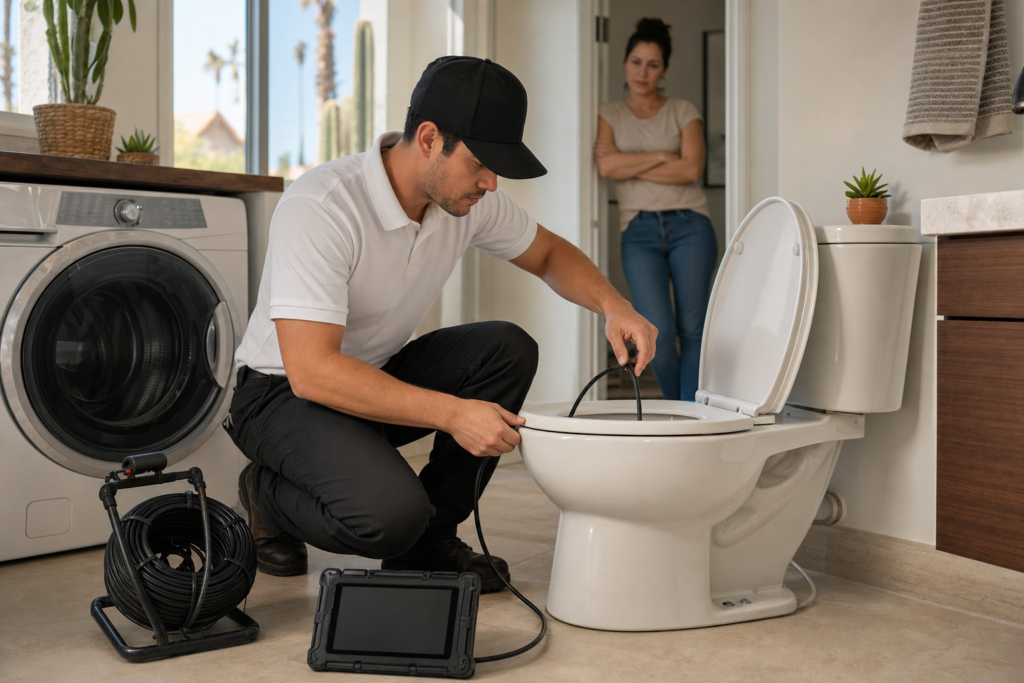
The most reliable diagnostic tool for sewer line issues is a camera inspection, sometimes called a sewer scope. A compact waterproof camera is inserted into the pipe, and the technician monitors a real-time video display to assess conditions throughout the line. The camera can reveal the location and type of any blockage, whether the pipe walls are in good condition, whether tree roots have entered the line, and whether joints have shifted or separated.
This matters because the right solution depends entirely on what the inspection shows. A partial blockage from grease or buildup may call for professional drain cleaning or hydro jetting. Root intrusion may require clearing followed by a conversation about the long-term condition of the pipe. A vent blockage requires a different approach entirely. Without seeing inside the line, any recommendation is a guess — and guessing leads to paying for the wrong fix or missing the real problem.
At Fast Layne Plumbing, the goal of every diagnostic visit is to find the actual problem, explain it in plain English, and give you clear options with upfront pricing — so you can make an informed decision without pressure.
Phoenix-Specific Factors Worth Knowing
If you own a home in Phoenix, a few local conditions are worth understanding when it comes to sewer line health.
Aging pipe materials: Many homes in established Phoenix neighborhoods — areas built from the 1950s through the early 1990s — were originally plumbed with clay or cast-iron sewer lines. Clay pipes are durable but their joints can separate over time as desert soil shifts with seasonal temperature swings. Cast iron can develop internal scale and corrosion that narrows the pipe and catches debris. Both materials are more prone to partial blockages than modern PVC.
Tree root intrusion: Certain tree species common in Phoenix landscaping — including mesquite, citrus, ficus, and some palm varieties — send roots aggressively toward moisture. If a sewer line joint has even a small gap, roots can enter the pipe and gradually expand the opening while creating a catch point for other debris. Root intrusion is one of the most common causes of recurring main line blockages in older Phoenix properties.
Desert soil movement: Phoenix soil can expand and contract with moisture changes, particularly during monsoon season and irrigation cycles. Over many years, this movement can shift pipe joints and create low spots in the sewer line where water pools and sediment accumulates.
Hard water mineral buildup: Phoenix has notably hard water. Over time, mineral deposits can accumulate inside drain and sewer pipes, gradually reducing the interior diameter and contributing to the kind of partial restriction that causes gurgling symptoms.
None of these factors mean your sewer line is definitely damaged. They are context that helps explain why certain symptoms are more common in Phoenix homes than homeowners might expect — and why a professional inspection is worth the clarity it provides.
Frequently Asked Questions
Does a gurgling toilet mean the sewer line is broken?
Not necessarily. Gurgling most commonly indicates a partial restriction or a venting issue — not a cracked or collapsed pipe. A camera inspection is the most reliable way to determine whether the pipe itself is damaged or whether the line simply needs professional clearing.
Can a gurgling toilet fix itself?
In rare cases, a very minor restriction may shift enough for normal flow to resume temporarily, and the gurgling may stop on its own. However, the underlying condition that caused the restriction usually remains. If it happened once, it is likely to happen again, and the problem tends to get gradually worse rather than better.
Is a gurgling toilet dangerous?
The gurgling sound itself is not dangerous. However, if the gurgling is caused by a vent blockage or severe enough negative pressure to pull water out of a fixture trap, sewer gases could enter the home. Sewer gas has an unpleasant sulfur odor and is not something you want to breathe regularly. If you notice persistent odors along with the gurgling, it is worth having the system evaluated.
Can a toilet and washing machine share the same drain?
Yes. This is a normal and common plumbing configuration. The washing machine and a nearby bathroom often connect to the same branch drain line before that line feeds into the main sewer line. The shared drain is not the problem — a restriction within that shared drain or further downstream is what causes the gurgling.
Why does the toilet gurgle only when the washing machine drains and not at other times?
The washing machine discharges a much larger volume of water in a shorter burst than most other household fixtures. A sink or shower releases water gradually, so the air displacement is small enough that a partial restriction does not cause noticeable symptoms. The washing machine’s rapid discharge creates a bigger pressure event, which is why it triggers the gurgling when other fixtures do not.
What if the toilet gurgles when the shower drains too?
The same mechanism applies. If the gurgling happens during both washing machine and shower use, it suggests the restriction is further downstream — likely in a shared branch drain or in the main sewer line — rather than in a pipe that only the washing machine uses.
How do I know if the problem is in my drain lines or in the city sewer?
As a homeowner, you are generally responsible for the sewer line from your home to the connection point at the city main, which is typically near the street. A plumber can help determine where the restriction is located using a camera inspection. If the issue turns out to be in the city’s portion of the system, your plumber can help point you in the right direction for reporting it.
When does a sewer line issue need a camera inspection versus just cleaning?
A camera inspection is most valuable when the symptoms are recurring, when multiple fixtures are affected, or when the plumber suspects the issue may go beyond a simple buildup. It helps confirm the exact cause, location, and condition of the pipe so the right solution can be recommended — rather than clearing a symptom only to have it return weeks later because the real problem was not addressed.
The Right Next Step
A gurgling toilet after the washing machine drains is your plumbing system telling you that something is restricted, blocked, or out of balance somewhere in the shared drain or vent system. It may be a straightforward clearing. It may be a vent issue. In some cases, it may point to an aging sewer line that needs closer evaluation.
The only way to know for certain is to have a licensed plumber take a look.
Fast Layne Plumbing serves homeowners across Phoenix, AZ, and we handle exactly this kind of diagnostic work every week. We show up when we say we will, explain what we find in plain English, and give you upfront pricing before any work begins — so you always know what you are paying for and why.
If your toilet has been gurgling and you want a straight answer about what is going on, call Fast Layne Plumbing at 480.485.4659 to schedule service.