Trenchless vs. Traditional Sewer Repair Cost in Phoenix: Why the Plumbing Bill Is Only Half the Story
Trenchless sewer repair typically costs more in plumbing labor and materials than traditional excavation — but traditional repair often costs more in total once you factor in what it takes to restore your Phoenix property afterward. The right method depends on what is above your sewer line, what is happening inside it, and the specific conditions of your property.
This guide is written for Phoenix homeowners weighing a major sewer repair decision. It covers what each method involves, what drives the cost in either direction, when one approach may make more financial sense than the other, and what a licensed plumber needs to know before giving you an accurate quote. The goal is to help you ask better questions and feel confident in the conversation — not to replace a professional diagnosis.
What You Are Actually Comparing: Plumbing Cost vs. Total Project Cost
Why These Are Two Different Numbers in Phoenix
Most cost comparisons for sewer repair focus only on the plumbing work itself — the labor, equipment, and materials to fix or replace the damaged pipe. That number matters, but in Phoenix, it is often only part of what you will pay.
Traditional sewer repair requires digging a trench to access the pipe. That trench has to go through whatever is above the sewer line. In many Phoenix homes, that means a concrete driveway, a paver patio, mature desert landscaping, an irrigation system, or even a pool deck. After the plumbing work is finished, all of that needs to be repaired or replaced — and that restoration work is a separate cost.
Trenchless methods typically avoid most of that surface disruption, which means the restoration bill is usually much smaller or eliminated entirely. So while the plumbing portion of a trenchless repair may cost more per foot, the total project cost — plumbing plus restoration — can end up lower depending on your property.
This distinction is the single most important thing to understand before comparing quotes. When you evaluate a bid, ask whether it includes restoration of your driveway, landscaping, or hardscape. If it does not, you are looking at an incomplete number.
What Traditional Sewer Repair Involves and What It Costs in Phoenix
Traditional sewer repair — sometimes called open-trench or excavation repair — is exactly what it sounds like. A trench is dug along the path of the damaged pipe, the broken section is exposed, and the pipe is repaired or replaced directly.
The Base Plumbing Cost
The plumbing portion of a traditional sewer repair in Phoenix generally falls in a broad range depending on the length of pipe involved, the depth of the line, the pipe material, and the severity of the damage. Short repairs on shallow lines with easy access cost less. Longer runs, deeper pipes, or lines made of older materials like cast iron or clay cost more.
There is no single number that applies to every job. A plumber who quotes a price without first running a camera inspection or evaluating your specific conditions is guessing — and that guess may not hold up once the work begins.
The Restoration Cost: What Gets Torn Up and What It Costs to Fix
This is where traditional repair gets expensive in Phoenix specifically. The restoration cost depends entirely on what sits above your sewer line:
- Concrete driveway or walkway: Removing and replacing concrete adds significant cost and usually requires a separate contractor.
- Paver patio or pool deck: Pavers can sometimes be salvaged and reset, but pool deck work often requires specialty finishing.
- Desert landscaping: Mature desert plants, gravel beds, and decorative rock take time and money to restore. Mature saguaros and other established plantings may not survive being relocated.
- Irrigation systems: Lines that cross the trench path need to be cut and reconnected.
- Grass yards: In homes that have turf, re-sodding is typically the least expensive restoration scenario.
In many Phoenix properties, the restoration cost can equal or even exceed the plumbing cost itself. This is the part of the bill that surprises homeowners most often, and it is the reason the total project cost matters more than the plumbing cost alone.
How Caliche Soil Affects Excavation Cost in the Phoenix Area
Caliche is a calcium carbonate layer found in much of the soil throughout the Phoenix Valley. It is extremely hard — sometimes compared to soft concrete — and it makes excavation significantly more difficult and time-consuming than digging through normal soil.
When a sewer line runs through or beneath a caliche layer, the labor hours required for excavation increase, equipment costs may go up, and the overall project takes longer. This is a genuinely Phoenix-specific cost factor that national pricing guides do not account for. If your property has a heavy caliche layer, traditional excavation will almost certainly cost more than average estimates suggest.
What Trenchless Sewer Repair Involves and What It Costs in Phoenix
Trenchless sewer repair is a category that includes two primary methods. They work differently, apply to different situations, and cost differently. Understanding the distinction matters.
Pipe Lining (CIPP): How It Works and What It Costs
CIPP stands for Cured-In-Place Pipe lining. A resin-saturated flexible liner is introduced into the damaged pipe, expanded outward against the interior pipe walls, and allowed to harden in position. What remains is essentially a new pipe formed within the old one.
Pipe lining works well when the existing pipe is still structurally intact enough to serve as a host — meaning it has cracks, joint separations, or root intrusion points, but has not collapsed or severely shifted out of alignment.
One thing to know: because the liner sits inside the original pipe, it slightly reduces the internal diameter. For most residential sewer lines, this reduction does not meaningfully affect flow. But for older homes with already-narrow pipes, a licensed plumber can evaluate whether lining is appropriate or whether replacement is the better path.
CIPP liners are designed for long-term durability. A licensed plumber can discuss realistic longevity expectations based on your specific pipe condition, installation quality, and ongoing maintenance needs.
Pipe Bursting: How It Differs and When It Is Used
Pipe bursting is a trenchless replacement method. A specialized bursting head is drawn through the deteriorated pipe, breaking it apart and pushing the fragments outward while a new pipe is drawn in to take its place. Unlike lining, pipe bursting fully replaces the old pipe rather than reinforcing it.
Pipe bursting is typically used when the existing pipe is too damaged for lining — when there are collapses, severe breaks, or the pipe material has deteriorated beyond repair. It requires small access pits at each end of the section being replaced rather than a full trench.
Pipe bursting generally costs more than pipe lining but less than full traditional excavation and replacement when restoration costs are included.
Why Trenchless Costs More Per Foot but Often Less Overall in Phoenix
The per-foot cost of trenchless repair is typically higher than traditional excavation for the plumbing work itself. The equipment is specialized, the materials are engineered, and the technicians performing the work need specific training and experience.
However, because trenchless methods avoid most or all surface excavation, the restoration cost is dramatically lower. In a Phoenix home where the sewer line runs under a concrete driveway, a paver patio, or mature landscaping, the savings on restoration can more than offset the higher per-foot plumbing cost.
This is why looking only at the plumbing bid — without asking about restoration — can lead to a misleading comparison.
Side-by-Side Cost Comparison for Phoenix Homeowners
This table provides a general framework for comparing the two approaches. These are not guaranteed prices — actual costs depend on your specific property, pipe condition, and the scope of the work. Use this as a starting point for understanding the trade-offs, not as a substitute for a professional evaluation.
| Factor | Traditional Excavation | Trenchless (Lining or Bursting) |
|---|---|---|
| Base plumbing cost | Generally lower per foot for the plumbing work itself | Generally higher per foot due to specialized equipment and materials |
| Restoration cost | Can be significant — depends on what is above the line (concrete, pavers, landscaping, pool deck) | Minimal to none in most cases |
| Total project cost | Can be lower for simple jobs with easy access and minimal surface restoration; can be higher when restoration is extensive | Often lower in total when the sewer line runs under hardscape, landscaping, or other valuable property features |
| Project timeline | Several days to a week or more, depending on length, depth, and restoration scope | Often completed in one day for the plumbing work; restoration time is minimal |
| Property disruption | Significant — open trench across the property, heavy equipment, displaced landscaping or hardscape | Minimal — small access points rather than a full trench |
| Best suited for | Short repair sections, shallow pipes, lines under grass or bare soil, collapsed or severely misaligned pipes | Lines under concrete, pavers, pool decks, or mature landscaping; pipes that are cracked or root-damaged but not collapsed |
| Limitations | Restoration cost can be unpredictable; caliche soil increases labor significantly | Not viable for fully collapsed pipes or severe misalignment; lining slightly reduces pipe diameter |
Phoenix-Specific Factors That Move the Price in Either Direction
Sewer repair costs are not the same everywhere. Phoenix has specific conditions that affect both the price and the method a plumber may recommend. Here are the factors that matter most.
Caliche Soil and Excavation Depth
As described above, caliche is a hard calcium carbonate layer common throughout the Valley. It increases excavation time and equipment needs for traditional repair. Deeper pipes compound this — the deeper the trench, the more caliche a crew may encounter, and the more expensive the dig becomes.
What Is Above Your Sewer Line
This is often the single largest variable in total project cost. A sewer line running under a grass yard is inexpensive to restore. A line running under a stamped concrete driveway, a travertine pool deck, or established desert landscaping with drip irrigation is a different situation entirely.
Before you call a plumber, take a few minutes to think about what is directly above and around the path of your sewer line. This information helps any plumber give you a more accurate estimate.
Pipe Material and Age
Older Phoenix homes — especially those built from the 1950s through the 1980s — may have sewer lines made of cast iron, clay, or Orangeburg (a tar-paper-based material). These materials deteriorate over time and may affect which repair method is appropriate.
- Cast iron: Common in mid-century Phoenix homes. Can corrode from the inside out over decades. May be a candidate for lining if the pipe is still structurally sound, or may require bursting or excavation if it has collapsed.
- Clay: Also found in older homes. Prone to root intrusion at the joints. Often a good candidate for lining.
- ABS and PVC: Found in homes built from the late 1970s onward. Generally more durable but can still crack, shift, or separate at joints.
A licensed plumber can identify the pipe material during a camera inspection and recommend the appropriate repair approach.
Pipe Length and Depth
Longer sewer lines cost more to repair regardless of method. Depth matters especially for traditional repair, where a deeper trench means more labor, more soil removal, and more backfill. For trenchless methods, depth is less of a factor in most residential situations, though extremely deep lines may add complexity.
Camera Inspection as a Prerequisite
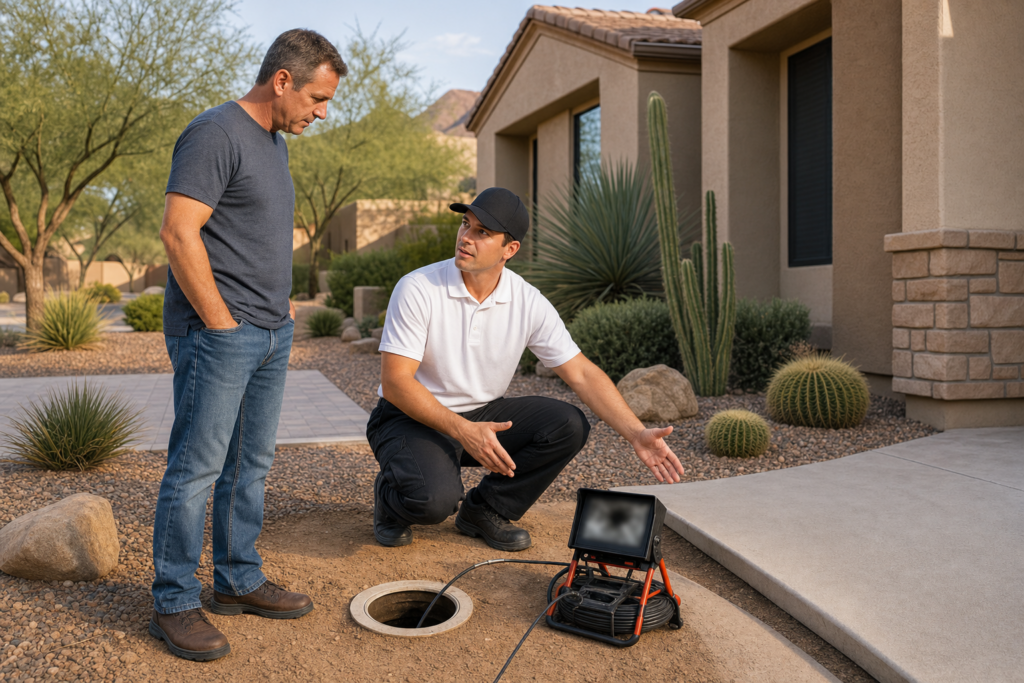
A sewer camera inspection is typically the first step before any sewer repair recommendation. A small waterproof camera is fed through the pipe to visually evaluate the condition, locate the damage, identify the pipe material, and determine the best repair approach.
Without a camera inspection, any repair recommendation is based on guesswork. A reputable plumber will not tell you which method is right — or give you an accurate quote — without first seeing what is happening inside the pipe.
Camera inspections have their own cost, which varies by provider. The investment is worth it because the footage gives you and your plumber the information needed to make the right decision. Some homeowners request a copy of the footage, which can be useful if you want to get a second opinion or compare approaches from different providers.
Permit Requirements Across Phoenix Metro Municipalities
Sewer line repair may require a permit depending on the municipality. Phoenix, Scottsdale, Mesa, Tempe, Glendale, and other Valley cities each have their own permitting rules. Permit costs vary and can add to the total project cost.
A licensed plumber familiar with the Phoenix metro area can advise on whether a permit is needed for your specific job and municipality. This is not something a homeowner typically needs to handle independently, but it is worth asking about when you receive a quote so there are no surprises.
When Traditional Repair May Actually Be the Lower-Cost Option
Trenchless repair is not always the right answer. There are situations where traditional excavation is the more practical and more affordable choice:
- Short damaged section: If the damage is limited to a small area with easy access, a targeted excavation repair may be simpler and less expensive than mobilizing trenchless equipment.
- Shallow pipe under grass or bare soil: When there is nothing valuable above the sewer line and the pipe is not deep, excavation is straightforward and restoration is minimal.
- Collapsed or severely misaligned pipe: Trenchless lining requires the existing pipe to serve as a host. If the pipe has collapsed, caved in, or shifted so far out of alignment that a liner cannot be installed, excavation may be the only viable option. Pipe bursting can handle some of these situations, but not all.
- Pipe material or condition that rules out lining: In some cases, the pipe condition may not support a trenchless approach. A camera inspection will reveal whether the existing pipe can serve as a foundation for lining or whether it needs to come out entirely.
Being honest about this matters. A plumber who tells you trenchless is always the answer is not giving you the full picture. The right method depends on your specific pipe and property — and sometimes the older approach is genuinely the better one.
When Trenchless Is Likely the Smarter Financial Choice in Phoenix
For many Phoenix homes, trenchless repair offers a lower total project cost and significantly less disruption. It tends to make the most sense when:
- The sewer line runs under concrete, pavers, or a pool deck: Avoiding the cost of removing and replacing hardscape is often the largest financial advantage of trenchless methods.
- Mature desert landscaping or irrigation sits above the line: Established plantings, decorative rock, and drip systems are expensive to restore and difficult to replicate. Trenchless methods leave them undisturbed.
- The pipe is cracked, root-damaged, or deteriorating but not collapsed: This is the ideal scenario for CIPP lining — the existing pipe is compromised but still structurally intact enough to host a liner.
- The homeowner wants minimal disruption and faster completion: Many trenchless repairs are completed in a single day, with minimal mess and no open trench across the yard.
- Caliche soil is present: Avoiding excavation through caliche eliminates one of the biggest cost drivers for traditional repair in Phoenix.
What a Licensed Phoenix Plumber Needs to Know Before Quoting Either Method
An accurate sewer repair quote is not something a plumber can give over the phone without information. Here is what a thorough evaluation typically involves:
- Camera inspection findings: The footage shows the location, type, and severity of the damage, as well as the pipe material and overall condition.
- Pipe length: How many linear feet of pipe need repair or replacement.
- Pipe depth: How deep the line sits below the surface, which affects both excavation cost and trenchless feasibility.
- Pipe material: Cast iron, clay, ABS, and PVC each behave differently and may affect method suitability.
- What is above the line: Concrete, pavers, landscaping, grass, pool deck, irrigation — this determines restoration cost for traditional repair.
- Access points available: Where the plumber can enter and exit the pipe for trenchless work, or where the trench needs to be dug for traditional work.
- Permit requirements: Whether the municipality requires a permit for the scope of work involved.
If you are preparing to call a plumber, gathering what you know about these factors can help the conversation be more productive from the start. You do not need to know everything — that is what the camera inspection is for — but having a general sense of your property helps.
A Simple Property Assessment Before You Call
You do not need to diagnose your own sewer line. But answering a few basic questions about your property can help you and your plumber have a more productive conversation:
- What is directly above the path of your sewer line? Concrete driveway? Paver patio? Desert landscaping? Grass?
- Approximately how old is your home?
- Do you know what your sewer pipe is made of? (Your plumber can determine this with a camera inspection if you are not sure.)
- Is there an irrigation system or pool equipment near the sewer line path?
- Have you had previous sewer repairs, cleanings, or camera inspections done on this line?
This is not a diagnostic checklist — it is simply preparation that helps your plumber give you better information faster.
Questions Phoenix Homeowners Commonly Ask
Is trenchless sewer repair worth it in Phoenix?
For many Phoenix properties, yes. The value of trenchless repair increases significantly when the sewer line runs under concrete, pavers, pool decks, or established desert landscaping — because avoiding the cost and disruption of restoring those features can offset the higher per-foot plumbing cost. A camera inspection is the best way to determine whether trenchless is a viable option for your specific pipe and property.
What are the disadvantages of trenchless pipe replacement?
Trenchless methods are not suitable for every situation. If the pipe has fully collapsed, is severely misaligned, or has shifted in a way that prevents a liner or bursting head from passing through, excavation may be necessary. Pipe lining also slightly reduces the internal diameter of the pipe, which is usually not an issue for standard residential sewer lines but may matter for already-narrow older pipes. Additionally, the upfront plumbing cost per foot is typically higher than traditional excavation.
Can all sewer pipes be repaired with trenchless methods?
No. Trenchless lining requires the existing pipe to be structurally intact enough to serve as a host for the liner. Pipe bursting can handle more severe damage because it replaces the pipe entirely, but it still requires adequate access points and certain alignment conditions. A camera inspection is the only reliable way to determine which method is appropriate for your line.
Does trenchless pipe lining reduce pipe diameter?
Yes, slightly. Because the liner is installed within the existing pipe, the usable interior diameter becomes marginally smaller. For most residential sewer lines — typically four inches or larger — this reduction does not affect flow or performance in any meaningful way. If your pipe is unusually narrow or already has flow restrictions, a licensed plumber can evaluate whether lining is the right approach.
How long does trenchless sewer repair last?
CIPP liners are designed for long-term durability. How long a liner performs in practice depends on the quality of the installation, the state of the pipe it was placed in, and how well the system is maintained over time. A qualified plumber can discuss realistic expectations based on your specific situation.
What does a sewer camera inspection cost in Phoenix?
Camera inspection costs vary by provider and the complexity of the job. It is a standard diagnostic service and is typically the first step before any sewer repair recommendation. The cost is modest relative to the value of the information it provides — footage of exactly what is happening inside the pipe, which allows for an accurate diagnosis and an appropriate repair recommendation. Ask your plumber about camera inspection as part of the initial evaluation.
Do I need a permit for sewer repair in Phoenix?
Permit requirements vary by municipality across the Phoenix metro area. Some cities require a permit for sewer line work; others may not depending on the scope. Your plumber should be able to advise on whether a permit is needed for your specific job and handle the process if it is. It is reasonable to ask about permit costs upfront so they are included in your total project budget.
How Fast Layne Plumbing Approaches Sewer Repair in Phoenix
At Fast Layne Plumbing, we believe the right repair starts with the right diagnosis — not a sales pitch. When a Phoenix homeowner calls us about a sewer concern, we start with a camera inspection to see exactly what is happening inside the line. We explain what the footage shows in plain English, walk through the options that genuinely apply to the situation, and provide upfront pricing before any work begins.
We do not push trenchless when traditional repair is the more practical choice. We do not recommend excavation when a liner would do the job. We recommend what the pipe and the property actually need — and we explain why so you can make a confident decision.
As a family-owned plumbing company serving Phoenix, we understand that a sewer repair is a significant investment. We treat your home with respect, clean up after the work, and do not leave until the job is done right. If you are dealing with a sewer line issue — or you just want to understand what is going on before it becomes a bigger problem — we are here to help.
Call Fast Layne Plumbing at 480.485.4659 to schedule a sewer camera inspection or talk with a local Phoenix plumber about your options.