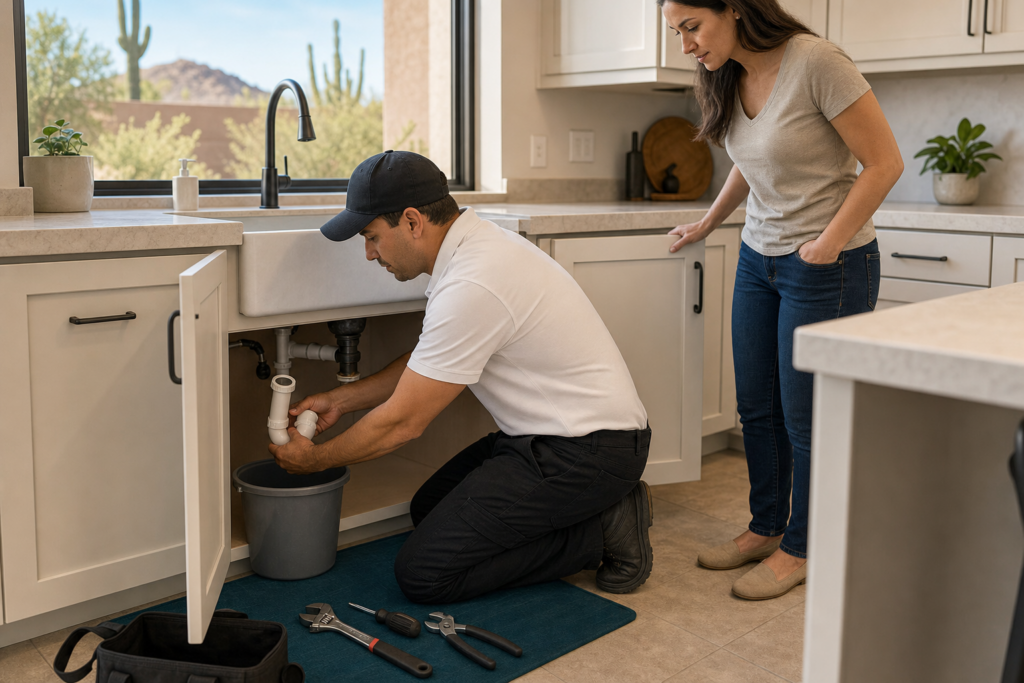
Kitchen Drain Clogged in Phoenix? How to Find Affordable Drain Cleaning Help and What to Try First
Most kitchen drain clogs in Phoenix start the same way — water pools in the sink a little longer than usual, then one day it stops draining altogether. The good news is that many kitchen clogs are located right under the sink in a section of pipe called the P-trap, and some can be cleared with basic tools you already have at home. For clogs that need professional help, kitchen drain cleaning in the Phoenix area typically falls within a range that depends on where the blockage is, how severe it is, and what equipment is needed to clear it.
This guide covers what actually causes kitchen drain clogs in Phoenix homes, what you can safely try on your own, what professional drain cleaning involves, and how to find a service that gives you honest answers and fair pricing — without the surprises.
Why Kitchen Drains Clog More Often in Phoenix Homes
The Most Common Culprits
Kitchen drain clogs rarely happen because of one thing. They build up over time. The three most common causes in Phoenix kitchens are:
- Grease and cooking oil. Grease goes down liquid and solidifies as it cools inside the drain line. In Phoenix, high summer temperatures can make grease seem like it is flowing freely, but it still collects and hardens further down the pipe where temperatures are cooler.
- Food debris. Rice, pasta, coffee grounds, eggshells, and fibrous vegetables like celery are common offenders. These materials do not break down easily and tend to catch on grease buildup already inside the line.
- Hard water mineral buildup. Phoenix has some of the hardest water in the country. Over months and years, dissolved minerals like calcium and magnesium leave a chalky scale inside drain pipes. This scale narrows the inside diameter of the pipe, which means even small amounts of grease or food can create a blockage more quickly.
In older Phoenix homes — especially those built from the 1950s through the early 2000s — the original drain pipes may be galvanized steel or cast iron. These materials corrode and roughen on the inside over time, which gives grease and scale more surface area to grab onto. If your home has older pipes, kitchen clogs may happen more frequently than they would in a home with newer PVC lines.
Does Your Garbage Disposal Connect to This Drain?
If your kitchen sink has a garbage disposal, the disposal discharge connects directly into your drain line. A disposal that is not grinding food finely enough, or one that is being used without enough running water, can push partially broken-down food into the drain where it collects and blocks flow. If the disposal itself sounds like it is running but water is not draining, the clog may be just past the disposal outlet — not inside the disposal unit.
Before assuming you need a new disposal, it is worth checking whether the drain line downstream is the actual problem. A licensed plumber can evaluate this quickly during a service visit.
Is This a Kitchen Drain Clog or Something Bigger?
A clog that only affects one kitchen sink is usually isolated to the drain line directly below that sink. But if you notice slow draining in other fixtures at the same time — a bathroom sink, a shower, or a floor drain — the problem may be further down in the main sewer line rather than in the kitchen branch line. The distinction matters because the cause, the equipment needed, and the cost are all different.
A single slow kitchen drain usually points to a localized blockage. Multiple slow drains happening at once could indicate a main line issue that needs a different approach.
What to Try Before Calling Anyone
Not every kitchen clog requires a service call. Some can be cleared safely at home with basic tools. Here is what is reasonable to try and where each option stops being effective.
Check the P-Trap First
The P-trap is the U-shaped section of pipe directly underneath your kitchen sink. It holds a small amount of water at all times to block sewer gases from coming back up through the drain. It is also where most kitchen clogs live, because the curved shape catches grease, food particles, and debris before they travel further into the line.
To check the P-trap:
- Place a bucket or a large bowl directly under the P-trap to catch water.
- Loosen the slip nuts on both ends of the curved section by hand or with a pair of pliers. Turn them counterclockwise.
- Carefully remove the P-trap and empty its contents into the bucket.
- Look inside the trap and the short pipe sections on either side for buildup or blockage. Clear out anything you find.
- Reassemble the P-trap, hand-tighten the slip nuts, and run water to check for leaks.
This takes about ten minutes and requires no special tools. If the P-trap was packed with grease or food debris, clearing it may restore full drainage. If the P-trap is clean and the drain is still slow, the blockage is further down the line and a different approach is needed.
Use a Sink Plunger
A flat-bottomed cup plunger works for kitchen sinks. This is not the same as a toilet plunger, which has a flange designed to seal around a toilet drain. A cup plunger creates a flat seal over a sink drain opening.
Fill the sink with a few inches of water, place the plunger over the drain, and push and pull with firm, even pressure. The goal is to use water pressure to dislodge the clog, not to force air through the line. If you have a double-basin sink, block the second drain opening with a wet cloth to maintain pressure.
Plunging works best on soft blockages like food buildup. It is less effective on hardened grease or mineral scale.
Baking Soda and Hot Water Flush
Pour about half a cup of baking soda into the drain, followed by half a cup of white vinegar. Let it sit for fifteen to twenty minutes, then flush with hot — not boiling — water from the tap. This combination can help loosen light grease buildup and freshen the drain.
Be honest about what this does and does not accomplish. A baking soda flush works well as a maintenance step or for very mild slowdowns. It is unlikely to clear a fully blocked drain or break through compacted grease and food debris. If the water is standing and not moving at all, a baking soda flush is not going to solve the problem.
When to Stop and Call a Licensed Plumber
Stop trying DIY solutions and call a professional if any of these apply:
- You have cleared the P-trap, tried plunging, and the drain is still blocked.
- Water is backing up into the sink from another fixture.
- The clog returns within a day or two of being cleared.
- You hear gurgling sounds from other drains when the kitchen sink is running.
- There is standing water and a noticeable odor coming from the drain.
- You are not comfortable working under the sink or removing the P-trap.
At this point, continuing to force the issue with household methods can push debris further into the line or — in the case of chemical products — potentially damage the pipes. A licensed plumber has the tools and training to locate the blockage accurately and clear it without creating a secondary problem.
A Word About Chemical Drain Cleaners
Something worth knowing before you reach for a chemical drain cleaner: Most liquid drain cleaners use caustic or oxidizing chemicals that generate heat inside the pipe to dissolve organic material. In older homes with galvanized steel, cast iron, or aging PVC connections, repeated use of chemical cleaners can weaken joints, corrode pipe walls, and accelerate the need for pipe repair. If there is standing water in the sink, pouring a chemical cleaner on top of it creates a pool of hazardous liquid that you or a plumber will eventually need to deal with. Chemical cleaners can also damage garbage disposal components and are not safe to use if you have a septic system. They may offer a temporary improvement on minor buildup, but they are not a reliable solution for a fully blocked kitchen drain.
What Does Professional Kitchen Drain Cleaning Cost in Phoenix?
A Realistic Price Range
According to publicly available data from home service platforms, professional drain cleaning in the Phoenix metro area generally falls in a range from roughly $100 to $300, with the average landing somewhere around $175 to $200. That range is wide because the actual cost depends on several factors specific to your situation.
These figures reflect general market data and are not a quote from any specific company. The price you are quoted may be higher or lower depending on what the technician finds during the visit.
What Drives the Price Up or Down
- Location of the clog. A blockage in the P-trap or the first few feet of drain line is typically faster and simpler to clear than a clog further down the branch line or near the main sewer connection.
- Type of equipment needed. A basic drain snake may be all that is required for a straightforward clog. If the blockage involves heavy grease or mineral scale deeper in the line, hydro jetting — which uses high-pressure water to scour the inside of the pipe — may be recommended. Hydro jetting typically costs more than standard snaking.
- Garbage disposal involvement. If the clog involves the disposal or the short line between the disposal and the drain, additional diagnostic time may be needed.
- Access difficulty. Cleanout access points that are easy to reach keep the process straightforward. If the technician needs to work through tight spaces or access the line from an alternate point, it may take longer.
- Time of service. Emergency or after-hours calls may carry additional charges depending on the company.
Flat-Rate Pricing vs. Hourly Pricing
Flat-rate pricing means the company quotes a single price for the job before work begins. You know the cost upfront, and it does not change based on how long the work takes. Hourly pricing means you are charged based on time, which can make the final bill unpredictable — especially if the clog turns out to be more involved than expected.
When you are comparing options, ask whether the quoted price is flat-rate or hourly, and whether the service call fee or dispatch fee is included in the price or added separately. This is one of the simplest ways to avoid surprises on the bill.
How to Find an Affordable Drain Cleaner in Phoenix Without Getting Burned
What “Affordable” Actually Means
Affordable does not always mean the lowest advertised number. Some companies advertise very low promotional prices for drain cleaning, but those prices may not include the full scope of the work, or they may come with conditions — a specific type of clog, a maximum distance from the cleanout, or a minimum additional service purchase. The price you see in an ad is not always the price you pay when the work is done.
A genuinely affordable drain cleaning service is one where the price you are quoted is the price you pay, the diagnosis is honest, and the work actually resolves the problem. Paying a fair price for a job done right the first time is more affordable in the long run than paying a low price for a job that does not hold.
Questions to Ask Before Anyone Starts Work
Before you agree to service, ask these questions. The answers will tell you a lot about whether the company operates with transparency:
- Is the price flat-rate, and does it include the service call fee?
- What happens if the clog is more complicated than expected — will the price change, and will you be notified before additional work begins?
- What equipment will be used, and why?
- Is the technician licensed and insured?
- Will the technician explain what they find before recommending next steps?
- Is there a warranty or guarantee on the work? If so, what does it cover and for how long?
A company that answers these questions clearly and without hesitation is a company that operates on transparency. A company that gets vague or evasive is telling you something worth paying attention to.
Where to Research Local Options
Google reviews, Yelp, Angi, and Thumbtack are all useful starting points for finding licensed drain cleaning companies in Phoenix. When reading reviews, look for patterns rather than individual comments. Consistent mentions of on-time arrival, clear communication, fair pricing, and honest diagnosis are stronger signals than a single five-star review with no detail.
Pay attention to how the company responds to negative reviews as well. A company that responds calmly, takes responsibility, and offers to make things right is showing you how they handle problems — which is what matters most when something goes wrong.
Licensing and Insurance
In Arizona, plumbing work requires proper licensing. A licensed plumber has met state requirements for training and competence. Insurance protects you if something goes wrong during the work — a pipe is damaged, a fitting leaks, or there is water damage to your property. Asking about licensing and insurance is not rude. It is a basic step in protecting your home, and any reputable company will answer without hesitation.
Warning Signs That the Problem Is More Than a Kitchen Clog
Sometimes what looks like a simple kitchen clog is actually a symptom of a bigger issue in the drain or sewer system. If any of the following are happening, the problem may not be limited to the kitchen line:
- Multiple drains are slow at the same time. If the kitchen sink, a bathroom sink, and a shower are all draining slowly, the blockage is likely in the main sewer line rather than in any individual branch.
- Gurgling sounds from other fixtures. When water draining from the kitchen causes gurgling in a bathroom sink or toilet, it usually means air is being displaced in the main line — a sign of a downstream blockage.
- Water backing up into another fixture. If running the kitchen sink causes water to appear in a floor drain or bathtub, the main line cannot handle the flow.
- The clog keeps coming back. A kitchen clog that returns within days of being cleared may indicate a deeper issue — root intrusion, a collapsed section of pipe, or heavy scale buildup that a single cleaning cannot resolve.
These situations typically require a camera inspection to see inside the line and identify the cause before recommending the right repair. A technician can evaluate whether the issue is a localized clog or something more involved.
What to Expect When You Call Fast Layne Plumbing
Fast Layne Plumbing is a family-owned plumbing company serving Phoenix, AZ. When you call about a kitchen drain clog, here is what the process looks like:
- Someone answers the phone. You talk to a real person, not a phone tree. You describe the issue, and we schedule a visit that works for your day.
- A licensed technician arrives and evaluates the drain. Before any work starts, the technician explains what they are seeing and what they recommend — in plain English, not industry jargon.
- You get upfront pricing before the work begins. You know the cost before anyone picks up a tool. If the situation turns out to be different than expected, you are told before any additional work happens.
- The work is done with care and respect for your home. We clean up after ourselves. We do not leave a mess in your kitchen.
- No unnecessary upsells. If a simple drain cleaning is all you need, that is all we recommend. If something more involved is going on, we explain why so you can make an informed decision.
We understand that many Phoenix homeowners have had frustrating experiences with plumbing service — a technician who did not show up, a quote that felt too high, or a recommendation that did not seem necessary. Fast Layne Plumbing was built around doing things differently. We find the real problem, explain it clearly, and let you decide how to move forward.
Frequently Asked Questions
How much does it cost to unclog a kitchen drain in Phoenix?
Based on publicly available market data, professional kitchen drain cleaning in the Phoenix area generally ranges from about $100 to $300. The actual cost depends on the clog’s location, severity, and what equipment is needed to clear it. Ask for a flat-rate quote before work begins so you know the full cost upfront.
Should I use chemical drain cleaner on a kitchen clog?
Chemical drain cleaners can offer temporary relief for minor buildup, but they are not effective on fully blocked drains and can damage older pipes with repeated use. They also create a safety hazard if there is standing water in the sink. For a stubborn or recurring kitchen clog, a professional evaluation is a safer and more reliable option.
How do I know if my garbage disposal is part of the problem?
If the disposal runs but water does not drain, the clog is likely in the drain line just past the disposal outlet rather than inside the disposal itself. If the disposal is not turning on at all, the issue may be electrical or mechanical. A technician can evaluate both the disposal and the connected drain line during a single visit.
What questions should I ask a plumber before they start work?
Ask whether the pricing is flat-rate, whether the service call fee is included, what happens if the scope of work changes, whether the technician is licensed and insured, and whether the company will explain their findings before recommending next steps. Clear answers to these questions are a strong sign of a transparent operation.
How do I tell if my kitchen clog is actually a main line problem?
If only the kitchen sink is draining slowly, the clog is most likely in the kitchen branch line. When several fixtures throughout the home — including sinks, showers, tubs, or floor drains — are all draining poorly or backing up around the same time, that pattern points toward a blockage in the main sewer line rather than any single branch. Gurgling sounds coming from other fixtures while the kitchen drains are another reliable indicator of a main line issue.
Does Phoenix hard water make kitchen drains clog faster?
Yes. Phoenix has notably hard water, which means dissolved minerals gradually build up inside drain pipes as scale. This scale narrows the pipe’s interior over time, making it easier for grease and food debris to create a blockage. Homes with older galvanized or cast iron pipes tend to be more affected because the rougher interior surface holds onto mineral deposits more readily.
The Right Next Step
If you have tried the basics — checking the P-trap, using a plunger, running a baking soda flush — and the kitchen drain is still not clearing, or if the clog keeps coming back, the next step is a professional evaluation. A licensed plumber can identify where the blockage is, what is causing it, and what it will take to clear it properly.
Fast Layne Plumbing serves homeowners across Phoenix, AZ with honest diagnosis, upfront pricing, and plain-English explanations. No pressure, no unnecessary upsells, and no surprises on the bill.
Call Fast Layne Plumbing at 480.485.4659 to schedule service.