Multiple Drains Backing Up at Once in Your Phoenix Home — What It Means and What to Do Right Now
When more than one drain in your home backs up at the same time, the problem is almost certainly not in the individual fixtures. It is in the main sewer line — the single underground pipe that carries all wastewater from your home to the city sewer system. A blockage or damage in that line affects every drain connected to it, which is why your kitchen sink, shower, and toilets can all slow down or back up within the same window of time.
This guide is written for Phoenix homeowners who are dealing with this right now or recently noticed the signs. Below, you will find a clear explanation of what is happening, what steps to take before a plumber arrives, what to avoid doing, why Phoenix homes are particularly susceptible, and what a licensed plumber actually does to resolve it.
Why Multiple Drains Backing Up Is Different From a Single Slow Drain
Your home’s plumbing works like a tree. Individual drains — the kitchen sink, the bathroom sink, the shower, each toilet — are branches. They all feed into one main trunk: the main sewer line. That main line runs underground from your home to the city sewer connection, typically beneath your yard or driveway.
When a single drain is slow, the clog is usually in that fixture’s branch line. A hair clog in the shower or food buildup in the kitchen sink affects only that one drain. The rest of the house works fine.
When two or more drains back up at the same time, the blockage is almost always farther downstream — in the main sewer line itself. Because every fixture shares that line, a blockage there restricts flow for the entire house.
How to Tell the Difference
| Single Drain Clog | Main Sewer Line Problem |
|---|---|
| Only one fixture drains slowly or backs up | Two or more fixtures back up around the same time |
| Other drains in the house work normally | Using one fixture causes backup in another |
| Problem is usually near the fixture itself | Lowest drains in the home are affected first |
| Often fixable with basic drain clearing | Requires professional diagnosis and main line service |
One of the clearest signs of a main line issue: flushing a toilet or running the washing machine causes water to come up through a floor drain, a shower drain, or another fixture on a lower level. That backflow happens because water has nowhere to go except back toward the lowest open point in the system.
What to Do Right Now — Step by Step
If you are experiencing multiple drains backing up at the same time, these are the steps worth taking before a plumber arrives. None of these involve attempting a repair — they are about protecting your home and giving the plumber useful information.
Step 1 — Stop Using Water Throughout the House
This is the single most important thing you can do. When the main sewer line is blocked, every gallon of water you send down any drain has nowhere to go. It will back up through the lowest open fixture in the house — often a floor drain, a ground-floor shower, or a first-floor toilet.
Stop running faucets. Do not flush toilets. Do not start the dishwasher or washing machine. Let everyone in the household know not to use water until the situation is assessed.
Step 2 — Check Which Fixtures Are Affected
Walk through the house and note which drains are slow, which are fully backed up, and which seem unaffected. Pay special attention to drains on the lowest level of the home — these are closest to the main sewer line and are typically the first to show symptoms.
This information helps a plumber understand the scope of the problem before arriving.
Step 3 — Look and Listen for These Warning Signs
- Gurgling sounds from drains or toilets, especially when another fixture is in use
- Sewage odor coming from drains, especially floor drains or basement drains
- Toilet water bubbling when the washing machine drains or when a nearby sink runs
- Water appearing in unexpected places — for example, water rising in the bathtub when you flush a toilet
These signs can indicate a main sewer line blockage. The more of them you notice, the more likely the issue is in the main line rather than in a single branch.
Step 4 — Locate Your Sewer Cleanout If You Can
The sewer cleanout is an access point to your main sewer line. On most Phoenix properties, it is a capped white or black pipe — usually three to four inches in diameter — sticking up a few inches above ground level near the foundation of the house, often along a side yard or near the front of the property. Some homes have more than one.
If you can find it, look at it from a safe distance. If sewage or water is standing around or overflowing from the cleanout cap, that is a strong signal that the main sewer line is blocked downstream of that point.
Do not attempt to open the cleanout yourself. If the line is pressurized or full, removing the cap can release sewage unexpectedly. Leave this for the plumber — they will use it as a primary access point for inspection and clearing.
Step 5 — Call a Licensed Plumber
When multiple drains are affected, this is not a situation where a store-bought tool or a home remedy is likely to resolve the problem. The blockage is deep in the system, and diagnosing the cause — whether it is buildup, root intrusion, a collapsed section, or something else — requires professional equipment and training.
When you call, it helps to tell the plumber:
- Which drains are affected and on which levels of the home
- When the problem started
- Whether you have noticed gurgling, odors, or backflow
- Whether you know where the sewer cleanout is located
- Whether this has happened before
This gives the technician a head start on understanding what they are walking into.
What Not to Do
There are a few common reactions that can make the situation worse or create new problems. Avoiding these protects both your home and the plumber who will be working on the line.
Do Not Pour Chemical Drain Cleaners Into the Drains
Chemical drain cleaners — the kind sold at hardware stores — are designed for minor clogs in individual branch lines close to the fixture. They are not effective against blockages in the main sewer line, which may be dozens of feet from the nearest drain opening.
When the line is blocked, the chemical sits in the pipe without reaching the clog. It can damage older pipe materials, and it creates a hazard for the plumber who will need to work in that line shortly after. A technician running a camera or a hydro jetter through a pipe full of caustic chemical is a genuine safety concern.
Do Not Keep Plunging Multiple Fixtures
Plunging a single clogged toilet can sometimes help. Plunging multiple fixtures when the main line is blocked does not clear the blockage — it just forces water from one fixture into another, potentially causing overflow in a different part of the house.
Do Not Assume It Resolved Itself
Sometimes a main line blockage will partially clear on its own. The drains seem to start working again, the water level drops, and the problem appears to be over. In many cases, the blockage has only shifted — the line is still partially obstructed, and the issue is likely to return, often at a worse time.
If your home experienced multiple simultaneous drain backups and the problem seemed to clear up without professional service, it is still worth having the line inspected. A partial blockage that goes unaddressed can lead to a full blockage later.
Why Phoenix Homes Face This Problem
Multiple-drain backups happen in every city, but certain conditions in the Phoenix area make main sewer line problems more common. Understanding these factors can help you make sense of what is happening in your home.
Desert Soil Movement
Phoenix sits on soil that expands and contracts with moisture changes — particularly during and after monsoon season. That ground movement can gradually shift the position of underground sewer pipes. Over years, a pipe can develop low spots, called bellies, where debris and sediment collect. A bellied pipe does not drain properly and becomes a recurring clog point.
Tree Root Intrusion
Even in desert-adapted landscaping, tree roots seek moisture aggressively. Sewer lines that have been in the ground for decades — particularly clay or cast iron pipes found in Phoenix homes constructed between the 1950s and 1980s — tend to develop hairline fractures and weakened joints as they age. Roots find those openings, grow into the pipe, and gradually restrict or block flow. Root intrusion is one of the most common causes of main sewer line problems in established Phoenix neighborhoods.
Aging Pipe Infrastructure
Many Phoenix homes in well-established areas still have their original sewer lines. Clay pipes can crack and shift. Cast iron pipes deteriorate along their interior walls over time. Orangeburg pipes — a tar-paper-based material used in some mid-century construction — can collapse entirely. If your home was built before the 1990s and the sewer line has never been replaced, the pipe material itself may be part of the problem.
Grease Accumulation in Warm Climates
Grease poured down a kitchen sink may flow easily at first because it is warm. In cooler underground pipes, it solidifies and coats the pipe walls. Over time, this coating narrows the pipe’s interior diameter and traps other debris. In Phoenix, where kitchen activity is year-round and cooking oils are common, grease accumulation is a frequent contributor to main line blockages.
Hard Water and Scale Buildup
Phoenix has notably hard water — high in dissolved minerals like calcium and magnesium. Over years, these minerals can deposit inside drain and sewer pipes as scale. That mineral buildup progressively narrows the usable diameter of the pipe and creates an uneven interior surface where debris tends to snag and collect. This is a slow process, but in older homes with original pipes, it can be a meaningful factor.
What a Licensed Plumber Will Do
Knowing what to expect from the service visit can make the process less stressful. Here is what typically happens when a plumber responds to a multiple-drain backup.
Sewer Camera Inspection
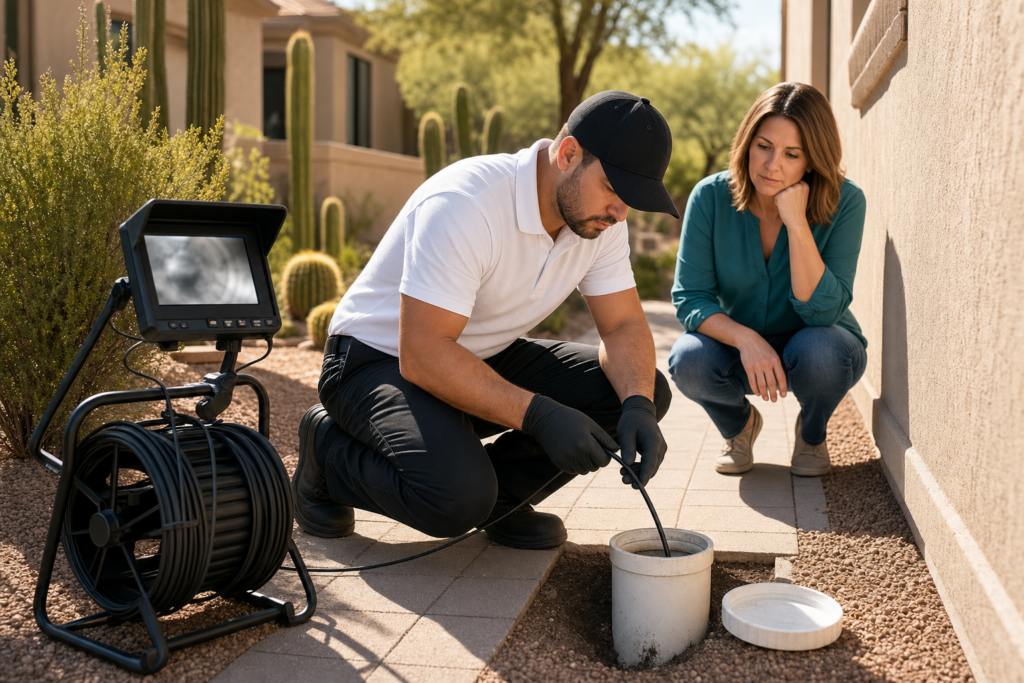
A sewer camera inspection involves threading a small, waterproof camera on a flexible cable into the main sewer line — usually through the cleanout access point. The camera transmits a real-time video feed to a screen so the technician can observe the interior of the pipe directly.
The camera can pinpoint the location of a blockage, identify what type of obstruction is present — whether grease, roots, debris, or a combination — and reveal the overall condition of the pipe. It shows whether the pipe has cracks, root penetration, collapsed sections, bellied areas, or scale buildup. This step matters because it determines what the right solution is — and it prevents the plumber from guessing or recommending work that may not actually be needed.
At Fast Layne Plumbing, the camera inspection is how we find the real problem. We show you what the camera shows us and explain what it means in plain English before recommending any next step.
Hydro Jetting
Hydro jetting uses high-pressure water — delivered through a specialized nozzle and hose — to clear blockages and clean the interior walls of the sewer line. It is effective against grease, scale, soft root masses, and accumulated debris. Hydro jetting does not just punch through a clog — it cleans the full diameter of the pipe, which helps restore proper flow and reduces the likelihood of a quick recurrence.
Hydro jetting is not always the right tool. If the camera inspection reveals structural damage — a cracked pipe, a collapsed section, or severe root infiltration — jetting alone may not resolve the issue, and a repair or replacement may be the appropriate path.
Motorized Drain Snake or Sewer Auger
A motorized drain snake (also called a sewer auger) is a rotating cable that can break apart or retrieve solid blockages. It is often used as a first-pass clearing tool or when the blockage is dense enough that hydro jetting needs a path to be effective. In some situations, a mechanical snake is all that is needed.
When the Camera Reveals Structural Damage
If the camera inspection shows that the pipe itself is damaged — not just blocked — the plumber will explain what the damage looks like, where it is, and what repair options may apply. Depending on the type and location of the damage, options could include traditional sewer repair, trenchless methods like pipe lining or pipe bursting, or in some cases, a section replacement.
A good plumber explains all of this before any work begins, with upfront pricing and no pressure to decide on the spot. That is how we approach it at Fast Layne Plumbing — the camera tells the story, we explain it clearly, and you decide how to move forward.
If Sewage Has Already Entered Your Home
If sewage has backed up into your home through a drain, toilet, or other fixture, take these precautions calmly:
- Keep people and pets away from the affected area
- Avoid using electrical outlets or appliances near standing water or sewage
- Do not attempt to clean up sewage with a standard household vacuum — sewage is a health concern and requires proper handling
- Open windows in the affected area if it is safe to do so, to improve ventilation
- Porous materials that have been in direct contact with sewage — carpet, padding, cardboard — may need to be discarded
- Hard surfaces can typically be disinfected after the backup is resolved
The priority is to stop adding water to the system, keep everyone safe, and get a licensed plumber on site to address the blockage. Once the line is cleared, you can begin cleanup with appropriate precautions.
Whose Responsibility Is It — Yours or the City’s?
This is a question many Phoenix homeowners have, and it is worth a quick explanation. Generally speaking, the sewer line extending from your house out to the municipal connection point — which is usually near the street or within a utility easement — falls under the homeowner’s responsibility. The city typically maintains the sewer main that runs beneath the street itself.
If a plumber’s camera inspection shows that the blockage or damage is on your side of the connection, it is your responsibility. If the problem appears to be in the city main, your plumber can help you understand the next step, which may involve contacting the city’s water services department.
A licensed plumber can help clarify this during the inspection. It is not something you need to figure out on your own.
Frequently Asked Questions
Why are all my drains backing up at the same time?
When multiple drains back up simultaneously, it typically means the blockage is in the main sewer line — the shared pipe that all your home’s drains connect to. A blockage there affects every fixture in the house, which is why you see the problem in more than one location at once.
Is this a plumbing emergency?
Multiple drains backing up at once is a situation that warrants prompt attention. It may not require a middle-of-the-night call in every case, but it should not be left unaddressed for days. If sewage is actively entering your home, calling a plumber as soon as possible is the right move.
Can I use Drano or Liquid-Plumr if multiple drains are clogged?
Chemical drain cleaners are not effective against main sewer line blockages. The chemical cannot reach a clog that is far downstream, and it can damage pipes and create a safety hazard for the plumber who will need to work in the line. It is best to avoid chemical cleaners in this situation.
What is a sewer cleanout and where do I find it?
A sewer cleanout is a capped pipe — usually white or black PVC, about three to four inches in diameter — that provides access to the main sewer line. On most Phoenix properties, it is located near the foundation of the home, often along a side yard or near the front. Some homes have more than one. The plumber will use this access point for camera inspection and line clearing.
What causes main sewer line clogs in Phoenix?
Common causes in the Phoenix area include tree root intrusion, grease accumulation, hard water scale buildup, aging pipe materials (clay, cast iron, or Orangeburg), and ground shifting from desert soil movement. Many of these factors develop gradually over years before causing a noticeable blockage.
How do I know if I have a clog versus a broken sewer pipe?
You generally cannot tell from inside the house. A clog and a collapsed pipe can produce similar symptoms — slow drains, backups, gurgling, and odors. A sewer camera inspection is the standard way to distinguish between a soft blockage that can be cleared and structural damage that may require repair or replacement.
What will the plumber do when they arrive?
A thorough plumber will start with a sewer camera inspection to see the condition of the line and identify the blockage. Based on what the camera shows, they may use hydro jetting, a motorized drain snake, or recommend a repair if the pipe is damaged. At Fast Layne Plumbing, we walk you through the camera findings and explain your options with upfront pricing before any work begins.
Can tree roots really cause all my drains to back up?
Yes. Tree roots are one of the most common causes of main sewer line blockages in Phoenix, especially in established neighborhoods with mature landscaping. Roots enter through small cracks or joints in older pipe materials and grow inside the line, gradually restricting or fully blocking flow.
When to Call Fast Layne Plumbing
If your Phoenix home has multiple drains backing up at the same time, a licensed plumber should evaluate the main sewer line. Waiting for the problem to resolve itself often means waiting for it to get worse.
At Fast Layne Plumbing, we are a family-owned Phoenix plumbing company built around honest diagnosis, clear communication, and upfront pricing. We answer the phone, show up when we say we will, and explain what we find in plain English. We use sewer camera inspections to find the real problem — not just treat the symptom — and we walk you through every option before any work begins. No pressure, no unnecessary upsells, and no surprises on the bill.
If you are dealing with multiple backed-up drains and want a plumber who will be straight with you, call Fast Layne Plumbing at 480.485.4659 to schedule service.