How Long Does It Take a Plumber to Clear a Laundry Drain Clog in Phoenix?
Most laundry drain clogs take a licensed plumber somewhere between 30 minutes and two hours to resolve, counting from arrival through final testing. Where your job lands within that window depends on where the blockage sits in the line, what caused it, and whether the problem is isolated to your laundry drain or tied to something further into your plumbing system. This article walks through each phase of the service call, covers the factors that compress or extend the timeline, and helps you understand what your situation might look like before the plumber shows up.
What a Plumber Actually Does During a Laundry Drain Service Call
Understanding what happens during the appointment helps you plan your day and makes sense of why the job takes the time it does. A laundry drain call is not a single task — it moves through three distinct phases, each serving a specific purpose.
Phase One: Diagnosing the Clog — About 10 to 15 Minutes
Before any clearing begins, a thorough plumber needs to understand what is actually happening. That means inspecting the laundry standpipe — the vertical pipe your washing machine drain hose empties into — and examining the surrounding area for signs of backup, overflow, or standing water. The technician will also ask a few questions: when the issue first appeared, whether other drains in the home are affected, and whether you have noticed any unusual sounds or odors.
This step is important because a laundry drain problem does not always mean the blockage is in the laundry line itself. If other fixtures are also draining poorly, the issue may be located further down the system. A few minutes of careful evaluation helps prevent the wrong approach and saves time in the long run.
Phase Two: Clearing the Blockage — About 15 Minutes to One Hour
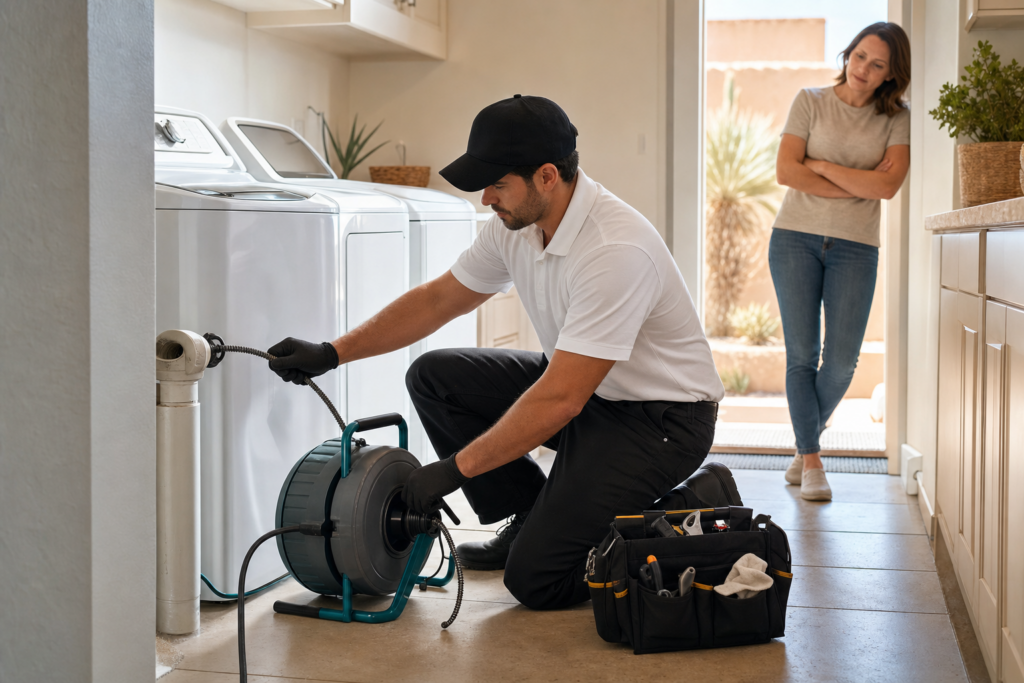
Once the plumber has a clear picture of what they are working with, the actual clearing begins. For typical laundry drain blockages, this means using a motorized drain auger — a coiled metal cable that is fed into the pipe to break apart or dislodge the obstruction. The cable is advanced through the clog and then retracted along with the debris.
If the blockage is further down the line or more densely packed — think heavy lint combined with soap residue — the plumber may need to run the auger through more than once or move to a heavier-gauge cable. When buildup is coating the pipe walls rather than forming a single plug, hydro jetting may be the better option. That process uses pressurized water to scrub the pipe interior and remove accumulation that mechanical snaking alone cannot fully address.
This is the phase where most of the time variability occurs. A soft lint blockage near the P-trap may clear in under 15 minutes. A hardened soap-and-mineral deposit sitting deep in the branch line can take considerably more effort.
Phase Three: Testing and Confirming — About 10 to 15 Minutes
Once the blockage has been cleared, the plumber runs water through the drain to verify that flow has been restored. They check drainage speed, listen for any lingering gurgling, and observe the standpipe to confirm water is moving freely without backing up. If anything suggests an underlying problem — a pipe section that appears damaged, a recurring issue, or a partial blockage that was not completely resolved — a camera inspection may be recommended to see inside the line directly.
This closing step protects you from facing the same problem again in a matter of days. It is also the point where a careful plumber can give you a straightforward explanation of what was found and whether any follow-up work is warranted.
Simple Laundry Clog vs. Something More Involved: How to Tell the Difference
Not every laundry drain problem is a routine clog. Knowing which situation you are likely dealing with helps you set realistic expectations for the service call and communicate more clearly when you speak with your plumber.
Signs You Likely Have a Local Laundry Drain Clog
- Water backs up into the standpipe or spills onto the floor only when the washing machine runs its drain cycle
- The utility sink beside the washer drains slowly or makes gurgling sounds during a wash cycle
- Other drains in the home — kitchen, bathroom, showers — are functioning normally
- The problem developed gradually over the course of weeks or months
A localized clog — one sitting in the branch drain that serves your laundry area — is the most common scenario. These are typically caused by lint, soap residue, or small items that got past the washer. Most local laundry clogs fall toward the shorter end of the 30-minute to two-hour range.
Signs the Problem May Be Deeper in the System
- Multiple fixtures are draining slowly or backing up simultaneously
- Toilets gurgle or bubble when the washing machine drains
- Water shows up at a floor drain when the washer runs
- A sewer odor is present throughout the home, not just near the laundry area
When more than one drain is affected, the blockage may be in the main sewer line — the larger pipe that moves all household wastewater out to the municipal system. A main line problem is a fundamentally different job. It generally takes longer, requires different equipment, and may point to something beyond a simple clog, such as root intrusion or a compromised pipe section. A licensed plumber can assess the situation and explain exactly what is going on before any work begins.
What Makes a Laundry Drain Job Take Longer
The 30-minute to two-hour window is accurate, but it is a range for good reason. Here are the specific factors that push a job toward the longer end.
| Factor | What It Means for the Timeline |
|---|---|
| Clog location | A blockage near the standpipe or P-trap clears more quickly than one deep in the branch drain or close to the main line connection. The further down the line the problem sits, the more cable or equipment the plumber needs to use. |
| Clog cause | Light lint clears quickly. Compacted lint bound with soap and mineral deposits takes more effort. Foreign objects — a sock, a coin, a small toy — may require additional time to locate and remove. |
| Pipe accessibility | When the washer is tucked into a narrow closet, a cramped utility space, or pushed flush against a wall, the plumber may need extra time to safely reach the drain opening. |
| Pipe age and condition | Older Phoenix homes — particularly those built between the 1950s and 1980s — may have narrower drain lines or pipes with significant interior buildup that slows the clearing process. |
| Camera inspection | When the plumber suspects pipe damage, a recurring issue, or a partial blockage that snaking did not fully resolve, a camera inspection adds roughly 15 to 30 minutes. This is a diagnostic measure, not an unnecessary add-on, when it is genuinely called for. |
| Main line involvement | If the laundry clog turns out to be a sign of a main sewer line blockage, the nature of the job changes. The plumber will walk you through what was found and discuss your options before moving forward. |
Why Laundry Drains Clog in the First Place
Laundry drain clogs behave differently from kitchen or bathroom clogs. Understanding what causes them helps you catch warning signs earlier and gives you useful context when you call for service.
- Lint accumulation: Every wash cycle sends a significant amount of lint down the drain. Even with a lint filter on the machine, fine fibers pass through and collect inside the pipe over time, eventually forming a dense mat that restricts water flow.
- Soap and detergent residue: Detergent that does not dissolve fully can coat the inside of the drain pipe, narrowing the passage and giving lint something to cling to as it moves through.
- Hard water mineral buildup: Phoenix has hard water. The calcium and magnesium present in the local water supply can bond with soap residue to form a chalky, stubborn coating on the interior of drain pipes. This narrows the pipe over time and makes lint clogs both more likely and harder to clear.
- Grease and oil from clothing: Work clothes, shop rags, and kitchen towels laundered at home can carry grease into the laundry drain. That grease adheres to pipe walls and speeds up clog development.
- Foreign objects: Coins, hair ties, buttons, small toys, and socks that slip out during the wash cycle can lodge in the drain or P-trap and cause an immediate blockage.
In many Phoenix homes, it is rarely just one factor at work — it is several of them together. Hard water speeds up soap accumulation, which catches more lint, which traps small objects. That compounding effect explains why a laundry drain that has performed reliably for years can suddenly stop draining altogether.
How to Help Your Plumber Get the Job Done Faster
A few straightforward steps on your end can have a meaningful impact on how efficiently the appointment goes.
- Clear access to the washer and drain. Move boxes, laundry baskets, or any stored items away from the washing machine before the plumber arrives. The technician needs enough room to work and direct access to the standpipe or drain opening.
- Know your symptoms. Before you call, take a moment to observe: does the problem occur only when the washer drains, or are other fixtures involved? Is it a slow drain or a complete backup? When did it start? Having this information ready helps the plumber zero in on the issue more quickly.
- Mention anything you have already tried. If you used a plunger, poured something down the drain, or attempted any other fix, tell the plumber. It saves time and gives them a clearer picture of the drain’s current condition.
- Know where your cleanout access is, if you have one. Some Phoenix homes have a cleanout point near the laundry area or on an exterior wall. If you know where yours is, point it out when the plumber arrives. If you are not sure, that is fine — the technician will find the best access point.
- Keep pets and small children away from the work area. A simple heads-up about household logistics lets the plumber focus and work safely.
None of these steps are required, and an experienced plumber will adapt to whatever they find. But taking them can trim time off the visit and help everything go more smoothly.
Frequently Asked Questions
How do I know if my laundry drain is clogged?
The clearest sign is water rising into the standpipe or spilling onto the floor while the washing machine is draining. You might also notice water pooling in a nearby utility sink, a gurgling noise from the drain during or after a wash cycle, or an error code on your washing machine related to drainage. A drain that has been getting progressively slower over several weeks is another common indicator. If you are uncertain, a licensed plumber can take a look and tell you what is going on.
Can I unclog a laundry drain myself?
Visible lint sitting at the very top of the standpipe can sometimes be pulled out by hand. Past that point, most laundry drain blockages are located deep enough in the line that a household plunger or a basic retail snake will not reliably reach them. Liquid drain cleaners are not a good fit for laundry drains — they can deteriorate pipe material with repeated use, particularly in older homes, and they frequently leave the underlying blockage intact. When a clog is causing overflow, recurring slow drainage, or backup in more than one fixture, a licensed plumber is the more dependable and safer option.
What if the plumber finds a bigger problem during the service call?
Sometimes what appears to be a straightforward laundry clog turns out to be a sign of something deeper — a damaged pipe section, root intrusion, or a partial main line blockage. A trustworthy plumber will explain exactly what they found, walk you through any camera inspection footage if one was performed, and present your options clearly before any additional work begins. At Fast Layne Plumbing, we provide upfront pricing and plain-English explanations so you can make a confident decision without pressure.
How often should laundry drains be cleaned?
There is no single schedule that applies to every home. How quickly buildup develops in your laundry drain depends on how many loads you run each week, the type of detergent you use, how hard your water is, and the age and condition of your pipes. If your drain has slowed down more than once over the past year, talking to a plumber about periodic preventive cleaning may be worthwhile. A plumber can look at your drain and give you a straightforward recommendation based on what they find.
Does hard water in Phoenix make laundry drain clogs worse?
It can. The water in Phoenix carries elevated levels of dissolved minerals that can combine with soap residue to form a scale-like deposit along the inside of drain pipes. That buildup narrows the usable diameter of the pipe and creates a rougher interior surface that catches lint and debris more readily. Over time, this can mean laundry drains in Phoenix homes develop clogs more often than the same drains would in areas with softer water. Using the recommended detergent amount — not more — and periodically flushing the drain with hot water can help slow the process, though it will not stop it entirely.
When to Call a Plumber for a Laundry Drain Clog
If your washing machine is backing up, draining slowly, or overflowing onto the laundry room floor, waiting tends to make the situation worse as lint and residue continue to compact inside the pipe. A professional service call for a laundry drain clog is typically a same-day appointment — not an all-day commitment. Most homeowners are back to running laundry within a couple of hours.
Fast Layne Plumbing is a family-owned plumbing company serving Phoenix, AZ. We arrive when we say we will, explain what we find in plain English, and provide upfront pricing before any work starts. No surprise charges, no pressure, and no unnecessary add-ons. If your laundry drain needs attention, we are ready to help.
Call Fast Layne Plumbing at 480.485.4659 to schedule service.