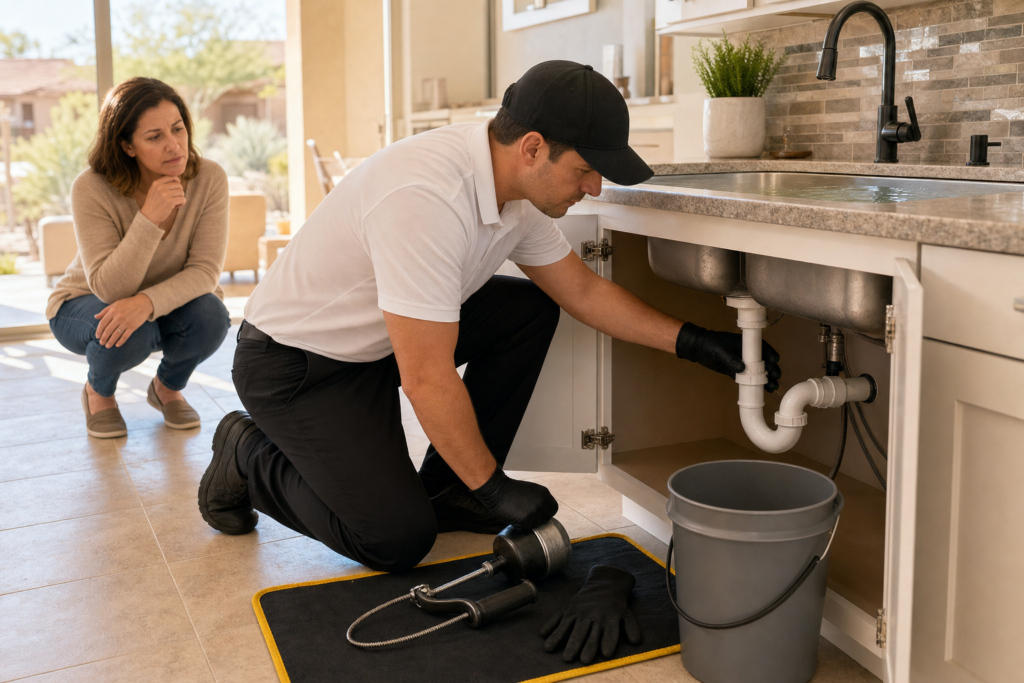
Why Your Kitchen Sink Is Still Draining Slowly After Chemical Cleaners
Chemical drain cleaners rarely clear a kitchen sink clog completely. What usually happens is the liquid burns a narrow channel through the middle of the blockage, restoring just enough flow to make you think it worked — until the water starts pooling again a few days later. Kitchen sink clogs are built from layers of hardened grease, food residue, and soap buildup that coat the inside walls of the pipe, and chemical products are not designed to scrub those layers away.
If you have already poured a chemical cleaner down your kitchen drain and the sink is still slow, you are not doing anything wrong. The product simply is not the right tool for what is happening inside your pipes. This article explains why, walks you through what you can safely try next, and helps you recognize when it is time to call a licensed plumber in Phoenix.
How Chemical Drain Cleaners Actually Work — And Where They Fall Short
Most liquid drain cleaners use a strong alkaline or acidic formula to generate heat and dissolve organic material. When poured into standing water, the product sinks toward the clog and begins reacting with whatever it contacts first.
Here is the problem: in a kitchen drain, the clog is usually not a single solid object sitting in the pipe. It is a thick, greasy coating that has built up along the pipe walls over weeks or months. The chemical flows through the center of the pipe, melts a small opening through the densest part of the blockage, and drains away — leaving the majority of the buildup still stuck to the walls. That narrow channel lets water pass slowly, but it closes back up as new grease and food particles accumulate.
This is why your sink may seem to improve for a day or two, then go right back to draining slowly. The cleaner treated a symptom without addressing the real problem.
Why Kitchen Sink Clogs Are Especially Resistant to Chemical Cleaners
Not every drain clog is the same. Kitchen sinks face a specific set of conditions that make chemical cleaners less effective than they might be in other parts of the house.
Grease, Fats, and Oils
Cooking grease is the primary cause of persistent kitchen sink clogs in Phoenix homes. When warm grease goes down the drain, it cools inside the pipe and solidifies along the walls — similar to how bacon fat hardens in a pan left on the counter. Over time, layers of grease build up and narrow the pipe opening. Chemical cleaners can soften the surface of this buildup, but they do not dissolve the deeper layers clinging to the pipe walls.
Dense Food Debris
Starchy foods like pasta, rice, and potato peels expand when they absorb water and can form dense, paste-like blockages. Coffee grounds settle into pipe joints and pack together. Fibrous scraps like celery strings and onion skins tangle and resist chemical breakdown. These materials do not respond well to liquid drain cleaners because they are not the types of organic matter the product is formulated to dissolve.
Standing Water Dilutes the Product
If your sink already has standing water when you pour in the cleaner, the chemical is diluted before it ever reaches the clog. The product loses concentration as it mixes with the water sitting in the basin and the pipe, which reduces its ability to react with the blockage. This is among the most frequently overlooked reasons a chemical cleaner produces no visible result whatsoever.
The Clog May Be Sitting in the P-Trap or Positioned Farther Along the Line
The P-trap is the curved pipe section located directly under your sink. Its job is to retain a small water reservoir at all times, which prevents sewer gases from traveling up into your living space. That same curve tends to collect grease, food particles, and debris, making it one of the most frequent locations where kitchen drain blockages develop. Chemical cleaners have limited contact time with material lodged in that bend, and they cannot reach obstructions that have formed deeper in the drain line.
Hard Water Mineral Buildup — A Phoenix Factor
Phoenix has notably hard water, which means the water supply carries a higher concentration of dissolved minerals like calcium and magnesium. Over time, these minerals deposit a rough, chalky scale on the inside of drain pipes. That scale gives grease and food particles something to grip onto, accelerating buildup and making clogs denser and harder to clear. Chemical cleaners are not formulated to dissolve mineral scale, so in Phoenix homes, a slow kitchen drain often involves a combination of grease and mineral deposits that no store-bought product can fully address.
Before You Try Anything Else — A Safety Note
If you have already used a chemical drain cleaner and the water is still sitting in the sink, take a moment before doing anything else. Residual chemicals in the water can pose a real hazard if handled improperly.
- Do not use a plunger immediately after using a chemical cleaner. Plunging can splash caustic water onto your skin, eyes, or clothing.
- Do not pour a second chemical product into the drain. Mixing different drain cleaners — especially bleach-based and ammonia-based products, or acid-based and lye-based formulas — can produce toxic fumes or violent chemical reactions.
- Wear rubber gloves and eye protection if you plan to work near the drain opening or handle any standing water.
- If the sink is full of standing water with chemical cleaner in it, do not reach into the water. Let it sit, ventilate the area, and consider whether calling a plumber is the safer choice.
- If you do call a plumber, let them know that a chemical product was used. This is important so the technician can take proper precautions before opening the P-trap or using mechanical equipment.
What to Try Next — In Logical Order
If the chemical cleaner did not fully clear your kitchen drain and you want to try a few things before calling a plumber, here is a practical sequence. Start simple and stop if you are uncomfortable with any step.
Step 1: Hot Water Flush
Once any chemical residue has had time to drain or dissipate, try running hot tap water through the drain for several minutes. Hot water can soften grease enough to move some of the buildup farther down the line. If your home has PVC drain pipes — which are common in Phoenix homes built from the 1970s onward — stick with hot tap water rather than boiling water, as extreme heat can soften PVC joints over time. Older metal pipes can generally handle hotter water.
A hot water flush is not a fix for a significant clog. It can help with minor grease softening and is a reasonable first step.
Step 2: Clean the P-Trap
The P-trap is the U-shaped pipe beneath your kitchen sink. It is designed to be removable for cleaning. Place a bucket or pan underneath to catch water, loosen the slip nuts on both ends of the curved section by hand or with pliers, and carefully remove the trap. You will likely find a buildup of grease, food particles, and debris inside.
Rinse the P-trap thoroughly, reassemble it, and test the drain. If the sink drains normally now, the clog was in the trap — and no further work is needed. If the drain is still slow, the blockage is deeper in the line.
Note: If you used a chemical cleaner recently and the P-trap still contains that water, wear gloves and eye protection during this step. If you are not comfortable disassembling the trap, this is a good time to call a plumber.
Step 3: Use a Drain Snake or Hand Auger
A drain snake — also called a hand auger — is a flexible metal cable that you feed into the drain to physically break up or pull out a clog. This is where the real difference between chemical and mechanical methods becomes clear. A chemical product tries to dissolve the blockage with a reaction. A drain snake physically contacts the obstruction and either breaks it apart or hooks it so you can pull it out.
For kitchen sink clogs caused by grease and food buildup, mechanical action is almost always more effective than chemical action. Inexpensive hand augers are available at most hardware stores and can reach several feet into the drain line.
If the snake does not clear the clog, or if you feel significant resistance that does not give way, the blockage may be farther down the line or more substantial than a basic tool can handle. That is a clear signal that professional equipment is the right next step.
Step 4: Consider an Enzyme-Based Cleaner for Ongoing Maintenance
Enzyme-based drain cleaners work differently than chemical drain cleaners. Instead of using caustic chemicals to burn through a clog, they use biological enzymes that slowly break down organic matter over time. These products are not effective at clearing an active blockage, but they can help maintain a drain that has already been cleared — reducing the rate at which grease and food residue build back up.
Think of enzyme cleaners as a maintenance step, not a repair tool. They are gentler on pipes than chemical alternatives and can be used periodically without the same risk of pipe damage.
When to Stop and Call a Licensed Plumber
DIY methods work well for surface-level clogs in the P-trap or the first few feet of the drain line. But some situations require professional equipment, diagnostic tools, and the experience to identify what is actually happening inside the pipe.
Consider calling a plumber if any of these apply:
- More than one drain in your home is slow at the same time — this may indicate a main sewer line issue rather than a single kitchen clog.
- Water backs up into another fixture when you run the kitchen sink.
- You hear gurgling sounds from other drains when the kitchen sink is draining.
- There is a sewage odor coming from the drain or elsewhere in the house.
- You have cleared the P-trap and used a snake, and the drain is still slow.
- The clog keeps returning within a few weeks of clearing it.
- A chemical cleaner is still sitting in the pipe and you are unsure how to proceed safely.
A licensed plumber can use professional-grade tools — including motorized drain snakes, camera inspections, and hydro jetting — to locate the blockage, determine what is causing it, and clear it in a way that a store-bought product or basic hand tool cannot. Camera inspections are especially useful because they show the actual condition of the pipe, which helps determine whether the problem is a simple buildup or something more involved like root intrusion, a damaged section, or heavy mineral scale.
Why Repeated Chemical Cleaner Use Can Make Things Worse
It is tempting to try a second or third bottle when the first one did not fully work. But repeated chemical cleaner use carries real risks, especially for the pipes themselves.
Caustic drain cleaners generate significant heat during their chemical reaction. In older metal pipes, this can accelerate corrosion. In PVC pipes, repeated exposure to high-heat chemical reactions can weaken joints and pipe walls over time. If the product sits in a pipe without fully draining — which is exactly what happens when it does not clear the clog — the concentrated chemical continues reacting against the pipe material rather than the blockage.
Chemical cleaners also do not address the underlying cause. If grease buildup, food debris, or mineral scale is the issue, the clog will return regardless of how many times a chemical product is poured in. Professional cleaning addresses the buildup itself, not just the narrowest point of the blockage.
Frequently Asked Questions
Can I use a plunger right after using drain cleaner?
It is best to wait. Plunging a drain that still contains caustic chemical cleaner can splash the product onto your skin, eyes, or nearby surfaces. If you need to plunge, flush the drain with plain water first and wear protective gloves and eye protection.
Why does my kitchen sink drain slowly but never seem fully clogged?
This usually means there is a partial blockage — most commonly a layer of grease coating the inside of the pipe that narrows the opening without completely closing it. Water still gets through, but not at full speed. This type of buildup tends to worsen gradually and may eventually lead to a full blockage if not addressed.
What is the difference between a drain snake and a drain auger?
In everyday use, the terms are interchangeable. Both refer to a flexible cable tool that is fed into a drain to physically break up or retrieve a clog. Professional plumbers often use motorized versions that can reach farther and apply more force than the hand-operated models sold at hardware stores.
Is baking soda and vinegar effective for kitchen sink clogs?
Baking soda and vinegar produce a mild fizzing reaction that can help with light odor and minor residue, but they do not generate enough force or chemical action to clear a meaningful grease or food clog. If a chemical drain cleaner did not work, baking soda and vinegar are unlikely to make a noticeable difference.
How do I know if my slow drain is a P-trap problem or a deeper issue?
If you clean the P-trap and the drain returns to normal speed, the problem was in the trap. If the drain is still slow after cleaning the trap, the blockage is farther down the line — and that typically requires a longer snake or professional equipment to reach and clear.
Does Phoenix hard water make kitchen sink clogs worse?
It can. Phoenix’s hard water leaves mineral scale deposits inside pipes over time. That rough, chalky buildup gives grease and food particles something to adhere to, which means clogs can form faster and become denser than they would in areas with softer water. This is one reason kitchen drains in Phoenix homes — especially older homes — may need professional cleaning more frequently than homeowners expect.
When You Are Ready for an Honest Answer About Your Drain
A slow kitchen sink is frustrating, especially when the product you bought to fix it did not deliver. If you have tried the steps above and the drain is still not flowing the way it should, the smartest next move is having a licensed plumber take a look.
At Fast Layne Plumbing, we approach every drain call the same way: show up when we say we will, look at the actual problem, explain what we find in plain English, and give you upfront pricing before any work begins. We are not going to recommend hydro jetting or a major repair if a simple drain cleaning is all your sink needs. And if the inspection shows something more involved, we will walk you through exactly what is going on and what your options are — no pressure, no surprises on the bill.
We are a family-owned plumbing company serving Phoenix, AZ, and we treat every home the way we would want our own home treated. If your kitchen sink is still giving you trouble, give us a call.
Call Fast Layne Plumbing: 480.485.4659