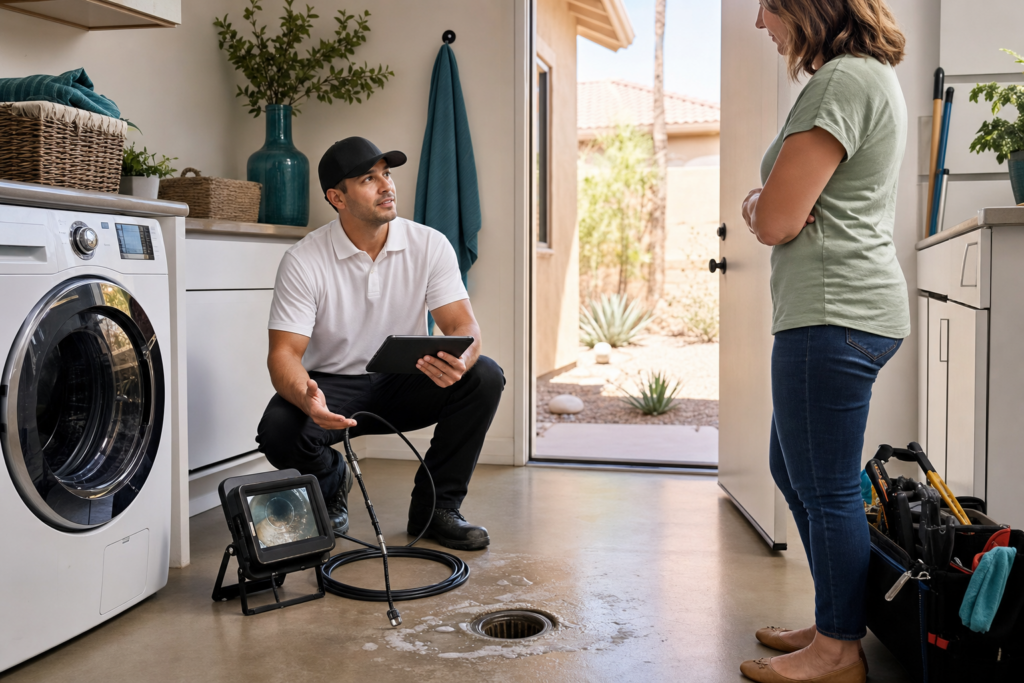
Recurring Laundry Room Floor Drain Backup? Here Is What Fast Layne Plumbing Does Differently
Yes — Fast Layne Plumbing diagnoses and addresses recurring laundry room floor drain backups for homeowners throughout Phoenix, AZ. If your laundry room floor drain has backed up more than once, that pattern matters. A one-time clog and a recurring backup are two different problems, and they call for two different approaches. Fast Layne Plumbing focuses on finding the actual cause of the recurrence — not just clearing the line temporarily — so you understand what is happening in your drain system and what it takes to address it properly.
This article explains why laundry room floor drains back up repeatedly, what a licensed plumber looks for during diagnosis, how the repair process works, and what Phoenix homeowners should know before scheduling service.
Why a Recurring Backup Is Not the Same as a One-Time Clog
A single clog usually means something got stuck. A wad of lint, a sock that slipped past the drain cover, a buildup of soap residue that finally closed the line. A plumber or homeowner clears it, water flows again, and the problem is over.
A recurring backup is different. When the same drain backs up again weeks or months after it was cleared, the blockage is usually a symptom rather than the whole problem. Something deeper in the line is causing material to accumulate again, or the line itself may have a condition that prevents proper flow even after cleaning.
What Recurrence Tells a Plumber
When a technician hears that a laundry room floor drain has backed up multiple times, it changes the diagnostic approach. Instead of simply running a snake through the line, a qualified plumber considers questions like:
- Is the backup happening only when the washing machine drains, or does it also occur at other times?
- How quickly does the backup return after the line is cleared?
- Are other drains in the house slow, gurgling, or producing odors?
- What is the age and material of the drain line serving the laundry room?
These details help narrow down whether the issue is isolated to the laundry room branch line or connected to a larger problem in the main sewer line. That distinction is important because the right repair depends entirely on what the inspection reveals.
Common Causes of Recurring Laundry Room Floor Drain Backups in Phoenix Homes
Not every recurring backup has the same cause. Below are the most common reasons a laundry room floor drain backs up again and again, explained in enough detail that you can understand why each one produces a pattern rather than a single event.
Lint and Detergent Buildup in the Branch Drain Line
Washing machines discharge a significant amount of lint, soap residue, and fabric softener with every cycle. Over time, this material coats the interior walls of the branch drain line — the pipe that carries water from the laundry area to the main sewer. Unlike a sudden blockage, this buildup narrows the pipe gradually. Snaking the line clears a path through the center, but the coating along the pipe walls remains. Within weeks or months, the narrowing returns and the backup follows.
This is one of the most common causes of recurring laundry drain problems, and it is one reason why a standard drain snake may not be enough to resolve the issue long-term.
A Partial Blockage Deeper in the Line
Sometimes the real restriction is not near the floor drain at all. A partial blockage further down the branch line or even in the main sewer can cause water to back up through the lowest accessible opening — which is often the laundry room floor drain. A snake may push through the partial blockage temporarily, but if the obstruction is caused by root intrusion, a collapsed section, or heavy scale buildup, it reforms after the snake is removed.
This is a common scenario in older Phoenix homes, especially those built in the 1950s through the 1980s, where cast iron or clay drain lines may have deteriorated over decades of use and exposure to the region’s hard water and soil conditions.
Pipe Damage, Bellies, or Improper Slope
Drain pipes rely on gravity. When a section of pipe settles, cracks, or forms a low point — sometimes referred to as a belly — water and debris pool in that area rather than continuing toward the main sewer. Clearing the line removes the accumulated debris, but the low point itself stays in place, and material begins collecting there again.
In Phoenix, where many homes are built on slab foundations, shifts in the underlying soil can affect pipe alignment over time. A camera inspection is often the only way to identify this type of problem, because the pipe looks clear after snaking even though the structural issue remains.
Washing Machine Discharge Overwhelming the Drain
Modern washing machines drain quickly — often faster than the branch drain line was originally designed to handle, particularly in older homes. When the washer empties a full load in a short burst, the drain line may not be able to move that volume of water fast enough. The excess water backs up through the floor drain until the line catches up.
If the backup happens primarily during or immediately after the wash cycle’s drain phase, this volume mismatch could be a contributing factor. A licensed plumber can evaluate whether the drain line size and slope are adequate for the washing machine’s discharge rate.
Main Sewer Line Involvement
In some cases, what looks like a laundry room problem is actually a main sewer line issue. If the main sewer is partially blocked — by roots, buildup, or a damaged section — water backs up through whichever drain sits lowest in the system. In many Phoenix slab-foundation homes, the laundry room floor drain is one of the lowest points, which makes it the first place a main sewer problem shows up.
A useful indicator: if other drains in the house are also slow, gurgling, or producing odors, the problem may extend beyond the laundry room. A plumber can determine whether the issue is in the branch line or the main sewer during an inspection.
How Fast Layne Plumbing Diagnoses and Addresses Recurring Backups
Fast Layne Plumbing does not assume every floor drain backup needs the same fix. The approach starts with understanding your specific situation — when the backup happens, how long it has been recurring, and what has already been tried — before recommending any service.
Starting With a Thorough Assessment
When a Fast Layne technician arrives, the first step is asking questions and observing the drain system, not immediately running equipment. Understanding the pattern of the backup helps determine where to focus and what tools are most appropriate. This is where plain-English communication matters — you should understand what the technician is looking for and why, before any work begins.
Mechanical Drain Cleaning and Snaking
A motorized drain snake is often the first step in clearing a backed-up line. The snake breaks through the immediate blockage and restores flow. For a recurring backup, snaking also provides diagnostic information: how far the snake travels before hitting resistance, what comes back on the cable, and whether the line drains freely after clearing all give the technician clues about the underlying cause.
If the line has been snaked before and the problem returned quickly, that history tells the technician that snaking alone may not be enough — and that further evaluation is warranted.
Hydro Jetting for Stubborn or Recurring Buildup
Hydro jetting uses high-pressure water to scour the interior walls of a drain pipe, removing the accumulated coating of lint, grease, scale, and soap residue that a snake leaves behind. Where a snake clears a path through the center of a blockage, hydro jetting cleans the full diameter of the pipe.
For recurring laundry drain backups caused by gradual buildup, hydro jetting can address the accumulation that keeps narrowing the line. It is not appropriate in every situation — a technician evaluates whether the pipe condition and material can handle the pressure safely before recommending it — but when the situation calls for it, hydro jetting addresses a type of buildup that snaking alone cannot.
Camera Inspection When the Cause Is Not Clear
A sewer camera is a small, waterproof camera fed through the drain line to show the technician exactly what is happening inside the pipe. It reveals conditions that are invisible from the outside: cracks, root intrusion, pipe bellies, scale buildup, separated joints, and partial collapses.
For a recurring backup, camera inspection is often the step that finally answers the question of why the problem keeps coming back. If the line has been snaked or jetted before and the backup returns, the camera shows whether there is a structural problem that cleaning cannot fix.
Fast Layne Plumbing uses camera inspection as a diagnostic tool — not as an automatic upsell. If snaking resolves the problem and the evidence suggests the line is in good condition, there may be no need for a camera. But if the recurrence pattern points to something deeper, the camera provides the information needed to make an honest recommendation.
Evaluating Branch Line Versus Main Sewer Issues
One of the most important diagnostic questions for a recurring laundry drain backup is whether the problem is in the branch line serving the laundry room or in the main sewer line that serves the entire house. The answer determines the scope and type of repair.
A qualified technician evaluates this by checking other fixtures, observing drain behavior during and after the washer drain cycle, and using camera inspection when needed. Fast Layne Plumbing explains what the inspection reveals and what options are available — in plain English, with upfront pricing — so you can make an informed decision without feeling pressured.
What to Observe Before You Call
When you contact a plumber about a recurring floor drain backup, the details you provide help the technician prepare and diagnose more efficiently. Before you call, take a moment to note:
- When does the backup happen? Only when the washing machine drains? When you run the kitchen sink? When any fixture in the house is used? Or seemingly at random?
- How long has the problem been recurring? Weeks, months, or years?
- Has the drain been snaked or cleaned before? If so, how quickly did the backup return?
- Are other drains affected? Slow drains, gurgling sounds, or odors from other fixtures in the house can indicate a main line issue rather than a branch line problem.
- What does the backup look like? Clean water, soapy water, or darker water with sediment or odor? This helps narrow down where the backup is originating.
These observations are genuinely useful. They give the technician a head start and help ensure the diagnosis focuses on the right part of the system from the beginning.
When Basic Maintenance Is Enough and When It Is Not
What Homeowners Can Safely Do
Some basic maintenance can help reduce the frequency of laundry drain issues:
- Clean the washing machine’s lint trap regularly if your model has one
- Keep the floor drain cover free of lint, hair, and debris
- Run hot water through the laundry drain periodically to help dissolve soap residue near the drain opening
- Avoid pouring grease, paint, or other materials down the laundry room floor drain
These steps help with surface-level maintenance and may extend the time between professional cleanings.
When the Problem Requires a Licensed Plumber
If the backup returns despite basic maintenance, or if it is accompanied by slow drains elsewhere in the house, foul odors, or water appearing in unexpected places, the problem is likely beyond what surface-level maintenance can address. A recurring backup that keeps coming back after cleaning typically points to a condition inside the pipe that requires professional diagnosis — and potentially hydro jetting, camera inspection, or repair.
Attempting to resolve a recurring drain problem with store-bought chemical drain cleaners can make the situation worse. Chemical cleaners can damage older pipe materials and rarely address the actual cause of a recurrence. A licensed plumber with the right equipment can evaluate the line safely and accurately.
Why Phoenix Homeowners Choose Fast Layne Plumbing for Recurring Drain Problems
Fast Layne Plumbing is a family-owned plumbing company serving Phoenix, AZ. The approach is straightforward: answer the phone, show up when scheduled, find the real problem, explain it clearly, provide upfront pricing, and treat your home with respect.
For recurring drain backups specifically, that approach matters more than it might for a simple clog. When a drain keeps backing up, homeowners often feel frustrated by previous experiences — a plumber who snaked the line but the problem came back, a quote that felt too high for what seemed like a simple issue, or uncertainty about whether a recommended repair was truly necessary.
Fast Layne Plumbing addresses those concerns directly:
- Honest diagnosis: The technician explains what they find and why they are recommending a particular approach. If snaking is enough, that is what gets recommended. If the situation calls for hydro jetting or camera inspection, you will understand why before any work begins.
- Upfront pricing: You know the cost before work starts. No surprises on the bill.
- Plain-English communication: Every homeowner deserves to understand what is happening in their own home. Fast Layne technicians explain the problem and the options in language that makes sense.
- Respect for your home: The work area gets cleaned up. Your home is treated the way the technician would want their own home treated.
- Prompt service: When a drain backup is disrupting your laundry routine or affecting other parts of the house, waiting days for a plumber adds stress. Contact Fast Layne Plumbing to check availability and get the problem addressed as quickly as possible.
Frequently Asked Questions
Why does my laundry room floor drain back up every time I run the washing machine?
The most common reason is that the branch drain line connecting your laundry area to the main sewer has a partial blockage or buildup that restricts flow. When the washing machine empties quickly, the restricted line cannot handle the volume, and water backs up through the floor drain. A licensed plumber can evaluate the line to determine whether the issue is buildup, a partial obstruction, or a pipe condition that needs repair.
Is a recurring floor drain backup a sign of a main sewer line problem?
It can be. If the backup is accompanied by slow drains, gurgling, or odors from other fixtures in the house, the problem may involve the main sewer line rather than just the laundry branch line. A plumber can check other fixtures and, if needed, use a camera inspection to determine whether the main line is affected.
What is the difference between snaking a drain and hydro jetting?
A drain snake is a flexible cable that breaks through a blockage and restores flow. It clears a path but does not remove buildup along the pipe walls. Hydro jetting uses high-pressure water to scour the entire interior of the pipe, removing the accumulated material that causes recurring blockages. Snaking is often the first step; hydro jetting may be recommended when buildup is the cause of recurrence.
What does a camera inspection reveal that snaking cannot?
A camera inspection shows the interior condition of the pipe — cracks, root intrusion, settled sections, separated joints, and the extent of buildup. Snaking can clear a blockage without revealing what caused it. When a backup keeps recurring, the camera provides the visual evidence needed to understand whether the pipe itself has a condition that cleaning alone cannot resolve.
Can I fix a recurring floor drain backup myself?
Basic maintenance like cleaning the drain cover and lint trap can help, but a recurring backup typically involves a condition inside the pipe that requires professional equipment and diagnosis. Chemical drain cleaners are not recommended for recurring problems and can damage older pipes. A licensed plumber with a motorized snake, hydro jetting equipment, and a camera can diagnose and address the cause safely.
How do I know if the problem is in the branch line or the main sewer?
A useful indicator is whether other drains in the house are affected. If only the laundry room floor drain backs up and only during or after wash cycles, the issue may be in the branch line. If multiple fixtures are slow, gurgling, or producing odors, the main sewer line may be involved. A technician can evaluate this during an inspection and explain what they find.
Can a professional drain cleaning fix floor drain odors?
It depends on the cause. Odors from a floor drain can result from buildup inside the line, a dried-out drain trap, or a sewer gas leak from a damaged or improperly sealed pipe. Drain cleaning may resolve odors caused by buildup. If the odor persists after cleaning, further evaluation — potentially including a camera inspection — can help identify the source.
The Right Next Step
A recurring laundry room floor drain backup is not something you should have to keep dealing with. The pattern is telling you something about the condition of your drain line, and the right approach is an honest inspection by a licensed plumber who will explain what they find, recommend the appropriate repair, and give you upfront pricing before any work begins.
Fast Layne Plumbing serves homeowners throughout Phoenix, AZ. If your laundry room floor drain keeps backing up, call 480.485.4659 to schedule service. A local technician can evaluate the problem, explain the cause in plain English, and walk you through your options — so you can make an informed decision and get back to a home that works the way it should.