Why Your Drain Clogs Again Weeks After It Was Cleared
A drain snake opens a path through the blockage — but it does not clean the pipe. The buildup that caused the clog in the first place is still coating the inside of the pipe wall, and it starts collecting new debris the moment water flows through again. That is why the drain seemed fine right after clearing and then slowed down or stopped again a few weeks later. The clog did not come back. It never fully left.
If you are a Phoenix homeowner dealing with this exact pattern, this article explains what mechanical clearing actually does inside your pipe, the specific reasons the problem returns, and how to figure out whether you are dealing with a simple buildup issue or something deeper that needs a different approach.
What a Drain Snake Actually Does Inside Your Pipe
A drain snake — sometimes called a hand auger or drum auger — is a flexible metal cable that rotates through the drain line. When it hits a blockage, it either breaks through the mass, hooks onto it and pulls it out, or pushes it forward. Either way, the result is a passage through the obstruction. Water can flow again, and the drain seems clear.
But here is what the snake does not do: it does not scrub the pipe wall. It does not remove the layer of grease, mineral scale, soap film, or organic residue that has been building up on the interior surface of the pipe for months or years. That layer is still there, still sticky or rough, and still catching everything that flows past it.
Think of it like clearing a narrow path through a snowdrift versus shoveling the entire driveway. The path lets you walk through, but the snow on both sides is still there. One windy afternoon and the path fills back in. That is what happens inside a pipe after snaking. The passage is open, but the conditions that created the blockage have not changed.
Why the Clog Returns — The Most Common Reasons
When a cleared drain clogs again within a few weeks, the cause is almost always one of these. Each one works differently, returns on a different timeline, and calls for a different response.
Residual Buildup on the Pipe Wall
This is the most common reason a cleared drain re-clogs. Substances like grease, soap scum, hair, food debris, and dissolved minerals accumulate along the interior surface of drain pipes over time. The snake punches through the thickest part of the buildup, but the coating on the pipe wall remains intact. New material flowing through the drain sticks to that coating, and the blockage rebuilds.
The speed of re-clogging depends on how thick the wall coating is and how rough the pipe interior has become. A pipe with heavy buildup can re-clog in as little as a week. A pipe with lighter residue may hold for a month or two before the problem returns.
Phoenix-specific factor: Phoenix has some of the hardest municipal water in the country. Over time, dissolved minerals in hard water leave a chalky scale on the inside of drain pipes. This scale roughens the pipe wall surface and gives grease, hair, and soap something to grip. In many Phoenix homes, mineral scale is a significant contributor to recurring clogs — even if the homeowner is careful about what goes down the drain.
Biofilm — The Layer You Cannot See
Biofilm is a thin, slimy layer of bacteria that colonizes the interior of drain pipes. It forms naturally wherever organic matter and moisture are present, which means it exists in virtually every residential drain line to some degree.
What makes biofilm relevant to recurring clogs is that it acts as an adhesive surface. Debris such as hair, food particles, and soap residue that would otherwise pass through a smooth pipe gets caught by the biofilm layer and begins to accumulate. A drain snake does not remove biofilm — the cable passes through the center of the pipe, not along the walls. This is one reason some drains re-clog faster than others even when usage patterns are similar.
Addressing biofilm typically requires either enzymatic drain treatments or hydro-jetting, both of which reach the pipe wall surface in ways that mechanical snaking cannot.
Tree Root Regrowth
If roots have found their way into a sewer line through a cracked joint or pipe separation, snaking will cut through them and restore flow. But the snake does not seal the crack where the roots entered, and it does not kill the root system. The roots grow back — often branching more densely than before, because cutting stimulates new growth.
Root regrowth typically takes two to six weeks to cause a noticeable slowdown again, which matches the timeline many homeowners describe when they say the clog keeps returning month after month.
Phoenix-specific factor: Several tree species common in Phoenix landscapes — including oleander, ficus, and citrus — have aggressive root systems that seek out moisture. Sewer lines are a natural target, especially in older neighborhoods where clay or Orangeburg pipe was used and joints have loosened over decades of soil movement and temperature cycling.
Pipe Belly or Sag
A pipe belly is a low point in the drain line where the pipe has settled, shifted, or sagged. Gravity is supposed to keep water and waste moving downhill through the pipe, but a belly creates a spot where water pools and debris settles instead of flowing forward.
Snaking can push material through a belly temporarily, but the low point itself remains. Debris collects again in the same spot, and the drain slows down or blocks within weeks. This is a structural issue, not a buildup issue, and no amount of clearing will fix it permanently.
What you may notice: If the drain never seems to flow at full speed even immediately after clearing — if it is better but not completely normal — a pipe belly or sag could be the reason. A camera inspection can confirm whether the pipe has a low section that is holding water.
Corroded or Rough Pipe Interior
Older galvanized steel and cast iron drain pipes develop interior corrosion and scale over time. The inside of the pipe becomes rough, pitted, and uneven. This rough surface traps hair, grease, and debris far more aggressively than smooth PVC pipe does.
Snaking a corroded pipe clears the passage, but the rough interior immediately begins collecting new material. In severely corroded pipes, the effective inside diameter may already be reduced by scale buildup, which means even a small amount of new debris can restrict flow.
Phoenix-specific factor: Homes built in the Phoenix area before the mid-1970s may still have original galvanized steel or cast iron drain lines. If you are in an older neighborhood and dealing with recurring clogs in the same line, pipe condition is worth investigating.
A Blockage Farther Downstream
Sometimes the snake clears the most accessible blockage — the one closest to the fixture — but does not reach a second restriction deeper in the line. The drain improves because part of the obstruction is gone, but the deeper blockage continues to slow flow and allows new buildup to form between the two points.
This is especially common with main sewer line issues. A partial blockage in the main line can cause backups and slow drainage in multiple fixtures throughout the house, even after individual branch lines have been cleared.
What you may notice: If more than one drain in your home is slow — or if clearing one fixture causes gurgling, bubbling, or backup in another — the problem may not be in the individual drain at all. It could be in the main sewer line, which affects everything downstream.
How to Tell Which Cause Is Most Likely
You cannot diagnose a pipe problem from inside your house with certainty — that requires a professional inspection. But the pattern of symptoms can help narrow down what is going on and help you have a more productive conversation with a plumber.
- Clog returns within a few days: This usually points to heavy residual buildup on the pipe wall or a pipe belly where debris settles quickly. The snake opened a path, but the conditions for re-clogging are severe.
- Clog returns in two to four weeks: This timeline is common with root regrowth, moderate wall buildup, or a partial downstream restriction that was not fully reached.
- Multiple fixtures are slow or backing up: This suggests the problem is in the main sewer line, not in the individual fixture drain. Clearing one fixture will not solve it.
- Drain never fully returned to normal speed after clearing: This may indicate a pipe belly, sag, or significant reduction in pipe diameter from corrosion or scale.
- Problem is limited to one fixture and always the same one: This often points to localized buildup, a trap issue, or a problem in the branch line serving that fixture.
This is not a diagnosis — it is a starting point. A licensed plumber with the right equipment can evaluate what is actually happening inside the pipe and recommend the appropriate next step based on what they find.
What a Camera Inspection Reveals That Snaking Cannot
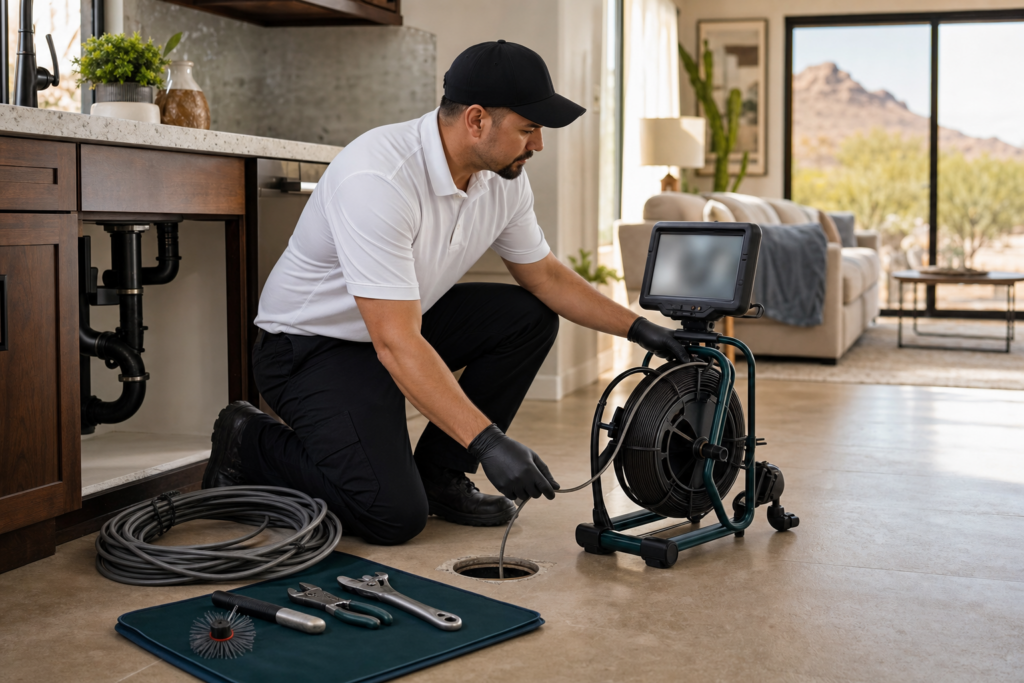
A sewer camera inspection uses a small, waterproof camera attached to a flexible cable. The camera is fed into the drain line and transmits a live video image of the pipe interior. A trained technician can see the condition of the pipe wall, the location and nature of any blockage, and structural issues that are invisible from outside.
What a camera inspection can show:
- The thickness and type of buildup on the pipe wall
- Root intrusion — where roots are entering and how dense the growth is
- Pipe belly or sag — visible as a section where water pools instead of flowing
- Cracks, breaks, or joint separations in the pipe
- Corrosion and scale on the interior surface
- A downstream restriction the snake did not reach
This matters because the right response to a recurring clog depends entirely on the cause. Snaking a pipe belly will not fix the sag. Snaking a root intrusion will not seal the crack. Snaking a corroded pipe will not smooth the interior. A camera inspection provides the information needed to match the service to the actual problem — instead of repeating the same clearing that did not hold the first time.
When Hydro-Jetting Makes Sense and When It Does Not
Hydro-jetting uses high-pressure water — typically delivered through a specialized nozzle — to scour the interior of a drain pipe. Unlike a snake, which passes through the center of the pipe, a hydro-jet cleans the pipe wall itself. It removes grease, mineral scale, biofilm, soap buildup, and soft root growth, and flushes the debris completely out of the line.
Hydro-jetting is often the appropriate next step when a drain has been snaked but keeps re-clogging, because it addresses what the snake leaves behind: the wall coating that causes the clog to rebuild.
However, hydro-jetting is not always the right choice. In older pipes with significant corrosion, cracks, or deterioration, the high-pressure water could potentially damage the pipe further. This is one reason many plumbers recommend a camera inspection before hydro-jetting — it confirms whether the pipe is in good enough condition to handle the pressure and shows the technician exactly what they are working with.
Hydro-jetting also does not fix structural issues. If the pipe has a belly, a collapsed section, or a break, jetting may temporarily improve flow but will not resolve the underlying problem. In those cases, pipe repair or replacement is typically the appropriate conversation to have.
What Fast Layne Plumbing Looks for When a Drain Keeps Coming Back
When a Phoenix homeowner calls Fast Layne Plumbing about a drain that has been cleared before but keeps re-clogging, we approach it as a diagnostic question — not just a clearing job. The goal is to understand why the clog is returning, not just push through it again.
That typically means asking a few questions about the history — when the drain was last cleared, which fixture is affected, whether other drains in the home are slow — and then evaluating the line with the appropriate tools. When the situation calls for it, a camera inspection helps identify whether the issue is buildup, root intrusion, pipe condition, or a downstream restriction.
We explain what we find in plain English, walk through the options, and provide upfront pricing before any work begins. If snaking is the right answer, we say so. If the situation calls for hydro-jetting, camera inspection, or a conversation about the pipe itself, we explain why and what that involves. We do not recommend services a homeowner does not need.
Fast Layne Plumbing is a family-owned company serving Phoenix, AZ. We answer the phone, show up when we say we will, and treat every home with respect.
Call Fast Layne Plumbing at 480.485.4659 to schedule service or talk with a local Phoenix plumber about a recurring drain problem.
Frequently Asked Questions
Why does my drain clog every few weeks?
A drain that clogs on a recurring cycle usually has an underlying condition that clearing alone does not resolve. The most common causes are heavy buildup on the pipe wall that rebuilds after each clearing, root intrusion that regrows after being cut, or a pipe belly where debris keeps settling in the same low spot. A camera inspection can help identify which cause is driving the cycle in your specific drain line.
What is the difference between snaking and hydro-jetting?
A drain snake is a rotating cable that breaks through or hooks onto a blockage and creates a passage for water to flow. It clears the clog but does not clean the pipe wall. Hydro-jetting directs high-pressure water along the full interior surface of the pipe, stripping away accumulated grease, mineral deposits, biofilm, and other residue. Snaking is often the right first step for a single clog. Hydro-jetting is often more appropriate when clogs keep returning because it addresses the wall buildup that causes recurrence.
Can a drain blockage clear itself?
Minor partial blockages can sometimes shift or break down enough for water to flow again, but this is not reliable and does not address the buildup that caused the restriction. A drain that seems to clear on its own and then slows again is likely dealing with a partial obstruction that shifts position rather than truly resolving. If a drain is repeatedly slow, it is worth having it evaluated rather than waiting for it to get worse.
When does a recurring clog mean there is a bigger plumbing problem?
A recurring clog may indicate a structural pipe issue when any of the following are present: the clog returns within days of clearing, multiple fixtures in the home are draining slowly, you notice gurgling or bubbling from other drains when using a fixture, or the drain never returns to full speed even immediately after clearing. These patterns can suggest pipe damage, a sag in the line, root intrusion, or a main sewer line restriction — all of which require more than routine clearing to address.
Why do plumbers recommend camera inspection after a recurring clog?
A camera inspection shows what is happening inside the pipe that is not visible from outside. It can reveal the cause of the recurrence — whether that is wall buildup, root growth, corrosion, a pipe belly, or a downstream blockage — and help the plumber recommend the service that actually matches the problem. Without a camera inspection, the plumber is working with limited information and may end up repeating a clearing that does not hold.
Does hard water in Phoenix affect drain clogs?
Yes. Phoenix has notably hard municipal water, which means dissolved minerals leave scale deposits on the inside of pipes over time. This mineral scale roughens the pipe wall, giving grease, hair, and soap residue a textured surface to cling to. In homes with hard water and older pipe materials, this scale buildup can be a meaningful contributor to recurring drain problems — even when the homeowner is careful about what goes down the drain.
The Real Takeaway
A drain clog that returns weeks after it was cleared is telling you something specific: the clearing addressed the symptom but not the cause. The pipe wall is still coated, the roots are still growing, the belly is still holding water, or the downstream restriction is still there. Understanding that distinction — between a drain that was opened and a pipe that was actually cleaned or repaired — is the key to breaking the cycle.
If you are dealing with a drain in your Phoenix home that keeps coming back no matter how many times it has been cleared, the right next step is an honest evaluation by a licensed plumber who will look at the full picture and explain what they find.
Call Fast Layne Plumbing at 480.485.4659 to schedule service.