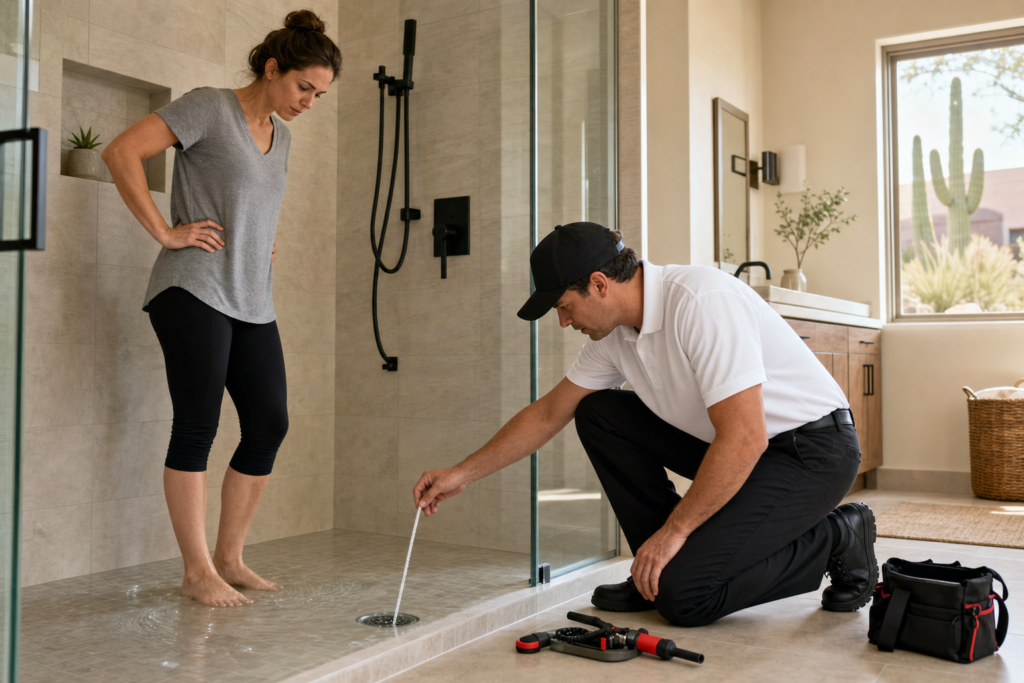
Why Your Shower Drain Works Fine at First, Then Slows Down Minutes Later
If your shower drains normally when you first turn the water on but starts pooling around your feet a minute or two later, you most likely have a partial clog somewhere in the drain line. The delay is not random. It is actually a useful clue about where the blockage may be sitting and how far it has developed.
This is one of the most common drain symptoms Phoenix homeowners describe, and it often causes confusion because the drain seems to work. It does — at first. But the pattern tells you something specific about what may be happening inside the pipe, and understanding it can help you decide whether this is a quick fix or something a licensed plumber should evaluate.
Why the Drain Works at First and Then Slows Down
A partial clog does not block the pipe completely. It narrows the opening, leaving enough space for water to pass through at a reduced rate. When you first start the shower, the flow of water reaching the drain is manageable — the pipe can still move water past the obstruction faster than it arrives.
After a minute or two, the math changes. Water accumulates in the pipe faster than it can squeeze past the narrowed section. The backup builds from the clog upward, and eventually the water has nowhere to go but up toward your feet.
Think of it like a garden hose with a partial kink. A trickle passes through without issue, but when you turn the faucet up, water pressure builds behind the kink and flow drops to almost nothing. That is essentially what may be happening inside your drain line during a shower.
This is different from a full clog, where water backs up immediately and does not drain at all. The delay can indicate the pipe is partially obstructed — not sealed. That distinction matters because it suggests the problem may still be developing, and it is generally easier to address earlier than after it progresses to a complete blockage.
What May Be Causing the Blockage
Hair and Soap Scum — A Common Cause
In many Phoenix showers, the cause is often a combination of hair and soap scum that has collected in the P-trap or the upper section of the drain line. The P-trap is the curved pipe section directly beneath your drain. Its shape is designed to hold a small amount of water to block sewer gas from entering the bathroom, but that curve also makes it a natural collection point for debris.
Hair tangles around the drain crossbars and inside the P-trap. Over time, soap residue, body oils, and conditioner coat the hair and the pipe walls, creating a sticky mass that narrows the opening. During a shower, water pressure can actually push hair tighter against the pipe walls, which means the clog may perform slightly worse while the water is running and slightly better after the shower stops and the water drains at its own pace.
This is why many homeowners notice that the standing water eventually drains after they turn the shower off. The reduced water volume can slowly work its way past the obstruction without new water constantly arriving behind it.
A licensed plumber can inspect the drain to confirm whether hair and soap scum are the cause and clear the line safely.
Hard Water Mineral Buildup — Especially Common in Phoenix
Phoenix has notably hard water. This means the water supply carries elevated levels of dissolved minerals — calcium and magnesium being the most prevalent. When this mineral-rich water combines with soap, it can produce soap scum — a chalky, sticky residue that clings to pipe walls and builds up over time.
On its own, mineral buildup rarely causes the sudden delay pattern you are noticing. But it is a compounding factor. Mineral deposits narrow the inside diameter of the pipe gradually, which means a hair clog that might be minor in a soft-water city can become a noticeable obstruction faster in a Phoenix home. If you live in an older home — especially one built between the 1950s and early 2000s — decades of mineral accumulation inside the pipes may make this problem more frequent.
A Blocked Plumbing Vent — Less Common but Worth Knowing About
Your plumbing system includes vent pipes, typically running up through the roof, that allow air into the drain system. These vents keep water flowing smoothly by preventing a vacuum from forming inside the pipes as water drains.
If a vent is partially blocked — by debris, a bird nest, or buildup — the drain system loses that air supply. The result can look and feel similar to a partial clog: the drain works fine at first, then slows as a vacuum effect builds and resists the flow of water. You may also hear a gurgling sound from the drain or from other nearby fixtures when this is happening.
Vent issues are less common than hair-and-soap clogs, but they are worth mentioning because the symptom can appear similar. A homeowner who has cleaned visible debris out of the drain and still experiences the same slow-then-stop pattern may be dealing with a vent issue rather than a drain clog — something a licensed plumber can evaluate with the right tools.
Pipe Slope Issues
In some homes, the drain pipe beneath the shower may not have enough slope to carry water away efficiently. This is typically an installation issue rather than a maintenance issue, and it is more common in older homes or additions where the plumbing may not have been laid to current standards.
Insufficient slope means the pipe relies more heavily on water volume and gravity to push flow through, and any partial obstruction — even a minor one — can have a bigger impact. If the delay pattern started shortly after the home was built or after a bathroom renovation, pipe slope could be a contributing factor a licensed plumber can evaluate.
What the Symptom Pattern May Tell You
The way your drain behaves during and after a shower can give you useful information about where the problem may be and how serious it has become. Here is a simple way to think through what you are observing:
- Only the shower drain is slow, and it clears after you turn the water off: This may point to a localized partial clog in the shower drain or P-trap. This is the most common scenario and often the simplest to address, though an inspection can confirm the cause.
- The shower slows down and you hear gurgling from a nearby sink or toilet: Gurgling in other fixtures while the shower runs can indicate a vent issue or a clog deeper in a shared drain line. This is worth having a plumber evaluate.
- Multiple drains in the home are slow: If the kitchen sink, bathroom sink, and shower are all draining slowly, the problem may involve the main sewer line rather than an individual fixture. A licensed plumber can use a camera inspection to assess the condition of the line.
- The water backs up and does not drain at all, even after the shower is off: This may suggest a full blockage rather than a partial one. If water is not moving, the clog may have progressed past the point where basic home maintenance will help.
None of these observations provide a definitive diagnosis on their own — the right next step is always an inspection by a licensed technician who can see what is happening inside the pipe. But paying attention to these patterns helps you communicate what you are experiencing when you call for service, which helps the technician prepare for the visit.
What You Can Reasonably Try at Home
For a straightforward partial clog caused by hair and soap buildup, there are a few steps you can take before calling a plumber:
- Remove the drain cover and check for visible hair. Many shower drain covers pop off or unscrew easily. You may find a visible clump of hair just below the surface. Pulling it out with your fingers or a pair of needle-nose pliers is often the simplest and most effective first step.
- Use a plastic drain-cleaning strip. These inexpensive plastic strips — sometimes called zip-it tools — slide a few inches into the drain and pull out hair and debris that you cannot see from above. They are available at most hardware stores in Phoenix and do not require tools or disassembly.
- Flush with hot water after clearing debris. Once you have removed visible hair, run hot water for a couple of minutes to help flush loosened residue down the line.
- Try a baking soda and vinegar flush for light soap scum. Pour about half a cup of baking soda into the drain, follow it with half a cup of white vinegar, wait 15 to 20 minutes, then flush with hot water. This can help with light soap scum buildup and is generally considered a low-risk approach, though if you are unsure about your pipe material or condition, a plumber can advise. It is not effective against dense hair clogs or mineral deposits.
A note about chemical drain cleaners: Most chemical drain cleaning products are not recommended for regular use. They can damage older pipes, they are rarely effective against hair clogs, and they can create safety hazards if a plumber needs to work on the drain afterward. If the basic steps above do not resolve the issue, a professional drain cleaning is a safer and more effective next step.
If you try these steps and the problem comes back within a few weeks, the clog is likely deeper than household tools can reach — and that is a normal point to call a plumber.
When to Call a Licensed Plumber
Not every slow shower drain needs a service call, but certain patterns suggest the problem may be beyond what basic home maintenance can handle. Consider calling a licensed plumber if:
- The slow drain keeps returning after you have cleared visible hair and debris
- You hear gurgling sounds from other fixtures when the shower is running
- More than one drain in the home is slow at the same time
- Water backs up into the shower or tub during normal use
- You notice a sewer smell coming from the drain
- The problem started suddenly and does not match your usual drain behavior
A plumber can use a motorized drain snake to reach clogs deeper in the line, or a camera inspection to see the condition of the pipe and identify where the blockage may be. This is especially useful in older Phoenix homes where mineral buildup, root intrusion, or aging pipes may be contributing to the problem.
How Fast Layne Plumbing Handles This in Phoenix Homes
At Fast Layne Plumbing, this is one of the drain symptoms we hear about most often from Phoenix homeowners. The delayed slowdown is a pattern we encounter regularly in this area — Phoenix’s hard water can accelerate the kind of buildup that contributes to partial clogs, and many of the homes we service were built in decades when drain pipe standards were different than they are today.
When you call us about a slow shower drain, we start by listening to what you are experiencing. The pattern you describe — when the drain slows, whether other fixtures are affected, how long the issue has been happening — helps our technicians prepare before they arrive.
On-site, we diagnose before we recommend. If the issue appears to be a straightforward hair clog in the P-trap, we will tell you that. If the camera inspection reveals something deeper — mineral buildup, root intrusion, or a pipe condition that needs attention — we explain what we are seeing in plain English, walk you through your options, and provide upfront pricing before any work begins.
We do not upsell services you do not need. If a basic drain cleaning addresses the problem, that is what we recommend. If the situation calls for hydro jetting or further evaluation of the sewer line, we explain why and let you make the decision with clear information in front of you.
Fast Layne Plumbing is family-owned and based right here in Phoenix. We show up when we say we will, we treat your home with respect, and we clean up when the job is done. That is the standard every homeowner deserves, and it is the one we hold ourselves to on every service call.
Call Fast Layne Plumbing at 480.485.4659 to schedule drain cleaning service or talk with a local Phoenix plumber about what you are experiencing.
Frequently Asked Questions
Why does my shower drain fine at first and then fill up with water?
A partial clog in the drain line or P-trap may allow water to pass through at a low volume but cannot keep up once the shower has been running for a minute or two. The water accumulates behind the narrowed section faster than it can drain, and it backs up toward the shower floor. The delay can be a sign that the pipe is partially blocked, not fully sealed — though a licensed plumber can inspect to confirm the cause.
Is it still a clog if the water eventually drains?
It can be. A partial clog may allow water to pass slowly, which is why the shower might drain completely after you turn the water off. The obstruction may still be present — it just has not closed the pipe entirely. Partial clogs tend to worsen over time as more debris collects on the existing blockage.
Can a slow shower drain fix itself?
In most cases, no. The hair, soap scum, and mineral residue that contribute to blockages do not dissolve on their own. Running hot water may temporarily improve flow by softening some of the buildup, but the underlying clog usually remains and continues to collect debris.
How do I know if the problem is in the shower drain or the main line?
If only the shower is slow and other fixtures in the home drain normally, the clog may be localized to the shower drain or the pipe immediately below it. If multiple fixtures are draining slowly — or if you hear gurgling from a sink or toilet when the shower runs — the issue may be deeper in a shared drain line or the main sewer line. A licensed plumber can use a camera inspection to help determine the location.
Does Phoenix hard water make shower drains clog faster?
It can contribute. Phoenix has hard water with a high mineral content. When those minerals react with soap, they can form soap scum that coats pipe walls and traps hair and debris more easily. Over time, this may narrow the pipe and make partial clogs more likely. Homes with hard water may benefit from more frequent drain maintenance.
When should I call a plumber for a slow shower drain?
If you have removed visible hair from the drain and the problem returns within a few weeks, or if you notice gurgling sounds, sewer smells, or slow drainage in multiple fixtures, a licensed plumber can evaluate the issue and clear the line safely. A professional drain cleaning reaches deeper into the pipe than household tools and can help identify whether a larger issue may be developing.