Why Phoenix Hard Water Scale Makes Drain Clogs Keep Coming Back
Yes, hard water scale in Phoenix can contribute to recurring drain clogs — but it usually works as an accomplice rather than acting alone. The minerals dissolved in Phoenix’s water supply leave a thin layer of chalky buildup on the inside walls of your drain pipes over time. That layer roughens the surface, which makes it easier for soap scum, hair, grease, and food particles to stick and accumulate. When a clog forms and you clear it — with a drain snake, a chemical cleaner, or even just hot water — the organic debris washes away, but the mineral scale underneath stays put. That rough foundation starts catching new debris almost immediately, which is why the same drain can clog again within weeks.
If you own an older Phoenix home and you have noticed the same drain slowing down repeatedly after cleaning, scale may be part of the picture. This article explains how the process works, what to watch for, and what actually breaks the cycle.
What Makes Phoenix Water Hard Enough to Matter
Phoenix draws its water supply from a combination of desert groundwater and surface water sources like the Salt and Verde Rivers and the Colorado River through the Central Arizona Project. As water moves through desert rock and soil, it picks up dissolved minerals — primarily calcium and magnesium. The arid climate also plays a role. Low rainfall means less natural dilution of mineral content, and high evaporation rates concentrate what is already there.
The result is that Phoenix’s municipal water supply is consistently classified as hard to very hard by standard water quality measures. If you have ever noticed white or chalky residue around a faucet, on a showerhead, or inside a kettle, that is mineral scale. It is the same material that can gradually coat the inside of your pipes — including your drain pipes.
Hard water simply means water with a higher-than-average concentration of dissolved calcium and magnesium. Scale (sometimes called limescale) is what those minerals leave behind when the water evaporates, heats up, or passes over surfaces repeatedly. It is not dirt. It is a mineral deposit, and it bonds to pipe surfaces rather than washing away on its own.
How Scale Gets Into Your Drain Pipes
Most people associate hard water scale with the supply side of their plumbing — the pipes that deliver water to faucets, showerheads, and the water heater. That is where the heaviest scale buildup tends to happen because those pipes carry a constant flow of mineral-rich water under pressure. But scale also affects drain pipes, and the way it gets there is worth understanding.
Every time you run water in a sink, shower, or tub, some of that mineral-rich water coats the inner walls of the drain pipe before flowing out. Over months and years, thin layers of calcium and magnesium deposit on those walls. The buildup is gradual — often too slow to notice — but it changes the texture of the pipe interior from relatively smooth to rough and slightly uneven.
There is a second pathway too. When hard water reacts with soap, it produces an insoluble residue commonly called soap scum. Soap scum is not just the film you see on your shower door. It also forms inside the drain, where it bonds to any existing mineral deposits and creates a sticky, layered coating that ordinary water flow cannot flush away.
In older Phoenix homes — especially those built from the 1950s through the 1980s — drain pipes may be galvanized steel or cast iron. These metal surfaces tend to accumulate scale more aggressively than the PVC pipes found in newer construction, because the slightly rougher interior surface of metal gives minerals more to grip.
Why Scale Makes Clogs Worse and More Frequent
Rough Surfaces Catch What Smooth Surfaces Let Pass
A clean, smooth drain pipe lets debris flow through with relatively little friction. Hair, soap, food particles, and grease may pass through without sticking, or they may only slow down briefly before water pressure pushes them along.
A scale-coated pipe is different. The mineral layer creates a rough, uneven surface — almost like fine sandpaper — that catches and holds debris that would otherwise wash away. Hair snags on it. Grease clings to it. Soap scum bonds to it. Each piece of trapped material makes the surface even rougher and stickier, which traps more material, which narrows the pipe further.
Hard Water and Soap React to Create Sticky Buildup
When the calcium and magnesium in hard water meet soap — whether it is bar soap, shampoo, dish soap, or body wash — they react to form soap scum. Soap scum is insoluble, meaning it does not dissolve back into water. Instead, it sticks to whatever surface it touches, including the inside of your drain pipe.
In a home with soft water, soap rinses cleanly and leaves minimal residue. In a home with Phoenix’s hard water, soap scum forms constantly. It layers on top of existing mineral scale, creating a dense, sticky coating that narrows the pipe and traps even more debris.
The Recurrence Cycle — Why the Clog Keeps Coming Back
This is the part that frustrates most homeowners. You clear the clog — maybe you use a drain snake, maybe you pour in a chemical cleaner — and the drain runs fine for a few weeks. Then it slows down again. Then it clogs again. The cycle repeats.
Here is why. Whether you snake a drain or apply a chemical cleaner, what gets pulled out or dissolved is the accumulated organic matter — the hair, the grease, the soap residue, the food debris. That is the visible blockage, and removing it restores flow for a time. But the mineral scale coating the pipe walls is untouched. It was present before the clog developed, and it remains after the blockage is gone.
Because the scale is still there, the pipe surface is still rough. Fresh debris begins accumulating on that surface right away. The next clog starts forming the same day the previous one was cleared, and it often develops more quickly because the scale layer may have thickened slightly from the minerals carried in the water used to flush the drain.
This is why recurring clogs that return within a few weeks of treatment can be a signal that something more than debris is involved. The clog is the symptom. The scale underneath it may be a contributing cause.
How to Tell If Scale May Be Contributing to Your Drain Problem
Not every recurring clog is caused by scale. Grease buildup, root intrusion, pipe bellies, and other issues can all cause drains to clog repeatedly. But there are observable patterns that may suggest scale is part of the picture:
- Gradual slowdown rather than sudden blockage. Scale-related clogs tend to develop slowly over weeks or months. The drain gets a little slower, then a little slower, then stops. A sudden, complete blockage is more often caused by a physical obstruction like an object dropped down the drain or a root intrusion in the sewer line.
- The clog returns quickly after cleaning. If you snake a drain or use a chemical cleaner and the clog comes back within a few weeks, the organic debris may be catching on a rough surface that was not addressed by the cleaning.
- White or chalky deposits around drain openings or fixtures. If you see mineral buildup around your faucet aerators, showerheads, or the rim of a drain opening, the same minerals are likely depositing inside the pipe.
- Multiple drains slowing at the same time. If your bathroom sink, shower, and tub are all getting sluggish around the same period, the shared factor may be the water itself rather than a single localized blockage.
- Older metal plumbing. Galvanized steel and cast-iron drain pipes — common in Phoenix homes built before the 1980s — accumulate scale more readily than PVC.
- Shower and bathroom drains are the worst offenders. The combination of hard water, soap, shampoo, and hair in shower drains creates the ideal conditions for scale-assisted clogs.
Signs that may point to a different cause:
- A sudden complete blockage — more likely a physical obstruction or a sewer line issue.
- Only one drain is affected and all others are fine — more likely a localized debris clog.
- Gurgling sounds from multiple drains or sewage odor — may indicate a sewer line problem rather than scale.
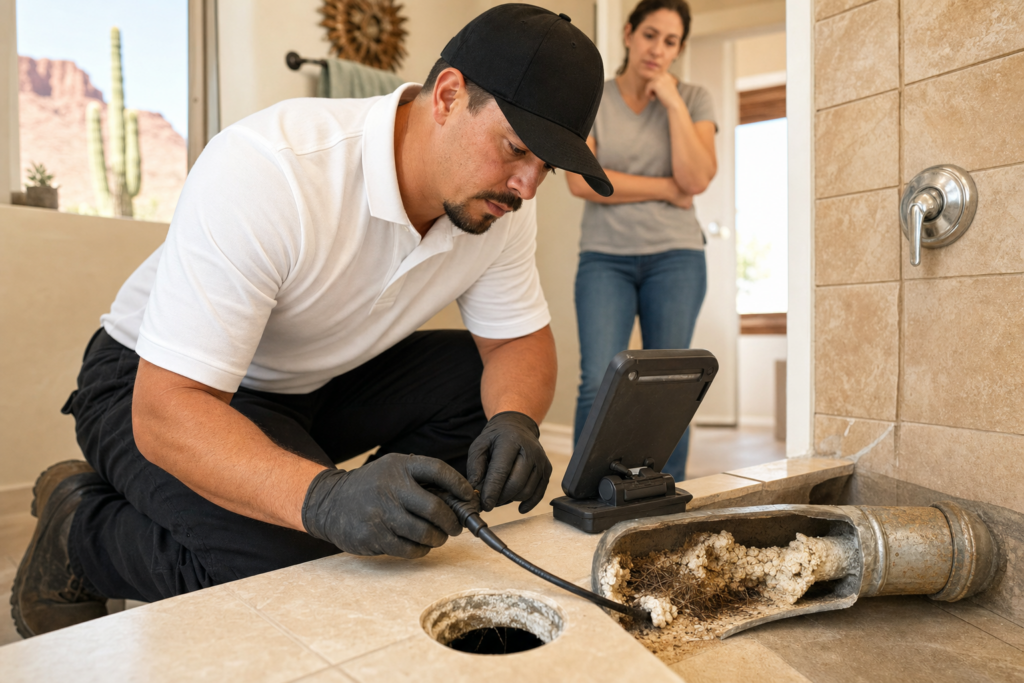
A camera inspection is the most reliable way to see what is actually happening inside a drain pipe. A small video camera is fed into the line, showing the interior condition of the pipe — including scale buildup, root intrusion, cracks, and blockages — so the diagnosis is based on what is actually there rather than guesswork.
What Actually Helps — and What Does Not
Why Chemical Drain Cleaners Often Fail in Hard Water Situations
Chemical drain cleaners are designed to dissolve organic material — hair, grease, soap scum, and food particles. Most of them do this reasonably well for a one-time, debris-only clog. But chemical cleaners do not dissolve mineral scale. Calcium and magnesium deposits are not organic. They are mineral, and they require mechanical force to remove.
This means that in a Phoenix home with hard water, a chemical cleaner may temporarily clear the organic part of the clog but leave the scale foundation completely intact. The drain flows again, but the conditions for the next clog have not changed. Repeated chemical use can also damage certain pipe materials — particularly older metal pipes — without ever addressing the underlying scale.
Snaking vs. Hydro Jetting
Drain snaking uses a flexible metal cable to break through a clog and restore flow. It is effective at clearing organic blockages and is often the right first step for a standard clog. However, a standard drain snake typically does not remove scale from the pipe walls. It punches through the clog, but the rough, coated surface remains.
Hydro jetting uses high-pressure water to scour the inside walls of the pipe, removing not just the organic clog but also the scale, soap scum, and buildup that contributed to it. It is a more thorough cleaning method and can restore pipe flow to closer to its original capacity.
Hydro jetting is not appropriate for every situation. Older pipes that are weakened, cracked, or severely corroded may not tolerate the pressure. That is why a professional assessment — and often a camera inspection — should come before hydro jetting. A licensed technician can evaluate the pipe condition and recommend the approach that fits the situation.
Camera Inspection — Seeing What Is Actually There
When a drain keeps clogging and the cause is not obvious, a camera inspection removes the guesswork. A small video camera on a flexible line is fed into the drain or sewer pipe. The technician can see the interior condition in real time — scale buildup, root intrusion, cracks, bellies, or obstructions — and make a recommendation based on what the pipe actually looks like.
For homeowners who have been dealing with recurring clogs and are unsure what is causing them, a camera inspection can be a straightforward way to get a clear answer before spending money on the wrong solution.
Water Softeners — What They Fix and What They Do Not
A water softener is an ion-exchange system installed on the home’s main water supply line. It removes calcium and magnesium from the water before it reaches your fixtures, appliances, and drains. This means softened water produces less scale, less soap scum, and less of the mineral residue that contributes to recurring clogs.
What a water softener does not do is remove scale that has already built up inside your existing drain pipes. If your pipes already have years of mineral deposit on the walls, a water softener prevents the problem from getting worse but does not reverse the buildup that is already there.
For many Phoenix homeowners, the most effective long-term approach is a combination: professional cleaning to remove existing buildup, followed by a water softener to slow or prevent new accumulation. But the right combination depends on the specific situation, and a licensed technician can help evaluate what makes sense.
Which Phoenix Drains Are Most Commonly Affected
- Shower drains — The combination of hard water, soap, shampoo, conditioner, and hair creates the ideal conditions for scale-assisted clogs. Shower drains in Phoenix homes are among the most frequent repeat offenders.
- Bathroom sink drains — Soap, toothpaste, and hard water residue combine to create a sticky buildup that narrows the drain over time.
- Kitchen sink drains — Grease, food particles, and dish soap interact with mineral-rich water to create stubborn accumulations, especially in homes without a garbage disposal or with an older disposal unit.
- Bathtub drains — Similar dynamics to shower drains, with the added factor that tubs often hold standing water longer, giving minerals more time to deposit on drain surfaces.
Older homes with galvanized steel or cast-iron drain lines may see more aggressive scale accumulation than newer homes with PVC plumbing. If your Phoenix home was built before the mid-1980s and you have never had your drain lines assessed, the pipe material itself may be a factor worth understanding.
When to Call a Licensed Plumber
Not every slow drain needs professional service. But recurring clogs — especially ones that return within a few weeks of cleaning — are worth having evaluated by someone who can look inside the pipe and identify what is actually going on.
Consider calling a licensed plumber if:
- The same drain keeps clogging after you have cleared it multiple times.
- Multiple drains in your home are slowing down around the same time.
- You see mineral deposits around drain openings or fixtures and your drains are also sluggish.
- Chemical cleaners or store-bought snaking tools are not producing lasting results.
- You want to understand the condition of your drain pipes before committing to a solution.
At Fast Layne Plumbing, we approach recurring drain problems by looking for the actual cause — not just treating the symptom. That often starts with a camera inspection to see the pipe condition, followed by a plain-English explanation of what we found, what your options are, and what each option actually does. We provide upfront pricing before any work begins, and we do not recommend services you do not need.
If your Phoenix home has been dealing with drains that keep clogging no matter what you try, a conversation with a licensed technician can help clarify what is happening and what makes sense to do about it.
Call Fast Layne Plumbing at 480.485.4659 to schedule service or talk through what you are seeing.
Frequently Asked Questions
Can hard water alone completely clog a drain?
It is uncommon for mineral scale alone to fully block a drain pipe. What scale typically does is roughen the interior pipe surface, which causes other materials — hair, soap scum, grease, food particles — to stick and accumulate faster. Scale is usually a contributing factor that makes clogs more frequent and harder to resolve, rather than the sole cause.
Why does my drain clog again so quickly after I snake it?
Snaking clears the organic debris that formed the blockage, but it generally does not strip mineral scale from the pipe walls. When the pipe interior is coated with scale, that rough surface begins collecting new material almost as soon as the drain is cleared. This is why scale-related clogs tend to return faster with each occurrence.
Does a water softener fix existing drain clogs?
No. A water softener prevents new mineral scale from forming by removing calcium and magnesium from the water supply before it reaches your fixtures and drains. However, it does not remove scale that has already built up inside your drain pipes. Professional cleaning may be needed to address existing buildup, with the water softener helping to prevent the cycle from repeating.
What is hydro jetting and is it safe for my pipes?
Hydro jetting uses high-pressure water to clean the interior walls of drain and sewer pipes, removing scale, soap scum, grease, and debris buildup. It is a more thorough method than standard snaking. However, hydro jetting is not appropriate for every pipe. Older or weakened pipes may need to be evaluated first — usually with a camera inspection — to confirm they can handle the pressure safely. A licensed technician can assess this before recommending hydro jetting.
How do I know if my drain problem is scale or something else?
Scale-related drain issues tend to develop gradually, affect multiple drains, and return quickly after cleaning. A sudden complete blockage, a single affected drain, or gurgling sounds from other fixtures may point to different causes such as a physical obstruction or a sewer line issue. The most reliable way to determine what is happening inside the pipe is a camera inspection, which shows the actual condition of the line.
Are older Phoenix homes more affected by drain scale?
They can be. Homes built before the mid-1980s in Phoenix often have galvanized steel or cast-iron drain pipes, which tend to accumulate mineral scale more aggressively than the PVC pipes used in newer construction. Decades of hard water exposure can result in significant buildup in older metal pipes. If your home is older and you are experiencing recurring drain issues, the pipe material may be worth evaluating.