How Plumbers Tell the Difference Between Grease Buildup and Tree-Root Intrusion in a Sewer Line
The definitive way to distinguish grease buildup from tree-root intrusion in a sewer line is a CCTV camera inspection — a small, waterproof camera sent through the pipe that shows exactly what is causing the blockage, where it is located, and how severe it is. But experienced plumbers do not start with the camera alone. They use a sequence of diagnostic clues — beginning with the symptoms you describe, which fixtures are affected, and what has been tried before — to build a working picture of what is happening before the camera confirms it.
If you are a Phoenix homeowner dealing with recurring drain problems, you have probably wondered whether the issue is something that can be cleaned out or something more serious. That question matters, because grease buildup and tree-root intrusion can produce nearly identical symptoms from your side of the drain. What is different is what is happening inside the pipe — and the right fix depends entirely on getting the diagnosis right first.
This article walks through the actual diagnostic process a plumber uses to tell these two problems apart, step by step, with Phoenix-specific context that applies to the trees, soil, and pipe materials common in homes across the Valley.
Why Grease and Tree Roots Are Easy to Confuse
Both grease buildup and tree-root intrusion cause slow drains, recurring backups, gurgling sounds, and unpleasant odors. From your kitchen or bathroom, the symptoms can feel identical. A drain that clears temporarily and then slows down again could be either problem — or both at once.
The reason symptoms alone are not enough is that both conditions restrict flow inside the pipe in ways that produce the same result at the fixture. Grease coats the inner walls and gradually narrows the opening. Roots push into the pipe through a crack or joint and create a physical obstruction. Either way, water backs up. Either way, you notice it at the sink, tub, or toilet.
Getting the diagnosis right matters because the treatment for each condition is different. Cleaning a grease-clogged line with the wrong approach may leave residue behind. Treating root intrusion as though it were a simple clog may clear the line temporarily but will not address the structural entry point where roots keep returning. A plumber who skips the diagnostic step and jumps straight to a recommendation is guessing — and guesswork can mean paying for the wrong repair.
Step One: What the Plumber Considers Before the Camera Goes In
Before running a camera, an experienced plumber gathers information. This is not guesswork — it is a process of narrowing down what is most likely happening based on what you are experiencing and what the property tells them.
Which Fixtures Are Affected and Where the Problem Originates
Grease buildup tends to start near the kitchen. If your kitchen sink is the first drain to slow down and other fixtures are unaffected, grease is a strong possibility. Cooking fats, oils, soap residue, and food particles accumulate gradually along the interior walls of the kitchen drain line and the horizontal pipe leading to the main sewer lateral.
Root intrusion, on the other hand, tends to affect the main sewer line — the pipe that carries waste from your entire house to the city connection. When roots are the problem, you may notice multiple fixtures backing up at the same time: a toilet bubbling when you run the washing machine, or the shower draining slowly while the kitchen sink is fine. That pattern of multiple fixtures affected simultaneously often points to a blockage deeper in the system.
How Long the Problem Has Been Building and Whether It Recurs
Grease buildup is gradual. It tends to worsen slowly over months or years. You might notice the kitchen drain taking a little longer each week before it finally stops draining altogether.
Root intrusion can also develop gradually, but it often produces a pattern of clearing and returning. If you have had the line snaked or jetted and the problem comes back within a few months — especially at the same location in the line — roots may be re-entering through the same crack or joint.
Seasonal Timing as a Diagnostic Clue
In Phoenix, root activity tends to increase during the warmer months when trees are actively growing and seeking moisture. If your sewer line problems seem to worsen in spring or summer and then ease slightly during cooler months, that seasonal pattern can point toward root intrusion. Grease buildup, by contrast, does not follow a seasonal cycle — it accumulates steadily regardless of the time of year.
Yard and Property Clues
A plumber may also look at what is growing near your sewer line. In Phoenix, several common landscape trees are known for aggressive root systems that can reach sewer pipes. Ficus, oleander, mesquite, citrus trees, and certain palm species are all common in Phoenix yards and all have root systems that can extend far enough to find a sewer lateral — especially if the pipe has a crack, a loose joint, or a deteriorated seal.
One indicator that sometimes points toward a pipe breach with root involvement is an unusually green or lush strip of grass or ground cover directly above the path of the sewer line. That extra moisture from a leaking pipe can feed vegetation in a visible pattern, even in the desert.
Pipe Age and Material in Phoenix Homes
Phoenix has a wide range of home ages, and the pipe material in your sewer line depends largely on when the home was built. Homes from the 1950s through the 1970s often have clay tile or cast iron sewer lines, both of which are more susceptible to root intrusion at the joints over time. Homes built from the 1980s onward are more likely to have ABS or PVC pipe, which is more resistant to root entry — but not immune, especially at connection points or where ground shifting has stressed the joints.
A plumber familiar with Phoenix neighborhoods can factor in the likely pipe material based on the home’s age and area, which helps narrow the diagnostic picture before the camera is even unpacked.
Step Two: What the Camera Actually Shows
The sewer camera inspection is the diagnostic step that moves from educated assessment to visual confirmation. Here is how it works and what it reveals.
How a CCTV Sewer Camera Inspection Works
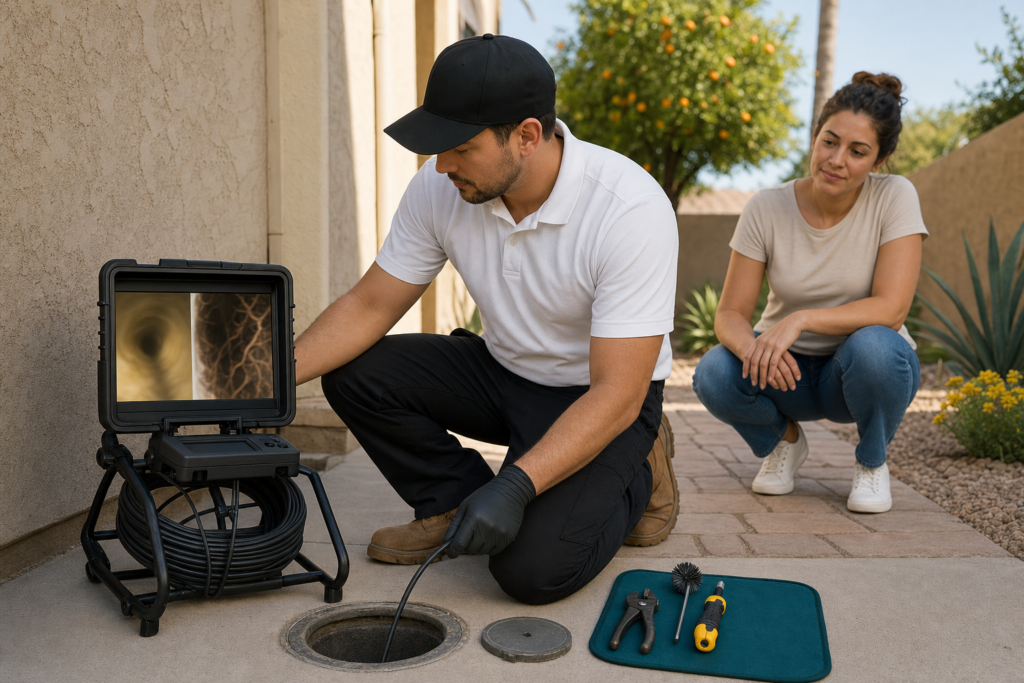
A small, waterproof video camera is attached to a flexible cable and fed into the sewer line through a cleanout access point — a capped opening that connects to the main drain. As the camera advances through the pipe, it sends a continuous video signal back to the plumber, who monitors the image as it progresses in real time. Distance tracking is built in, so the plumber can identify precisely how far into the line any given problem sits.
This is not a guess-and-check process. The camera shows what is inside the pipe, where it is, and in many cases, how severe it is.
What Grease Buildup Looks Like on Camera
Grease buildup appears as a thick, waxy coating on the interior walls of the pipe. It is often yellowish-white, gray, or off-white in color, and it coats the pipe walls in a distributed layer rather than concentrating at one specific point. Over time, the coating narrows the pipe opening progressively — like cholesterol narrowing an artery.
On camera, grease buildup may also have debris embedded in it: toilet paper, food particles, and soap scum that got caught in the sticky layer as wastewater passed through. The blockage tends to develop along a stretch of the pipe rather than at a single spot, which distinguishes it visually from root intrusion.
What Tree-Root Intrusion Looks Like on Camera
Root intrusion has a very different appearance. On camera, roots typically appear as fibrous, hair-like strands or dense, tangled mats protruding into the pipe from a specific location — usually a joint between two pipe sections, a crack in the pipe wall, or a deteriorated seal.
Unlike grease, roots enter from outside the pipe and push inward. On camera, you can often see the entry point clearly: a gap in the pipe where the root has found its way in. In more advanced cases, the root mass may fill a significant portion of the pipe interior, acting like a net that catches everything flowing through — toilet paper, grease, food waste — and creating a compound blockage that grows faster than either problem would alone.
Side-by-Side Comparison: Grease Buildup vs. Root Intrusion on Camera
| Diagnostic Factor | Grease Buildup | Tree-Root Intrusion |
|---|---|---|
| Appearance on camera | Thick, waxy coating on pipe walls; yellowish-white or gray | Fibrous strands or dense root mat protruding from a specific point |
| Location in the pipe | Distributed along a section of pipe, often near the kitchen line | Concentrated at a joint, crack, or compromised seal |
| How the pipe narrows | Gradually coated walls narrow the opening evenly | Obstruction protrudes inward from one or more entry points |
| Pipe damage visible | Usually no structural damage to the pipe itself | Often reveals cracks, joint separation, or seal failure at the entry point |
| Fixtures typically affected first | Kitchen sink, then nearby drains | Multiple fixtures or the lowest drain in the home |
| Seasonal pattern | No seasonal cycle; accumulates steadily | May worsen during warmer growing months |
The Combination Scenario: When Roots Trap Grease
One of the most important things the camera can reveal is a combination problem — and this is the scenario that is most commonly missed or misdiagnosed.
When roots have entered the pipe even partially, the fibrous root material acts like a net inside the line. Wastewater carrying grease, soap residue, toilet paper, and food particles passes through and deposits those materials directly into the root mass rather than continuing downstream. The result is a compound blockage that grows faster than either grease or roots alone.
On camera, this looks like a dense mass at a joint or crack point — with both fibrous root material and waxy grease mixed together. A plumber who recognizes this combination knows that simply jetting the grease will not solve the problem if roots are creating the trap, and cutting the roots will not fully clear the line if grease has hardened around them. The treatment plan needs to address both issues.
Step Three: What the Cleaning Process Reveals
The diagnostic process does not always end with the first camera pass. What happens during and after cleaning often provides critical additional information.
Mechanical Feedback: What Comes Back on the Snake
When a plumber runs a motorized drain snake or auger through the line, what comes back on the cable tells part of the story. Grease tends to produce a fatty, sludgy, foul-smelling residue on the cutting head. Root material comes back as tough, stringy, wood-like strands that are noticeably different in texture and resistance.
This is not the definitive diagnostic step — the camera provides that — but it gives the plumber real-time physical feedback that supports or adjusts their working assessment.
The Two-Camera Approach: Before and After Cleaning
A thorough diagnostic process often involves running the camera twice: once before cleaning to see the blockage, and once after cleaning to see the condition of the pipe underneath.
The pre-cleaning camera shows what is blocking the line. The post-cleaning camera shows what the pipe itself looks like once the blockage is removed. This second pass is important because it can reveal structural issues — cracks, joint separation, pipe deterioration — that were hidden behind the buildup. A root entry point that was masked by grease and debris may only become visible after the line has been cleared.
In some cases, the post-cleaning camera changes the diagnosis. What looked like a straightforward grease problem may turn out to have a root entry point underneath. What appeared to be root intrusion at one location may reveal additional grease accumulation further down the line. The second camera pass gives the plumber — and you — a clearer picture of what is actually happening.
When the Camera Cannot Give a Definitive Answer on the First Visit
Honesty matters here: sometimes the first camera inspection does not produce a completely definitive diagnosis. If the line is heavily blocked, the camera may not be able to pass beyond the obstruction. If both grease and roots are present, the full extent of the problem may only become clear after initial cleaning allows the camera to travel further.
A plumber who tells you that the camera could not see everything on the first pass is being honest with you. That honesty is a good sign — it means they are not guessing, and they are not recommending work based on incomplete information.
Why the Diagnosis Determines the Fix
The reason all of this matters is that grease buildup and tree-root intrusion require different treatment approaches. Applying the wrong one means the problem comes back — and you pay for work that did not address the real cause.
Grease Buildup: What Treatment Typically Looks Like
For grease buildup, hydro jetting — high-pressure water cleaning — is generally the most effective approach. Hydro jetting scours the interior walls of the pipe and removes the accumulated coating, restoring the full diameter of the line.
Mechanical snaking can punch through a grease blockage and restore flow, but it often leaves residue on the pipe walls that begins accumulating again right away. Hydro jetting provides a more thorough cleaning because it addresses the coating on the walls, not just the blockage at the center.
After a grease cleaning, changes in kitchen habits — how fats, oils, and food waste are disposed of — can help slow the rate of re-accumulation. A plumber can talk through practical steps during the service visit.
Tree-Root Intrusion: What Treatment Typically Looks Like
For root intrusion, the first step is usually clearing the roots from the line using mechanical root cutting, hydro jetting, or a combination of both. This restores flow, but it does not seal the entry point.
Roots grow back. The crack or joint where they entered the pipe is still there, and the roots will find it again — especially in Phoenix’s warm climate where growing seasons are long. This means that root intrusion is often a recurring maintenance issue unless the entry point is repaired.
Depending on the severity and location of the damage, repair options may include trenchless sewer repair methods such as pipe lining, pipe bursting for replacement of the damaged section, or traditional sewer line repair. A camera inspection after cleaning helps the plumber evaluate the structural condition of the pipe and recommend the appropriate next step — whether that is a maintenance schedule for periodic root clearing or a structural repair to address the entry point.
The Combination Scenario: Why It Requires a Different Approach
When both grease and roots are present, the treatment needs to address both layers. Jetting the grease without removing the root mass will leave the trap in place. Cutting the roots without cleaning the grease will leave a narrowed pipe that clogs more easily.
The plumber typically clears the roots first, jets the grease second, and then runs the camera again to assess the pipe’s structural condition. This layered approach takes longer, but it addresses the actual problem rather than just the most visible part of it.
What to Expect When You Call a Plumber for This Problem
A thorough diagnostic process is not complicated, but it does take more than a guess based on symptoms. Here is what a careful approach looks like:
- The plumber asks about your symptoms — which fixtures are affected, how long it has been happening, whether the problem has been cleared before and come back.
- They assess the property — looking at tree proximity, pipe access points, and the likely pipe material based on your home’s age.
- They run a camera inspection through the cleanout to see the condition of the line.
- If the line needs cleaning before the camera can pass through, they clear the blockage and note what comes back on the cable.
- After cleaning, they run the camera again to see the pipe walls and identify any structural issues.
- They show you the camera footage, explain what they found in plain English, and walk through the options before any additional work begins.
A plumber who skips the camera and recommends a repair based on symptoms alone is not giving you a complete diagnosis. And a plumber who shows you the footage and explains what it means — without pressure — is giving you the information you need to make a confident decision.
At Fast Layne Plumbing, that is how we approach sewer line diagnosis for Phoenix homeowners. We run the camera, we show you what we find, we explain what it means, and we give you upfront pricing before any work begins. When the camera reveals something outside the expected scope, we communicate that clearly. If the initial pass leaves gaps in the picture, we say so rather than guess. The goal is an accurate diagnosis — not a sales pitch.
Frequently Asked Questions
Can you tell from symptoms alone whether it is grease or roots?
Symptoms can point in a direction, but they cannot confirm the cause. Slow drains, recurring backups, and odors can come from either condition. A camera inspection is the reliable way to see what is actually inside the pipe and make the right call on treatment.
What dissolves grease in a sewer line?
Professional hydro jetting uses high-pressure water to scour grease from the pipe walls. Over-the-counter chemical drain cleaners are generally not effective against significant grease buildup in a sewer lateral, and some chemical products can damage certain pipe materials. A licensed plumber can evaluate the line and recommend the appropriate cleaning method.
How fast do tree roots grow back in sewer pipes after removal?
Root regrowth depends on the tree species, the size of the entry point, soil moisture, and the time of year. In Phoenix’s warm climate, roots can begin re-entering a compromised pipe within several months after clearing. Periodic camera inspections can help monitor the line and catch regrowth before it causes another backup.
Does homeowners insurance cover root intrusion in a sewer line?
Coverage varies significantly by policy. Some policies cover sudden damage caused by root intrusion, while others exclude sewer line issues or consider root growth a maintenance responsibility. Check your specific policy or speak with your insurance provider for guidance on what your plan covers.
What trees in Phoenix are most likely to cause root intrusion?
Several trees common in Phoenix landscapes have root systems known to reach sewer lines, including ficus, oleander, mesquite, citrus trees, and certain palm varieties. Proximity to the sewer lateral matters — any tree with a substantial root system planted within roughly 25 feet of the sewer line could potentially cause issues, especially in older homes with clay tile or cast iron pipes.
Is a camera inspection always necessary?
For a one-time kitchen drain clog that clears easily, a camera inspection may not be needed. But for recurring backups, main line blockages, sewer smells, or any situation where the plumber suspects root intrusion or structural damage, the camera is the tool that turns guesswork into a confirmed diagnosis. It is also the tool that protects you from paying for the wrong repair.
Get an Honest Diagnosis for Your Sewer Line
If your drains keep backing up and you are not sure whether the problem is grease, roots, or something else entirely, the right next step is a camera inspection — not a guess.
Fast Layne Plumbing serves homeowners across Phoenix, AZ with honest, camera-first sewer line diagnosis. We show you the footage, explain what we find in plain English, and give you clear options with upfront pricing before any work begins. No surprises on the bill. No pressure to approve work you do not understand.
Call Fast Layne Plumbing at 480.485.4659 to schedule a sewer camera inspection or talk through what you are experiencing. We are here to help you find the real problem — and the right fix.