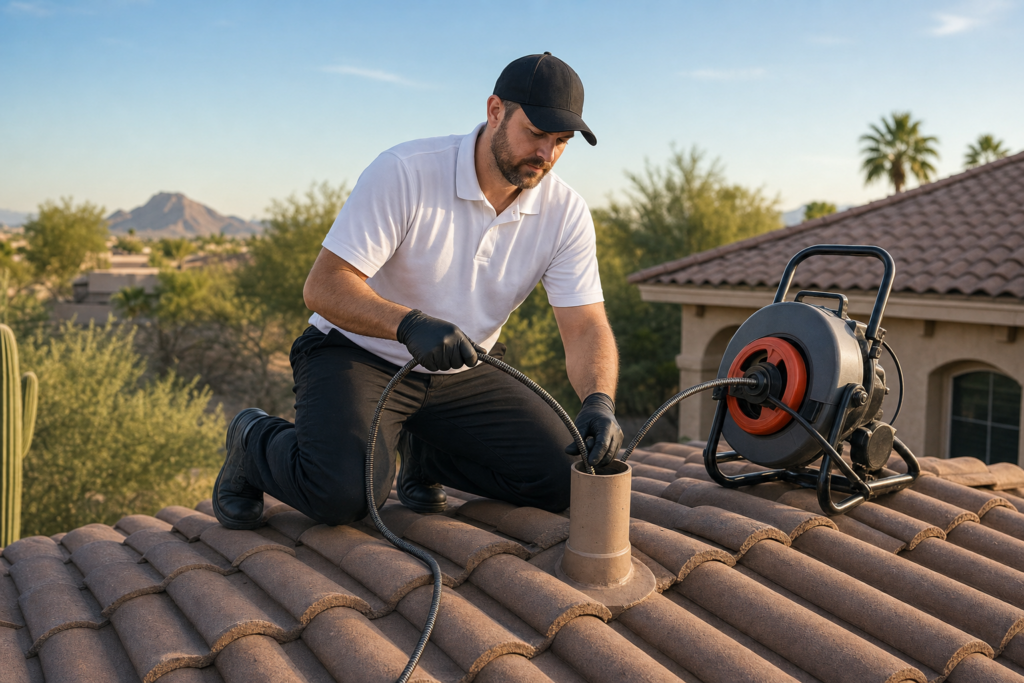
Cost to Snake a Main Sewer Line Through a Roof Vent in Phoenix
In Phoenix, snaking a main sewer line through a roof vent typically costs between $250 and $550 during normal business hours. That range runs higher than a standard ground-level cleanout job because roof vent access requires heavier equipment carried to height, additional safety setup, and often a second technician on site. The final number depends on your roof type, the severity of the blockage, when you call, and whether the technician recommends a camera inspection afterward.
If you have been quoted a price for roof vent sewer snaking and want to know whether it is reasonable — or if you are trying to understand why a plumber cannot just access the line from the ground — this page walks through what drives the cost in Phoenix specifically, what the process looks like, and what questions are worth asking before you agree to service.
What Roof Vent Sewer Snaking Costs Compared to Other Access Methods
Most Phoenix plumbers price drain and sewer work based on the access point, the type of equipment needed, and the difficulty of the job. Roof vent access is almost always more expensive than a ground-level cleanout because it takes more time, more setup, and sometimes a second person.
Here is a general comparison of what Phoenix homeowners can expect across the most common service types:
| Service Type | Typical Phoenix Price Range | What It Covers |
|---|---|---|
| Main line snaking through ground cleanout | $150–$350 | Cable fed through an accessible ground-level cleanout to clear the main sewer line |
| Main line snaking through roof vent | $250–$550 | Cable fed through the plumbing vent stack on the roof; includes ladder setup, roof access, and safety precautions |
| Sewer camera inspection | $150–$350 | Video inspection of the sewer line to identify the condition, location, and cause of a blockage or damage |
| Hydro jetting | $350–$800+ | High-pressure water used to clear heavy buildup, grease, scale, or root intrusion from the sewer line |
These are general ranges based on the Phoenix market. Actual pricing depends on the specific job, and a licensed plumber can provide an accurate quote after evaluating the situation.
Many Phoenix plumbing companies use flat-rate pricing, which means the quoted price covers the job regardless of how long it takes. If a company charges hourly instead, roof vent jobs tend to cost more simply because setup and access add time. It is worth asking which pricing model applies when you call for a quote.
Why Roof Vent Access Costs More Than a Ground Cleanout
A ground-level cleanout is a capped pipe that sticks up from the ground near your home’s foundation. When one exists and is accessible, it is the fastest and easiest way to reach the main sewer line. The plumber connects the cable machine at ground level and feeds it directly into the line.
A roof vent — also called a plumbing vent stack — is a vertical pipe that extends through your roof. Its primary purpose is to allow air into the drain system so wastewater flows properly. It was not designed as a primary service access point, but when there is no cleanout available, the roof vent becomes the next option for reaching the main line with a cable.
The price difference comes down to what the job actually requires:
Equipment Weight and Roof Safety Setup
A motorized drain cable machine can weigh 75 pounds or more. Getting it onto a roof safely requires a ladder, proper staging, and careful handling. In many cases, a second technician is needed just to assist with equipment transport and roof safety. That adds labor cost.
Phoenix Tile Roofs and Access Complications
Most Phoenix homes have tile roofs — concrete or clay tile that can crack under foot traffic or heavy equipment if not navigated carefully. A plumber working on a tile roof has to move slowly, avoid damaging tiles, and position the cable machine without creating new problems. Some roofs have steep pitches or limited flat areas near the vent stack, which adds difficulty and time.
Smaller Vent Diameter and Longer Cable Runs
Roof vent pipes are typically narrower than a cleanout opening. The plumber may need to use a smaller cable or take extra care feeding it through a tighter space. The cable also has to travel farther — down through the vent stack, through the building’s drain system, and into the main sewer line — which can mean a longer, more involved clearing process.
Many Phoenix Plumber Promotions Exclude Roof Access
This is a detail worth knowing before you call. Many plumbing companies in Phoenix advertise drain cleaning specials or coupon prices, but the fine print often excludes roof vent access. A low-price drain cleaning promotion almost always applies to a standard cleanout or secondary drain — not to roof vent work. If you are comparing quotes, ask specifically whether the price includes clearing through the roof vent. It saves a frustrating surprise on the day of service.
What Affects the Final Price in Phoenix
Within the $250–$550 range, several real factors determine where your job falls. Understanding them helps you evaluate a quote honestly.
Roof Type
A single-story home with a low-slope or flat roof is the easiest and fastest to access. A two-story home with a steep tile roof takes longer to set up safely, which can push the price toward the higher end. If the vent stack is in a hard-to-reach location on the roof, that matters too.
Severity and Type of Blockage
A soft blockage — toilet paper buildup, minor debris — usually clears faster than a heavy one. Root intrusion, hardened grease, or mineral scale may take more passes with the cable or may require the technician to recommend hydro jetting as a follow-up. The harder the blockage is to clear, the more time and effort the job takes.
Time of Year and Summer Heat
Phoenix summers are extreme. When it is 110°F or higher, working on a rooftop is genuinely dangerous. Some companies factor heat-related safety considerations into their pricing during peak summer months, and the work itself takes longer because technicians need breaks to stay safe. A roof vent job in March is a different experience than the same job in July.
After-Hours and Emergency Calls
If you need a plumber on a weekend, holiday, or late at night, most companies charge more for after-hours service. That premium applies on top of the roof vent access cost. If the situation is not an active emergency — meaning sewage is not backing up into the home right now — scheduling during normal business hours can keep the cost lower.
Whether a Camera Inspection Is Recommended
A camera inspection is not always included in the base price for snaking. Some plumbers include it, others offer it as a separate service. If the technician recommends running a camera after clearing the line, it typically adds $150–$350 depending on the company and the length of the inspection. A camera inspection can reveal whether the line is damaged, whether roots are intruding, or whether the blockage is likely to return — information that helps you decide what to do next.
Why Your Phoenix Home May Not Have a Ground-Level Cleanout
If a plumber has told you they need to access the line from the roof, you may be wondering why there is no easier option. The answer usually comes down to when and how your home was built.
Many older Phoenix homes — especially those built from the 1950s through the early 1980s — were constructed without a dedicated ground-level cleanout on the main sewer line. Building codes and construction practices have changed over time, and cleanouts became more standard in later decades. But thousands of homes across Phoenix still do not have one, or have one that is buried, blocked, or inaccessible.
A ground-level cleanout is a capped pipe, usually located near the foundation or in the yard between the house and the street. It provides direct access to the main sewer line without needing to go through the roof or pull a toilet. If you are not sure whether your home has one, look for a small capped pipe near the exterior wall of your home, often near a bathroom. A plumber can also help you locate it — or confirm that one does not exist.
If your home lacks a cleanout and you find yourself needing sewer service more than once, installing one may be worth discussing with a licensed plumber. It can make future service calls faster, easier, and less expensive. The cost of adding a cleanout varies depending on the location and the existing plumbing layout, so it is worth getting a specific evaluation rather than relying on a general estimate.
What Actually Happens During a Roof Vent Sewer Snaking
If you have never had this done before, here is what the process generally looks like from the homeowner’s perspective. This is not a DIY guide — roof vent sewer work should be performed by a licensed plumber with the right equipment and safety training. But understanding the process helps you know what to expect and what your plumber should be doing.
- Initial assessment. The plumber evaluates the situation — what symptoms you are experiencing, which drains are affected, and whether roof vent access is the right approach. In some cases, a cleanout may exist but needs to be located first.
- Roof access and setup. The technician sets up a ladder, inspects the roof for safe footing, and identifies the correct vent stack. On a tile roof, this step takes extra care to avoid damaging tiles.
- Equipment positioning. The motorized cable machine is brought to the roof and positioned near the vent opening. On some jobs, a second technician assists from the ground or from a second ladder.
- Cable fed into the vent stack. The plumber feeds the drain cable down through the vent pipe, through the building’s internal drain system, and into the main sewer line. The cable is advanced until it reaches the blockage.
- Blockage cleared. The rotating cable works through the blockage to break it up and restore flow. The technician may make multiple passes depending on what the cable encounters.
- Flow confirmed. The plumber tests the line — usually by running water through the drains inside the home — to confirm that flow has been restored.
- Camera inspection (if recommended). If the technician suspects the clog may return, or if there are signs of a deeper issue like root intrusion or pipe damage, they may recommend a sewer camera inspection to see the inside of the line.
- Cleanup and walkthrough. The equipment comes off the roof, the work area is cleaned up, and the plumber explains what they found, what they did, and whether any follow-up is recommended.
The entire process typically takes one to two hours for a standard job, though heavily clogged lines or difficult roof access can extend that. Most homeowners do not need to be on the roof or do anything during the process beyond keeping interior drains available for testing.
When Snaking May Not Be Enough
Snaking is the right first step for most main line blockages, but it does not solve every problem. It is honest to say that upfront rather than let you assume the job is always a one-and-done fix.
Hydro jetting may be the next step if the cable clears enough flow to confirm the line is open, but the technician finds heavy grease buildup, mineral scale, or root intrusion that snaking alone cannot fully remove. Hydro jetting uses high-pressure water to scour the inside of the pipe and is more thorough than a cable for certain types of buildup. It typically costs more than snaking, and a camera inspection beforehand helps confirm whether the pipe is in good enough condition to handle the pressure safely.
A camera inspection may change the diagnosis entirely. When the footage shows a cracked pipe, a section that has collapsed, a bellied run, or extensive root damage, the underlying problem is structural rather than a simple obstruction. In that situation, a plumber will likely recommend repairing or replacing the sewer line instead of clearing it repeatedly. That recommendation is not an upsell when the damage is genuine. A trustworthy plumber will walk you through the camera footage and explain what you are seeing so you can make an informed decision.
The key thing to watch for: a plumber who clears the line, confirms flow, and then explains what they found — including whether the problem is likely to come back and why — is doing the job right. A plumber who clears the line and leaves without any explanation of what caused the blockage is leaving you without the information you need.
Questions to Ask Before Agreeing to Roof Vent Sewer Snaking
Whether you call Fast Layne Plumbing or another licensed Phoenix plumber, these questions help you understand what you are paying for and avoid surprises:
- Does the quoted price include roof vent access specifically? Some quotes assume cleanout access. Confirm the price covers the actual method before agreeing.
- Is the price flat-rate or hourly? Flat-rate means the price is the price regardless of how long it takes. Hourly means a difficult clog could cost more than expected.
- Does your current promotion or coupon apply to roof vent jobs? Many do not. Ask directly.
- Will a camera inspection be included, or is it a separate charge? Know this before the work starts so you can decide whether to add it.
- What happens if the cable cannot clear the blockage? Ask whether there is a charge if the job does not resolve the problem, and what the next recommended step would be.
- Will you need a second technician for roof access? If so, is that factored into the quote?
- Will you walk me through what you find? A plumber who explains the issue in plain language and shows you what they discovered is one worth keeping.
Why Phoenix Homeowners Call Fast Layne Plumbing
We understand the frustration that comes with needing sewer work — especially when you have been told the only way to reach the line is through the roof. You may have already dealt with a plumber who did not show up, a quote that felt too high, or a diagnosis that left you wondering whether the work was really necessary.
Fast Layne Plumbing is a family-owned Phoenix plumbing company built around doing this differently. We answer the phone, show up when we say we will, and explain everything in plain English before any work begins. Our pricing is upfront — you know the cost before we start, not after. We do not push services you do not need, and we do not leave until the job is done and the work area is clean.
For sewer line work, that means honest diagnosis. If snaking clears the problem and the line looks good, we tell you that. If a camera inspection reveals something that needs attention, we show you the footage and walk you through your options — no pressure, no scare tactics, just clear information so you can make the right decision for your home.
Call Fast Layne Plumbing at 480.485.4659 to schedule sewer line service or ask about roof vent access for your Phoenix home.
Frequently Asked Questions
Can you snake a sewer line from the roof vent?
Yes. When a home does not have a ground-level cleanout, the plumbing vent stack on the roof can be used to access the main sewer line with a motorized drain cable. It is a common method in older Phoenix homes that were built without a dedicated cleanout.
How much does it cost to snake a main sewer line in Phoenix?
Through a ground-level cleanout, main line snaking in Phoenix typically ranges from $150 to $350. Through a roof vent, the cost is usually $250 to $550 due to the additional equipment setup, roof access, and safety requirements involved.
Why is roof vent access more expensive than using a cleanout?
Roof vent access requires carrying heavy equipment onto the roof, navigating tile or other roofing materials safely, working with a narrower pipe opening, and often having a second technician on site. These factors add time, labor, and safety considerations that a ground-level cleanout job does not require.
How do I know if my Phoenix home has a cleanout?
Look for a small capped pipe near the exterior foundation of your home, often near a bathroom wall or between the house and the street. It may be at ground level or slightly above. If you cannot find one, or if it appears buried or damaged, a licensed plumber can help locate it or confirm whether one was installed.
What happens if the snake does not clear the clog?
If the cable cannot fully clear the blockage, the plumber may recommend hydro jetting to address heavy buildup, or a camera inspection to determine whether the pipe itself is damaged. The right next step depends on what the technician encounters during the initial clearing attempt.
Is a camera inspection necessary after snaking?
Not always, but it can be valuable — especially if the blockage was severe, if the plumber suspects root intrusion, or if you have experienced recurring sewer problems. A camera inspection shows the condition of the pipe from the inside and can reveal damage that snaking alone cannot detect.
How long does it take to snake a main line from the roof?
Most standard roof vent snaking jobs take one to two hours, including setup, clearing, and testing. Jobs involving heavy blockages, difficult roof access, or a follow-up camera inspection may take longer.
Do plumber promotions and coupons apply to roof vent jobs?
Often they do not. Many Phoenix plumbing companies advertise drain cleaning specials that apply only to standard cleanout access or secondary drain lines. If you are calling about a promotional price, ask specifically whether it covers roof vent access before scheduling.