How to Choose a Plumber for Sewer Camera Inspections in Phoenix
The right plumber for a sewer camera inspection is one who uses quality equipment, explains what the camera finds in plain English, gives you the footage, and does not pressure you into repairs before you have had time to understand the situation. That is the short answer.
The longer answer matters because not every inspection is the same. The camera quality varies. The experience of the person operating it varies. What you receive after the inspection — whether that is a clear explanation or a high-pressure sales pitch — varies more than most homeowners expect. And in Phoenix, where older homes, shifting desert soil, and specific pipe materials create conditions that not every plumber is familiar with, choosing the right person for this job is worth a few extra minutes of research.
This guide walks through what to look for before you book, what should happen during the inspection, and what a trustworthy plumber should provide afterward.
Why the Quality of a Sewer Camera Inspection Matters More Than the Price
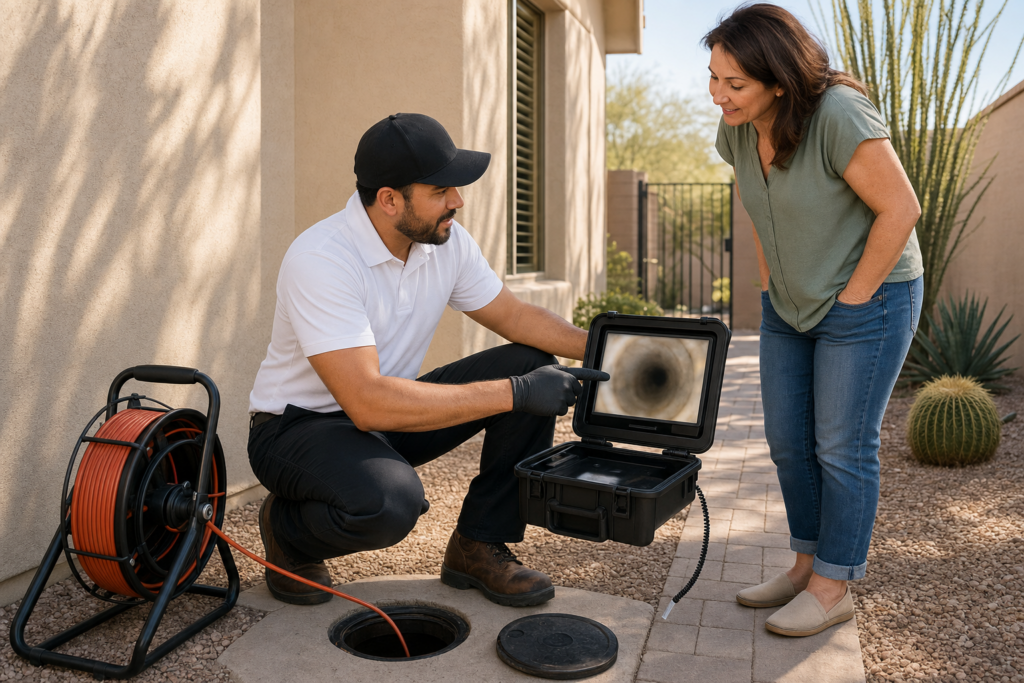
A sewer camera inspection is a diagnostic service. A plumber feeds a specialized waterproof camera through your sewer line to see the interior condition of the pipe. The camera sends a live video feed to a monitor, allowing the technician to identify cracks, root intrusion, buildup, offsets, bellied sections, and other issues that cannot be seen from the surface.
When this is done well, it gives you a clear picture of what is happening inside your sewer line and helps you make an informed decision about whether repair, cleaning, or monitoring is the right next step.
When it is done poorly — with outdated equipment, by someone who rushes through the line, or by a company that uses the inspection mainly as a doorway to sell expensive repairs — you can end up with a vague diagnosis, no footage to review, and a quote for work you may not actually need.
The price difference between a thorough inspection and a careless one is often small. The difference in what you walk away knowing can be significant.
Start with Licensing — and Know How to Verify It in Arizona
What the Arizona ROC License Means
In Arizona, plumbing contractors are regulated by the Arizona Registrar of Contractors, commonly referred to as the ROC. A valid ROC license means the contractor has met the state’s requirements for competency, bonding, and insurance. It also means there is a regulatory body you can contact if something goes wrong.
For sewer camera inspections specifically, you want a licensed plumber — not a general handyman or a drain company operating without the proper plumbing classification.
How to Look Up a Plumber’s License
You can verify any contractor’s license for free on the ROC website at roc.az.gov. Enter the company name or license number to pull up the listing. You will be able to confirm whether the license is currently active, what classification it covers, and whether any complaints are on record.
This takes about two minutes and is one of the most useful things you can do before hiring anyone for plumbing work in Phoenix.
What to Check Beyond the License Number
An active license is the starting point, not the finish line. You should also confirm that the company carries liability insurance and workers’ compensation coverage. If someone is working inside your home or accessing your sewer line, you want to know that both you and the technician are protected.
A reputable plumber will not hesitate to confirm this information when asked.
Ask About the Camera Equipment Before You Book
Not all sewer cameras are equal, and the equipment a plumber uses directly affects the quality of the inspection and the accuracy of the diagnosis.
What HD Camera Means in Practice
An HD sewer camera produces a clearer, more detailed image than older standard-definition models. This matters because the difference between a hairline crack and a shadow, or between minor scaling and a significant blockage, can be difficult to distinguish on a low-resolution feed. If the plumber is using outdated equipment, the inspection may miss problems or misidentify conditions.
What a Sonde Locator Is and Why It Matters
A sonde locator is a small transmitter built into the camera head. As the camera moves through the pipe, the sonde sends a signal that can be detected from above ground using a locating receiver. This allows the technician to pinpoint the exact location and depth of a problem — not just identify that a problem exists somewhere in the line.
This is especially important in Phoenix, where sewer lines can run under concrete slabs, driveways, and landscaping. Knowing the precise location of damage can mean the difference between a targeted repair and an unnecessary excavation. If a plumber cannot tell you where the problem is — only that there is one — the inspection has limited practical value.
What a Self-Leveling Camera Head Does
A self-leveling camera head keeps the image oriented correctly as the camera moves through the pipe, regardless of the pipe’s angle or curve. Without this feature, the footage can appear rotated or disorienting, making it harder to interpret what you are seeing. This is a standard feature on professional-grade equipment and a reasonable expectation for any company offering camera inspection services.
A Useful Signal: How the Plumber Talks About Their Equipment
When you call to ask about the inspection, pay attention to how the plumber describes the equipment they use. A company that takes diagnostic work seriously will be able to tell you about their camera’s capabilities without hesitation. If the person on the phone cannot answer basic questions about the equipment, that may be worth noting as you compare options.
What You Should Receive After the Inspection
This is the part of the process that separates a genuinely useful inspection from one that leaves you with more questions than answers.
The Video Recording
You should receive a copy of the full video recording from the inspection. This may be provided digitally — via USB, email, or cloud link — depending on the company’s process. The footage should show the full length of the inspected line, not just a few selected clips.
Having the full video allows you to review the findings on your own time, share the footage with another plumber for a second opinion if needed, or keep it as documentation for a home sale or insurance purpose.
The Post-Inspection Explanation
A trustworthy plumber should walk you through what the camera found. This means showing you the relevant sections of the footage, explaining what each finding means in plain language, and helping you understand which issues may need attention now versus which ones can be monitored over time.
This is where honest communication matters most. A good post-inspection conversation sounds like a calm explanation of what the camera showed, what it could mean, and what the reasonable options are. It does not sound like a high-pressure sales pitch delivered before you have even had time to process the information.
At Fast Layne Plumbing, we believe the inspection should give you clarity — not confusion. When our technicians run a camera through your sewer line, they explain the findings in plain English, show you the footage, and walk through your options so you can make a confident decision.
The Written Report
Some companies provide a written summary or report along with the video. A useful report typically includes the location and nature of any findings, the general condition of the pipe, the pipe material observed, and any recommendations. While not every company provides a formal written report, having some form of documented summary — even a clear verbal walkthrough paired with the footage — is important for your records.
Why Documentation Matters Beyond the Inspection Itself
If you are purchasing a home, documentation from a sewer camera inspection can support negotiations or help you understand future maintenance needs. If you are dealing with an insurance claim or planning a renovation, having professional footage and a clear summary of findings can be valuable. And if you want a second opinion before committing to a repair, having the footage makes that straightforward.
Questions to Ask Before You Book
These are practical questions you can ask any plumber before scheduling a sewer camera inspection. What matters is not just whether they answer, but how they answer.
-
Is the inspection performed by a licensed plumber? You want the person operating the camera and interpreting the findings to be a qualified, licensed plumber — not a subcontractor or assistant without plumbing credentials. A good answer is a direct yes with a willingness to provide the license number.
-
What kind of camera equipment do you use? You are looking for mention of HD resolution, a sonde locator or transmitter, and a self-leveling camera head. A concerning answer is vagueness or inability to describe the equipment at all.
-
Will I receive a copy of the full video? The answer should be yes, with a clear explanation of how the footage will be delivered. If a company is reluctant to provide the footage, that raises a question about transparency.
-
Does the inspection include locating the position of any damage found? A quality inspection should identify not just what the problem is but where it is. If the plumber says they can only tell you there is a problem somewhere in the line, the inspection may be less useful than you need it to be.
-
Will you explain the findings before recommending any work? This is important. You want a plumber who will show you what the camera found and explain your options before jumping to a repair recommendation. A straightforward answer sounds something like: “You will see everything we found before we talk about what comes next.”
-
What is your price for the inspection, and is it a flat rate? Flat-rate pricing means you know the cost before the work begins, with no surprises on the bill. A plumber who quotes a flat rate for the inspection is giving you financial clarity upfront, which is exactly what you want.
Understanding Pricing for Sewer Camera Inspections in Phoenix
Standalone sewer camera inspections in the Phoenix market generally range from roughly $150 to $500, depending on several factors. This is a general market range based on publicly available information — not a quote from any specific company.
What Drives the Price Variation
- Length of the sewer line: Longer lines take more time and more cable to inspect.
- Cleanout accessibility: A cleanout is the access point where the camera enters the line. If the cleanout is difficult to locate or access, the inspection may take longer.
- Whether the inspection is standalone or bundled: Some companies include a camera inspection as part of a drain cleaning or sewer service. Others offer it as a separate diagnostic service. Make sure you understand what you are paying for.
- Equipment quality: Companies using professional-grade HD cameras with sonde locators may price their inspections differently than companies using older equipment.
A Note on Free Inspection Offers
Some companies advertise free sewer camera inspections. In some cases, this is a legitimate offer — the company absorbs the inspection cost as part of evaluating whether a larger service is needed. In other cases, a free inspection can function as a sales tool, where the goal is to get inside the home and build urgency for expensive repairs.
This does not mean every free inspection is a concern. It does mean it is worth asking what happens after the inspection. Will the plumber explain the findings calmly and give you time to decide? Or will there be immediate pressure to commit to a repair on the spot? The answer to that question matters more than whether the inspection itself is free or paid.
Phoenix-Specific Pipe and Soil Conditions Worth Understanding
Phoenix has conditions that directly affect sewer lines, and a plumber who performs camera inspections in this area should be familiar with them.
Older Pipe Materials in Phoenix Homes
Homes built before 1980 in Phoenix may have sewer lines made of cast iron, clay, or in some cases, Orangeburg pipe — a type of pipe made from layers of wood pulp and tar that was common in mid-century construction. Each of these materials ages differently and is prone to different types of failure.
- Cast iron can develop internal scaling and corrosion over decades, gradually narrowing the pipe and restricting flow.
- Clay pipe is susceptible to cracking at the joints, which allows root intrusion and soil infiltration.
- Orangeburg pipe tends to deform and collapse over time, especially under soil pressure or shifting ground conditions.
A plumber experienced with Phoenix homes should be able to identify the pipe material on camera and explain what that material typically means for the condition and longevity of the line.
Desert Soil Movement and Monsoon Effects
Phoenix’s desert soil can shift and settle over time, particularly in areas with expansive clay soils. Monsoon season adds another factor — heavy rains can saturate the ground quickly, creating pressure changes around buried pipes. Over years, this can contribute to pipe offsets, bellied sections, and joint separations that a camera inspection can reveal.
A plumber who works regularly in Phoenix should understand how these conditions affect sewer lines and what the camera findings may indicate in the context of local soil behavior.
Tree Root Intrusion
Certain trees commonly planted in Phoenix landscapes — including ficus, olive, and various species of shade trees — send roots toward sewer lines seeking moisture. Root intrusion is one of the most common findings during sewer camera inspections in this area. An experienced technician can assess the severity of the intrusion and help you understand whether cleaning, repair, or ongoing maintenance is the most appropriate response.
A Note for Home Buyers in Phoenix
If you are purchasing a home in Phoenix — especially one built before the 1990s — a dedicated sewer camera inspection is worth considering separately from your general home inspection.
Most standard home inspections do not include a sewer scope. While a home inspector will assess the plumbing fixtures visible inside the house, running a camera through the actual sewer line is outside the scope of what they typically do. That means significant problems underground — root intrusion, pipe deterioration, offsets, or partial collapses — may not be identified until after you have closed on the property.
A standalone sewer camera inspection before closing gives you information you can use when making your purchasing decision. If the inspection reveals issues, those findings may be worth discussing with your real estate agent or other relevant professionals.
This is one of the more practical uses of a sewer camera inspection, and a plumber who regularly works with home buyers should be comfortable providing the inspection, the footage, and a clear summary of what they found.
How to Read Reviews for Sewer Camera Inspection Quality
When evaluating plumbers for this service, general star ratings only tell you so much. What matters more is the content of the reviews themselves.
Look for reviews that mention specific aspects of the inspection experience:
- Did the plumber explain what the camera found?
- Did the customer receive a copy of the footage?
- Did the reviewer feel informed and unpressured?
- Did the plumber show up on time and communicate clearly?
Searching within a company’s reviews for words like “camera,” “scope,” “explained,” “honest,” “footage,” or “showed me” can surface the most relevant feedback. Reviews that describe the customer’s experience with the diagnostic process — not just the repair that followed — are the most useful when evaluating a company’s camera inspection quality.
Patterns also matter. If multiple reviews mention feeling pressured into immediate repairs after an inspection, that is a signal. If multiple reviews mention clear explanations and honest communication, that is also a signal.
What Fast Layne Plumbing Believes a Good Inspection Looks Like
We are a family-owned plumbing company serving Phoenix, and we use sewer camera inspections as a diagnostic tool — tied to our drain cleaning, sewer cleaning, and sewer line repair services. We use camera inspections to find the real problem, not to create urgency for work that may not be necessary.
When we run a camera through your sewer line, we show you what we find, explain it in plain English, and walk through your options before recommending any work. You get a clear picture of what is going on, honest guidance about what it means, and the time and space to make a decision without pressure.
That approach comes from a simple belief: homeowners deserve to understand what is happening in their own home. When a plumber explains the problem clearly, provides upfront pricing, shows up when they say they will, and treats your home with respect, the trust follows naturally.
If you have a sewer line concern, a persistent drain issue, or you simply want to understand the condition of your pipes, a camera inspection is a reasonable place to start — and we are happy to walk you through what it involves.
Call Fast Layne Plumbing at 480.485.4659 to schedule a sewer camera inspection or ask any questions about the process.
Frequently Asked Questions
How much does a sewer camera inspection cost in Phoenix?
Standalone sewer camera inspections in the Phoenix area generally range from about $150 to $500, depending on factors like pipe length, cleanout accessibility, and whether the inspection is bundled with other services. Ask for a flat-rate price before booking so you know the cost upfront.
How do I verify a plumber’s license in Arizona?
You can verify any plumber’s license for free on the Arizona Registrar of Contractors website at roc.az.gov. Enter the company name or license number to confirm the license is active and check for any filed complaints.
What is a sonde locator and why does it matter?
A sonde locator is a small transmitter inside the camera head that sends a signal detectable from above ground. This allows the technician to pinpoint the exact location and depth of a problem in the sewer line. Without a sonde locator, the plumber may be able to identify a problem but not tell you precisely where it is — which limits the usefulness of the inspection, especially when planning repairs.
Will I get a copy of the video from the inspection?
You should. A reputable plumber will provide the full video recording of the inspection, typically delivered digitally. This allows you to review the findings, share them with another professional for a second opinion, or keep them for documentation purposes. Make sure to ask about this before you schedule.
How long does a sewer camera inspection take?
Most residential sewer camera inspections take somewhere between half an hour and a full hour, with the actual duration depending on how long the line is and how easily the cleanout can be accessed. The post-inspection explanation — where the plumber walks you through the findings — may add additional time, and that time is well spent.
Should I be present during the inspection?
It is generally a good idea to be present, or at least available, during the inspection. This allows you to watch the live camera feed alongside the technician and ask questions about what you are seeing in real time. Being present also means you can hear the explanation of findings firsthand rather than receiving a summary over the phone.
Is a free sewer camera inspection legitimate?
It can be. Some companies offer free inspections as part of evaluating whether a larger service is needed, and that can be a genuine offer. However, it is worth asking what happens after the inspection. If the process leads to a calm explanation and clear options, that is a good sign. If it leads to immediate high-pressure sales tactics, that may indicate the free inspection is primarily a sales tool.
What is the difference between a sewer scope and a camera inspection?
In practice, the terms are often used interchangeably. A sewer scope typically refers to a camera inspection performed specifically during a home purchase to evaluate the condition of the sewer line before closing. A sewer camera inspection is the broader term for the same diagnostic process, used in any context — from diagnosing a backup to evaluating an aging line.
Do I need a camera inspection before buying a home in Phoenix?
It is not required, but it is a practical step — especially for homes built before the 1990s, which may have cast iron, clay, or Orangeburg sewer lines. A standard home inspection typically does not include a sewer scope, so a dedicated camera inspection can reveal underground conditions that would otherwise go undetected until after the purchase.
What pipe problems are most common in Phoenix sewer lines?
Common findings during sewer camera inspections in Phoenix include root intrusion from landscape trees, internal scaling and corrosion in older cast iron pipes, joint separations in clay pipe, pipe offsets caused by soil shifting, bellied or sagging sections where the pipe has settled, and deterioration of Orangeburg pipe in mid-century homes. The specific findings depend on the age of the home, the pipe material, and the surrounding soil conditions.