How to Choose a Drain Cleaning Company for a High-Value Home in Phoenix
Choosing a drain cleaning company for a high-value Phoenix home comes down to three things: whether the company diagnoses before it treats, whether it protects your property during the work, and whether it communicates honestly about what it finds. Everything else — licensing, pricing structure, equipment quality — supports those three priorities.
If you own an older estate in Arcadia, a custom build in north Scottsdale, or a well-maintained property anywhere in the Phoenix metro, the stakes of hiring the wrong company are higher than they are for a standard service call. Expensive tile, custom cabinetry, specialty fixtures, and complex plumbing layouts all mean that a careless approach can create problems that cost far more than the original drain issue.
This guide covers what to look for, what to ask, and what to avoid — so you can make a confident decision before anyone enters your home.
Why Choosing a Drain Company Is Different for a High-Value Phoenix Home
What Makes Luxury Home Plumbing More Complex
High-value homes often have longer drain runs, more fixtures, and more complex layouts than standard residential properties. Multiple bathrooms, outdoor kitchens, pool drainage, and custom landscaping all add layers of plumbing that a basic drain cleaning company may not be equipped to evaluate properly.
The finishes inside the home raise the stakes further. Hardwood floors, natural stone tile, unlacquered brass fixtures, and custom countertops can all be damaged by careless equipment handling, dirty boots, or technicians who are not paying attention to what they are working around.
A drain clog in a standard home is an inconvenience. In a high-value home, a mishandled service call can become a property damage issue.
Phoenix-Specific Factors That Affect Your Drains
Phoenix plumbing faces environmental pressures that are different from most other cities, and those pressures affect drain cleaning decisions directly.
- Hard water mineral scale. Phoenix has some of the hardest municipal water in the country. Over time, calcium and mineral deposits build up inside drain lines, gradually narrowing the pipe and contributing to slow drains and recurring clogs. This buildup is especially common in homes that have been on Phoenix water for decades without water treatment.
- Desert tree root intrusion. Mesquite, palo verde, and ficus roots are aggressive water-seekers. In older Phoenix neighborhoods, tree roots commonly work their way into sewer lines through small cracks or joint separations, creating blockages that snaking alone may not resolve permanently.
- Monsoon season debris. During monsoon storms, dirt, gravel, and organic debris can wash into exterior drains, floor drains, and yard drainage systems. This seasonal influx can overwhelm drain lines that are already partially restricted by scale or roots.
- Pipe material variation. Older Phoenix neighborhoods — particularly areas developed in the 1950s through 1980s — often have cast iron or clay sewer lines that require more careful handling than the PVC lines common in newer construction. A drain cleaning company needs to understand what pipe material it is working with before choosing a method.
These local conditions mean that the right drain cleaning approach for a Phoenix home depends on factors that a company unfamiliar with the area may not consider.
Start with Diagnostic Capability, Not Just the Fix
What a Sewer Camera Inspection Involves and Why It Should Come First
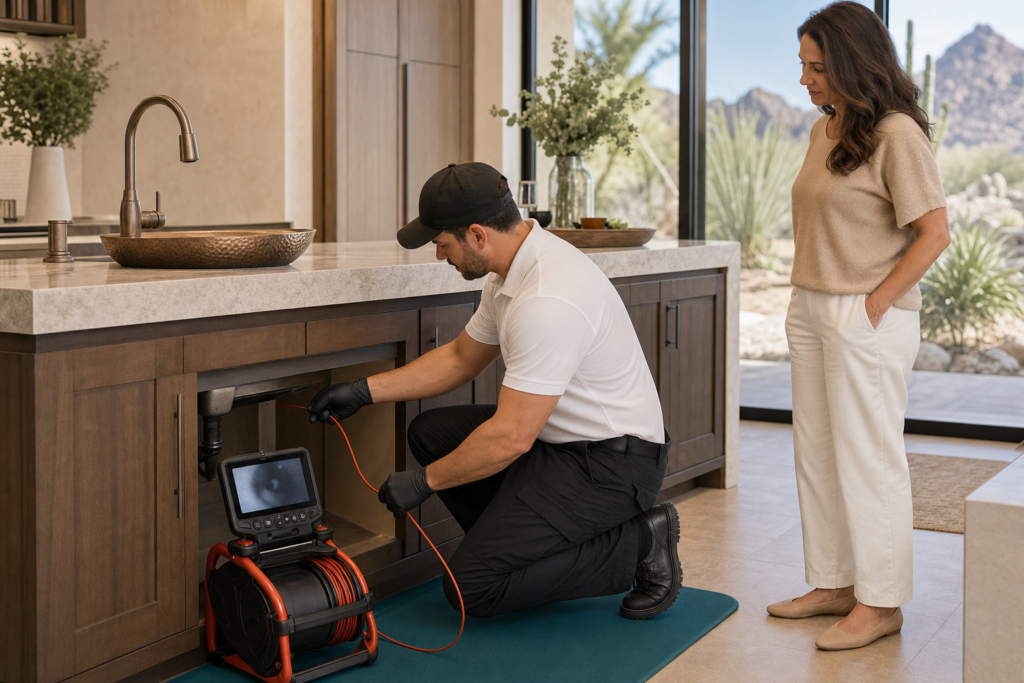
A sewer camera inspection uses a small, waterproof camera attached to a flexible cable that is fed into the drain or sewer line. The camera transmits a live video feed, allowing the technician to see the interior condition of the pipe — including the location and nature of the blockage, the condition of the pipe walls, and whether there are cracks, root intrusion, or structural issues.
For a high-value home, a camera inspection before any cleaning work begins is not an upsell. It is a basic diagnostic step. Without it, a technician is guessing at what is causing the problem, which increases the risk of using the wrong method, missing a deeper issue, or recommending unnecessary work.
A company that is willing to diagnose before it treats is telling you something important about how it operates.
Why Diagnosing Before Treating Protects Your Pipes and Your Property
Older cast iron or clay pipes can be damaged by aggressive cleaning methods applied without knowing the pipe’s condition first. A camera inspection helps the technician calibrate the approach — choosing the right equipment, the right pressure, and the right technique for the specific pipe material and the specific problem.
It also protects you from a common frustration: paying for a service that clears a symptom but misses the actual cause. If mineral scale has narrowed the line significantly, or if root intrusion has compromised a pipe joint, clearing the immediate clog without identifying the underlying issue means the problem will likely return.
Understand the Drain Cleaning Methods and When Each Is Appropriate
Mechanical Drain Snaking
A motorized drain snake — sometimes called an auger — is a flexible metal cable with a cutting head that is fed into the drain line to break through or pull out a blockage. Snaking is effective for soft clogs caused by hair, soap buildup, food debris, or minor organic matter.
Snaking is often the right first step for a straightforward clog in a single fixture — a kitchen sink, a shower drain, or a bathroom sink. It is less effective for widespread buildup, heavy mineral scale, or root intrusion that extends along a longer section of pipe.
Hydro-Jetting
Hydro-jetting uses a high-pressure stream of water delivered through a specialized nozzle to scour the interior walls of a drain or sewer line. It removes grease, mineral scale, root fragments, and accumulated buildup more thoroughly than snaking.
Hydro-jetting is particularly relevant in Phoenix because of hard water scale. In homes where mineral deposits have been building for years, hydro-jetting can restore the full interior diameter of the pipe in a way that snaking cannot.
However, hydro-jetting is not appropriate for every situation. The water pressure needs to be calibrated to the pipe material and condition. Older cast iron or clay pipes with existing cracks or deterioration may not tolerate the same pressure levels that newer PVC lines can handle. A qualified technician will assess the pipe condition — ideally with a camera inspection — before determining whether hydro-jetting is appropriate and at what pressure setting.
Ask the company whether they adjust water pressure based on pipe material and condition. If the answer is vague, that is worth noting.
Why Chemical Drain Cleaners Are Not the Right Choice for High-End Homes
Chemical drain cleaners — the kind sold at hardware stores — use caustic or acidic formulas to dissolve clogs. They can corrode older pipes, damage specialty fixtures and finishes, and often fail to clear the blockage completely. For a high-value home with quality fixtures and older or mixed-material plumbing, chemical cleaners introduce risk without solving the underlying problem.
Most licensed plumbers advise against chemical drain cleaners for this reason. If a company suggests pouring chemicals into your line as a first step, consider whether that reflects the level of care your home requires.
How to Verify Licensing and Insurance in Arizona
Checking the Arizona Registrar of Contractors
Every plumbing company working in Arizona should hold a valid license with the Arizona Registrar of Contractors (AZ ROC). You can verify a company’s license status, license classification, and complaint history directly on the AZ ROC website.
Here is what to look for:
- Go to the AZ ROC website and use the license search tool.
- Search by company name or license number.
- Confirm the license is active and in good standing.
- Check the license classification to confirm it covers plumbing work.
- Review the complaint history, if any, and how complaints were resolved.
This takes a few minutes and tells you more about a company’s track record than any advertisement can.
Why Standard Insurance May Not Be Enough for a High-Value Property
Most plumbing companies carry general liability insurance, which is a standard requirement. But the coverage limits matter. A policy that provides adequate coverage for a typical residential service call may not provide sufficient protection if a technician causes damage to high-end finishes, custom tile work, specialty fixtures, or landscaping in a multi-million dollar home.
It is reasonable to ask a company what their general liability coverage limits are before scheduling service. You are not being difficult — you are being responsible. A company that is comfortable working in high-value homes will not be surprised by the question.
Ask About Property Protection Before Anyone Enters Your Home
Surface Protection for Floors, Counters, and Custom Finishes
A drain cleaning service call involves bringing equipment into your home — motorized snakes, hydro-jetting units, camera equipment, and associated hoses and cables. That equipment can scratch hardwood, scuff natural stone, and damage custom finishes if the technician is not careful.
Before scheduling, ask the company what steps they take to protect interior surfaces during the work. Reasonable expectations include:
- Boot covers or clean, dedicated indoor footwear
- Floor protection in work areas and along access paths
- Care around countertops, cabinetry, and fixtures near the work area
- Cleanup of the work area after the job is complete
A company that treats your home with the same care you do is communicating something about its values — not just its technical ability.
Equipment Cleanliness
Drain cleaning equipment that was just used at another job site can track debris, bacteria, and residue into your home if it is not properly cleaned between service calls. This is a detail most homeowners do not think to ask about, but it matters — especially in a home where cleanliness and presentation are priorities.
Pricing Transparency and What a Written Estimate Should Include
One of the most common frustrations homeowners describe is uncertainty about what a plumbing service will cost. A quote that starts at one number and ends significantly higher creates stress and erodes trust — especially for higher-ticket services like hydro-jetting or sewer line work.
A trustworthy drain cleaning company should provide upfront pricing before the work begins. That means the technician explains the problem, describes the recommended approach, and tells you what it will cost — before starting.
A written estimate should include:
- A clear description of the work to be performed
- The total price, not just a starting range
- What is included and what is not
- Any conditions that could change the scope, explained in advance
If a company cannot or will not provide this level of clarity before beginning work, that is useful information for your decision.
Ten Questions to Ask a Drain Cleaning Company Before You Hire
These are practical questions you can ask over the phone or in person before scheduling. Each one tells you something meaningful about how the company operates.
- Do you perform a camera inspection before recommending a cleaning method? This tells you whether the company diagnoses before it treats.
- What drain cleaning methods do you use, and how do you decide which one is appropriate? A good answer involves assessing the pipe material, the type of blockage, and the condition of the line — not a one-size-fits-all approach.
- Do you adjust hydro-jetting pressure based on pipe material and condition? This matters especially for older Phoenix homes with cast iron or clay pipes.
- What is your AZ ROC license number? Any legitimate company will provide this without hesitation.
- What are your general liability insurance coverage limits? For a high-value home, this is a reasonable and important question.
- What steps do you take to protect floors, finishes, and fixtures during the work? The answer reveals how the company treats the homes it enters.
- Do you provide upfront pricing before starting the work? You should know the cost before the work begins, not after.
- Will you show me the camera footage and explain what you find? A company willing to share its findings in plain language is a company that trusts its own diagnosis.
- What happens if the cleaning reveals a larger issue, like a cracked pipe or significant root intrusion? You want to know how the company handles scope changes — whether it communicates clearly or pressures you into additional work on the spot.
- How do your technicians clean up after the work is done? A small question that tells you a lot about the company’s standards.
Red Flags to Watch For
Not every drain cleaning company operates the same way. These warning signs can help you avoid a poor experience:
- Recommending a full sewer line replacement without camera evidence. If a company tells you the entire line needs to be replaced without first showing you what the camera found, get a second opinion.
- No written estimate before work begins. Verbal quotes without documentation leave room for unexpected charges.
- Vague answers about methods or equipment. A qualified technician should be able to explain what they plan to do and why.
- Pressure to commit to additional services immediately. Honest diagnosis gives you time to evaluate your options — it does not demand an on-the-spot decision for expensive work.
- Unwillingness to share camera footage. If the company inspects your line but will not show you what they found, ask yourself why.
- No clear answer about licensing or insurance. This is non-negotiable. If the information is not readily available, move on.
How Fast Layne Plumbing Approaches Drain Cleaning in Phoenix
Fast Layne Plumbing is a family-owned plumbing company serving homeowners throughout the Phoenix area. Our approach to drain cleaning reflects the same values we bring to every service call: honest diagnosis, upfront pricing, plain-English explanations, and genuine respect for your home.
When you call us for a drain issue, here is what that looks like in practice:
- We answer the phone. That sounds simple, but if you have ever called a plumber and never heard back, you know it matters.
- We show up when we say we will.
- We use camera inspections when appropriate to understand what is actually happening inside the line — before recommending a cleaning method.
- We explain what we find in plain English, not technical jargon. If we use a camera, we show you the footage.
- We provide upfront pricing before any work begins. No surprises on the bill.
- We use professional equipment — including motorized drain snakes and hydro-jetting — and choose the method based on your pipe material, the type of blockage, and the condition of the line.
- We treat your home with respect. We protect your floors and work areas, and we clean up when the job is done.
- We do not pressure you into services you do not need. If a simple drain cleaning solves the problem, that is what we recommend. If the inspection reveals something more serious, we explain your options clearly and give you the space to decide.
We work on homes across Phoenix — from older properties with decades-old cast iron lines to newer custom builds. We understand the local conditions that affect your drains, and we tailor our approach accordingly.
If you are looking for a drain cleaning company you can trust with your home, we would welcome the chance to earn that trust.
Call Fast Layne Plumbing at 480.485.4659 to schedule service or ask us any of the questions listed above. We are happy to answer them.
Frequently Asked Questions
How often should drains be professionally cleaned in a Phoenix home?
There is no single schedule that applies to every home. Factors like the age of your plumbing, the number of fixtures, whether you have trees near your sewer line, and the hardness of your water all influence how quickly buildup accumulates. Some Phoenix homeowners benefit from annual preventive cleaning, while others may go several years without an issue. A licensed plumber can evaluate your system and recommend a maintenance interval based on what they find.
Is hydro-jetting safe for all pipe types?
Hydro-jetting is safe for most pipe types when the pressure is calibrated correctly. However, older cast iron or clay pipes that are already cracked, corroded, or deteriorated may not tolerate the same pressure levels that newer PVC lines can handle. This is one reason a camera inspection before hydro-jetting is important — it helps the technician assess whether the pipe can handle the process and at what pressure setting.
How do I verify a plumber’s license in Arizona?
You can verify any plumbing contractor’s license through the Arizona Registrar of Contractors (AZ ROC) website. Search by company name or license number to confirm the license is active, check the classification, and review any complaint history. The process takes a few minutes and is available to the public at no cost.
What is the difference between snaking and hydro-jetting?
Snaking uses a flexible metal cable with a cutting head to break through or remove a localized clog. For minor blockages — things like hair, soap residue, or food waste concentrated in a single fixture line — it is often the appropriate tool for the job. Hydro-jetting directs high-pressure water through the pipe to clean the interior walls, clearing accumulated buildup, mineral deposits, grease, and root material across a longer stretch of line. Hydro-jetting delivers a more comprehensive result but is not always the necessary choice — the correct method depends on the nature and location of the blockage and the overall condition of the pipe.
Why do plumbers recommend against chemical drain cleaners?
Chemical drain cleaners use caustic or acidic formulas that can corrode pipes — especially older cast iron, clay, or galvanized steel lines common in many Phoenix homes. They often fail to fully clear the blockage, can damage fixtures and finishes, and may create additional problems in the pipe over time. Professional mechanical or hydro-jetting methods are more effective and less likely to cause damage.
What is a sewer camera inspection and do I need one?
A sewer camera inspection involves feeding a small, waterproof camera into the drain or sewer line to visually inspect the pipe’s interior condition. It can identify the location and cause of a blockage, reveal cracks or root intrusion, and help the technician choose the right cleaning or repair approach. Whether you need one depends on the situation — for recurring clogs, slow drains throughout the house, or suspected sewer line issues, a camera inspection can provide clarity that saves time and money.
Can tree roots from desert landscaping cause drain problems in Phoenix?
Yes. Desert-adapted trees like mesquite, palo verde, and ficus have aggressive root systems that seek out moisture. If your sewer line has any cracks, joint separations, or deterioration, roots can work their way into the pipe and create blockages. This is especially common in older Phoenix neighborhoods where clay or cast iron sewer lines have been in the ground for decades. A camera inspection can confirm whether root intrusion is contributing to your drain issues.
The Right Drain Cleaning Company Makes the Difference
Choosing a drain cleaning company for a high-value Phoenix home is not just about finding someone who can clear a clog. It is about finding a company that diagnoses carefully, communicates honestly, uses the right methods for your specific plumbing, and treats your home with the respect it deserves.
The questions and criteria in this guide are designed to help you evaluate any company you are considering — including ours. We believe that an informed homeowner makes the best decisions, and we would rather earn your trust through transparency than through pressure.
If you have a drain issue in your Phoenix home and want it handled the right way, call Fast Layne Plumbing at 480.485.4659. We will answer the phone, show up when we say we will, and give you a straight answer about what your drains need.