Pipe Conditions That Make High-Pressure Hydro Jetting the Wrong Call
Hydro jetting works well on structurally sound pipes with heavy buildup, grease, scale, or root intrusion — but it can cause serious damage when the pipe is already compromised. The conditions that make jetting risky fall into two categories: structural damage that water pressure will worsen and fragile pipe materials that cannot handle the force. This is exactly why a camera inspection before jetting is standard professional practice — not an upsell, but a necessary step to protect your home.
If you own an older home in Phoenix, understanding these conditions can help you ask better questions before approving any jetting service and avoid turning a manageable drain problem into a costly repair.
Why Pipe Condition Matters More Than Most Homeowners Realize
Professional hydro jetting equipment sends water through your sewer or drain line at pressures typically ranging from 1,500 to 4,000 PSI. On a pipe in good structural condition, that force scours away grease, mineral scale, and even tree roots without harming the pipe walls or joints.
On a pipe that is already cracked, thinned, corroded, or shifted out of alignment, that same pressure can widen existing damage, force joints apart, or collapse weakened sections entirely. The result is a pipe that was partially functional before jetting and completely failed afterward.
The key distinction is this: hydro jetting is a cleaning method, not a repair method. It removes what is inside the pipe. It cannot fix what is wrong with the pipe itself. When the pipe’s condition is the real problem, jetting can make things worse.
Structural Conditions That Make Hydro Jetting Risky
These are situations where the pipe’s physical integrity is already compromised, regardless of what material it is made from.
Cracked or Fractured Pipe Sections
When a pipe wall already has cracks or fractures, high-pressure water forces its way through those openings and widens them. What may have been a hairline crack before jetting can become a full break afterward. In some cases, the surrounding soil washes into the pipe through the enlarged opening, creating a new blockage and undermining the ground around the line.
The risk in plain terms: Jetting does not seal cracks. It makes them bigger.
Collapsed or Partially Crushed Sections
A pipe that has already collapsed — partially or fully — cannot be cleaned back into shape. Directing high-pressure water into a crushed section can complete the collapse, turning a localized problem that might have been repairable into a full-length failure that requires excavation and replacement.
The risk in plain terms: Jetting into a collapsed section can finish what the ground started.
Bellied or Sagging Pipe
A pipe belly is a low spot or sag that forms when the ground beneath a pipe section settles unevenly. Water and debris collect in that low point because gravity no longer moves everything downhill the way it should. Jetting can clear what has collected in the belly, but it cannot fix the sag itself. The low spot remains, debris collects again, and the weakened section of pipe is now under repeated stress from both the standing water and the jetting pressure.
The risk in plain terms: Jetting treats the symptom but cannot correct the slope problem, and the weak spot stays vulnerable.
Severely Offset or Separated Joints
Pipes are assembled in sections, and the connections between those sections are called joints. Over time — especially in older systems — joints can shift, separate, or lose their seal due to ground movement, root pressure, or simple age. When a high-pressure jetting nozzle passes through an area where joints have already pulled apart, the water turbulence can push those sections further out of alignment or force them completely apart.
This is a failure mode that many homeowners do not think about because the pipe walls themselves may still be intact. The joints are the weak point, not the pipe body.
The risk in plain terms: Even when pipe walls look fine, shifted joints can be forced apart by jetting pressure.
Root-Damaged Pipe Where Roots Are Holding Sections Together
This is the condition that surprises most homeowners. When tree roots have grown into a sewer line through cracks or joint gaps, those roots sometimes become the only thing holding fractured pipe sections in place. The root mass fills the break and acts like a plug. Clearing those roots with hydro jetting removes the structural support, and the already-broken pipe sections can shift or cave in.
This does not mean root clearing is always a bad idea. It means that when a pipe is badly fractured and root-infiltrated, a camera inspection should come first so a technician can see what is actually happening inside the line before making a recommendation.
The risk in plain terms: Sometimes the roots are the only thing keeping a broken pipe from collapsing. Removing them without knowing the pipe’s condition can cause a bigger failure.
Pipe Materials That Are Particularly Vulnerable to High-Pressure Jetting
Some pipe materials are more likely to be damaged by hydro jetting — not because of their age alone, but because of how those materials deteriorate over time. A 50-year-old pipe in solid condition may handle jetting just fine, while a 25-year-old pipe with joint degradation may not. Condition matters as much as material.
Orangeburg Pipe
Orangeburg pipe is made from compressed wood fiber and tar. It was used widely from the 1940s through the early 1970s as a low-cost sewer line material. Over decades, Orangeburg softens, deforms, and eventually collapses under soil pressure. It is one of the most fragile pipe materials a plumber can encounter.
High-pressure water can puncture, crush, or fragment Orangeburg pipe that has already begun to deteriorate. In many cases, Orangeburg that has reached this stage needs replacement rather than cleaning.
Phoenix context: Homes built in Phoenix before the mid-1970s may have Orangeburg sewer lines, particularly in neighborhoods developed during the postwar building boom.
Old Clay Tile Pipe
Vitrified clay pipe was a common sewer line material for decades. The pipe body is hard but brittle, and the joints between clay sections were often sealed with mortar or oakum rather than modern rubber couplings. Over time, those joints crack, shift, and lose their seal. Ground movement, root intrusion, and decades of thermal cycling in Phoenix’s extreme heat accelerate this deterioration.
The risk with clay pipe is not always the pipe wall itself — it is the joints. Jetting pressure and nozzle turbulence can dislodge already-compromised clay joints and shift pipe sections out of alignment.
Phoenix context: Clay sewer lines are common in older Phoenix neighborhoods, especially in homes built from the 1950s through the 1970s.
Heavily Corroded Cast Iron
Cast iron pipe was used extensively for drain and sewer lines in homes built through the 1970s and into the 1980s. Cast iron is durable when intact, but it corrodes from the inside out over time. Interior rust and scale build up on the pipe walls, gradually thinning them. Eventually, sections of the pipe wall become so thin that they can no longer withstand normal use — let alone thousands of PSI of water pressure.
The distinction matters: surface corrosion on a thick-walled cast iron pipe is different from structural wall loss. A camera inspection can help a technician assess how much wall thickness remains and whether jetting is appropriate.
Asbestos Cement Pipe
Asbestos cement pipe, sometimes called Transite pipe, was used in some water and sewer applications through the mid-20th century. It becomes brittle with age and can fracture under high-pressure cleaning. If asbestos cement pipe is present, professional assessment is important before any cleaning or repair work is performed.
PVC Pipe With Existing Joint or Degradation Issues
Healthy PVC pipe in good condition generally handles hydro jetting well. PVC is smooth, durable, and resistant to corrosion. However, PVC pipe that has degraded joints, improper connections, or sections weakened by ground movement or root pressure may not tolerate jetting safely.
This is a nuance that matters: not all PVC is at risk, but damaged or poorly joined PVC can fail under pressure just like any other compromised material.
Phoenix context: Many Phoenix homes built from the late 1970s through the 1990s have PVC drain or sewer lines. Most are in serviceable condition, but homes with shifting soil, mature tree roots near the line, or previous repair work may have joint issues worth inspecting before jetting.
The Step That Should Always Come First: Camera Inspection
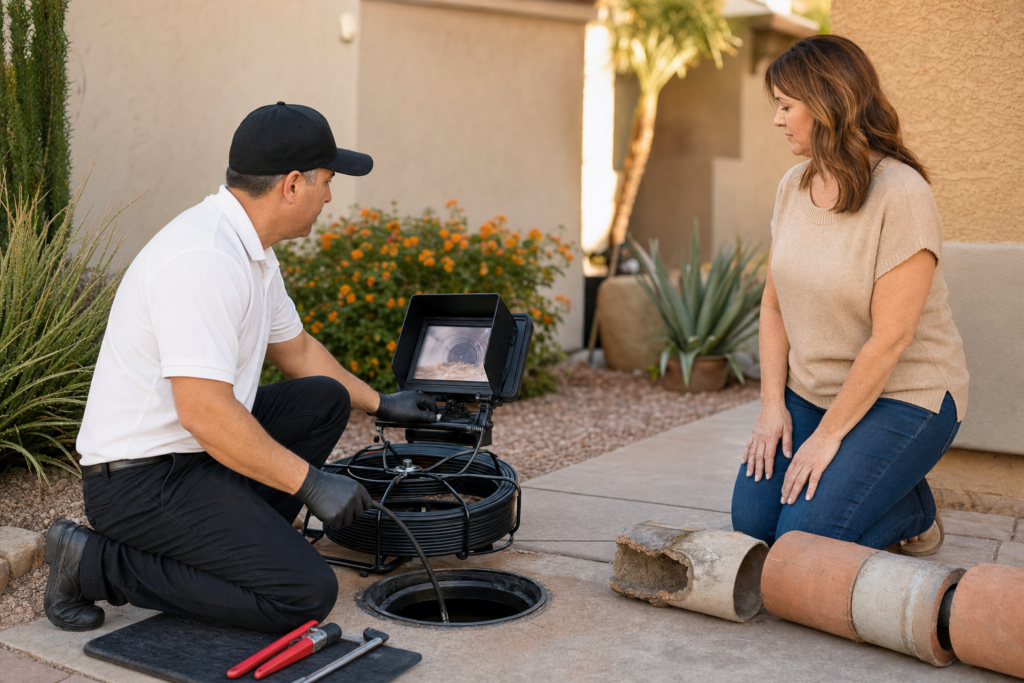
A camera inspection — sometimes called a CCTV pipe inspection or video line inspection — sends a small waterproof camera through the inside of your drain or sewer line. The live video feed shows the technician the pipe material, wall condition, joint alignment, root intrusion, cracks, bellies, offsets, and any other structural concerns that are not visible from the surface.
This matters because symptoms at the drain do not tell you the full story about what is happening underground. A slow drain could be caused by a grease buildup in a perfectly sound pipe, or it could be caused by root intrusion through a cracked section that would be made worse by jetting. Without a camera inspection, there is no reliable way to know which situation you are dealing with.
A camera inspection before jetting protects you as a homeowner. It gives both you and your plumber the information needed to make a sound decision about whether jetting is the right tool — or whether a different approach is more appropriate for what the pipe actually needs.
At Fast Layne Plumbing, a camera inspection is part of how we approach drain and sewer work when the situation calls for it. We want to see the real problem before we recommend a solution, and we explain what the camera shows you in plain English so you can make an informed decision.
What Happens When Jetting Is Not the Right Call
When a camera inspection reveals that a pipe is too compromised for hydro jetting, there are other paths forward depending on what the inspection shows.
- Mechanical drain snaking may be appropriate for simple blockages in pipes where the structural condition is questionable. A motorized drain snake clears the immediate clog with less force than jetting, though it does not scour the full pipe wall the way jetting does.
- Pipe repair or pipe relining may be an option when the damage is localized — a cracked section, a separated joint, or a short run of deteriorated pipe. The right repair method depends on the location, depth, material, and extent of the damage.
- Pipe replacement may be the most practical choice when the line is extensively deteriorated, collapsed, or made from a material like Orangeburg that has reached the end of its service life. In some cases, trenchless methods can reduce the disruption of replacement.
The right tool depends entirely on what the pipe actually needs. A trustworthy plumber will explain your options clearly, tell you what the inspection revealed, and help you understand the tradeoffs — without pushing you toward unnecessary work.
If you have been quoted hydro jetting and are unsure whether it is appropriate for your pipes, asking for a camera inspection first is a reasonable and smart request. Any reputable plumber should be willing to look before they blast.
Questions to Ask Before Approving Hydro Jetting
Whether you are working with Fast Layne Plumbing or any other licensed plumber, these questions can help you feel confident about the recommendation:
- Has a camera inspection been performed on the line?
- What did the camera inspection show about the pipe material and condition?
- Are there any cracks, offsets, bellies, or joint issues visible in the line?
- What PSI will be used, and is that appropriate for the pipe material?
- If jetting is not safe for this pipe, what alternative do you recommend and why?
A plumber who takes these questions seriously and answers them in plain language is a plumber who is looking out for your home — not just looking for the fastest way to close a ticket.
Frequently Asked Questions
Can hydro jetting damage PVC pipes?
PVC pipe in good condition typically handles hydro jetting without issue. The concern is PVC that has degraded joints, improper connections, or sections weakened by ground movement or root pressure. A camera inspection can help determine whether the PVC in your line is sound enough for jetting.
How do I know what material my pipes are made of?
Most homeowners do not know their pipe material without a professional inspection. A camera inspection can identify the material, condition, and joint type of your drain or sewer line. Your home’s age and construction era can also provide clues — for example, homes built in Phoenix before the mid-1970s may have clay, cast iron, or Orangeburg lines.
What should happen before hydro jetting is performed?
A camera inspection should be performed before hydro jetting on any line where the pipe condition is unknown or uncertain. The inspection allows the technician to assess the pipe material, wall thickness, joint condition, and structural integrity before applying high-pressure water. This step helps protect your pipe from avoidable damage.
Is hydro jetting safe for older homes in Phoenix?
It depends on the pipe’s condition, not just the home’s age. An older Phoenix home with a well-maintained cast iron or PVC sewer line may be a perfectly good candidate for jetting. An older home with deteriorated clay joints or thinning cast iron may not be. The only reliable way to know is a camera inspection before jetting.
What are the alternatives to hydro jetting for damaged pipes?
Depending on the situation, alternatives may include mechanical drain snaking for simpler blockages, pipe repair or relining for localized damage, or pipe replacement for extensively deteriorated lines. A licensed plumber can evaluate what the pipe needs based on a camera inspection and recommend the most appropriate option.
When You Want Honest Answers Before the Work Starts
Hydro jetting is a valuable tool when it is used on the right pipe in the right condition. The problem is not the method — it is applying it without knowing what the pipe can handle. That is where a diagnostic-first approach matters.
At Fast Layne Plumbing, we look before we recommend. We use camera inspections to understand what is actually happening inside the line, we explain what we find in plain English, and we give you upfront pricing before any work begins. If jetting is the right call, we will tell you why. If it is not, we will tell you that too — along with what we recommend instead and what it will cost.
We are a family-owned plumbing company serving Phoenix, AZ, and we built this business on honest diagnosis, reliable service, and treating every home with respect. If you are dealing with a stubborn drain issue, recurring backups, or a recommendation for hydro jetting that you want a second opinion on, we are happy to help.
Call Fast Layne Plumbing at 480.485.4659 to schedule a camera inspection or talk through your drain or sewer situation with a local Phoenix plumber who will give you a straight answer.