What Sewer Camera Footage Reveals That Drain Symptoms Alone Cannot Tell You
A slow drain tells you something is wrong. Sewer camera footage tells you what is wrong, where it is, and how serious the problem actually is. That distinction matters because two homeowners with the exact same symptom — a drain that keeps backing up every few months — can have completely different problems requiring completely different solutions. One may need a thorough hydro jetting. The other may have a cracked sewer line forty feet from the house that no amount of cleaning will fix.
Symptoms describe behavior. Camera footage provides evidence. For Phoenix homeowners trying to make a smart decision about sewer work, understanding what that evidence actually shows — and what it cannot prove on its own — is worth knowing before you authorize any repair.
What Drain Symptoms Can and Cannot Tell You
Homeowners pay attention. A drain that starts moving slowly, a toilet that gurgles unexpectedly, an odd smell coming from a floor drain, or a line that has backed up repeatedly over the past year — these are all signals that something is off. Those observations matter and give a plumber a useful starting point for understanding where flow is being restricted or disrupted.
But here is what symptoms alone cannot confirm:
- The cause — A slow kitchen drain could be grease buildup, a partial root intrusion, a bellied pipe section, or a joint offset. The symptom feels the same at the sink.
- The location — Is the problem five feet from the cleanout or sixty feet into the lateral line? Symptoms do not tell you where.
- The severity — A drain that backs up once a year and a drain that backs up because the pipe is partially collapsed can both start with the same slow-flowing warning sign.
- The pipe condition — A line can be cleaned, flow can be restored, and the homeowner can feel like the problem is solved — while cracks, corrosion, or structural damage remain hidden inside the pipe.
This is the diagnostic gap. Symptoms are the starting point, not the full picture. Camera footage is what closes that gap.
What Camera Footage Reveals That Symptoms Cannot
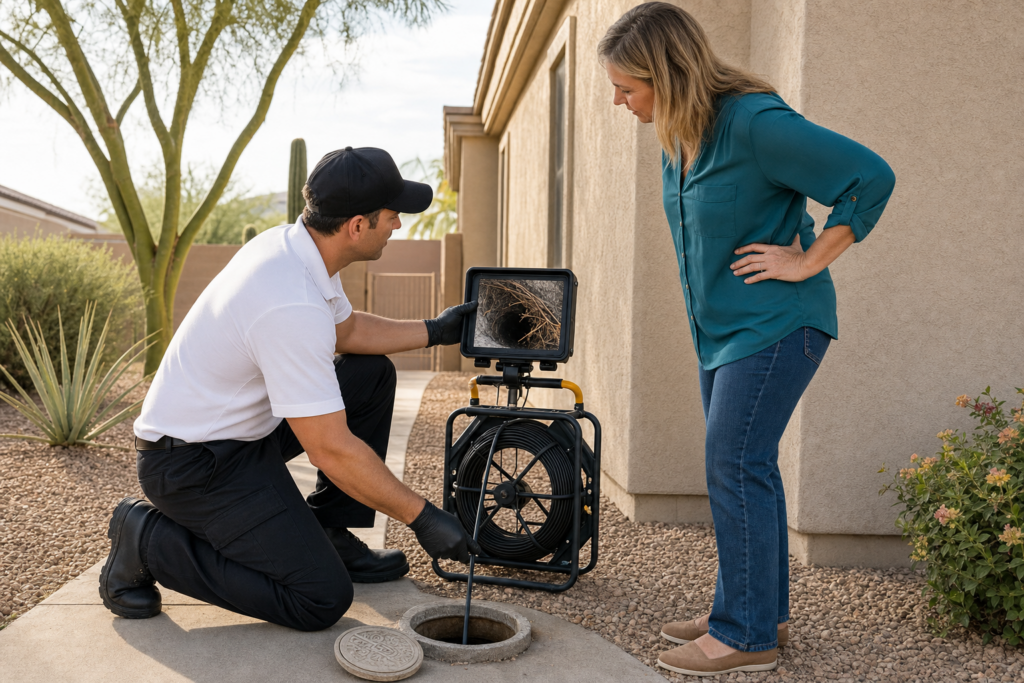
A sewer camera is a small, waterproof video camera attached to a flexible cable. A technician feeds it into the line through a cleanout or drain opening, and the camera sends a live video feed back to a monitor. What appears on that screen is the actual interior condition of your pipe — and it often tells a very different story than the symptom suggested.
Root Intrusion
Tree roots enter sewer lines through small cracks or gaps at pipe joints. On camera, root intrusion is visible as hairlike fibers growing through the pipe wall, or in more advanced cases, as a dense mass of roots partially or fully blocking the line. A homeowner experiencing a recurring slow drain may assume the issue is grease or debris. The camera shows whether roots are the actual cause — and just as importantly, where along the line they are entering and how much of the pipe wall is compromised.
In Phoenix, mature trees in established neighborhoods can send roots significant distances toward a sewer lateral, especially when irrigation or moisture near the line draws them in. Without camera footage, there is no reliable way to know whether roots are contributing to the problem or how far that intrusion has progressed.
Pipe Bellies
A pipe belly is a segment of the sewer line that has dropped or settled over time, forming a low point where water, waste, and sediment pool rather than continuing to flow downstream. On camera, a belly appears as standing water that does not move when the camera advances — the line dips down and the water pools rather than draining forward.
From inside the home, a pipe belly can cause intermittent backups that seem random. The drain may function normally on certain occasions and then back up without any apparent explanation. That unpredictability makes it hard to identify the cause through observation alone. Camera footage shows the belly clearly, confirms its location, and helps determine whether the sag is significant enough to require repair or whether it can be monitored over time.
Cracks, Fractures, and Collapsed Sections
Structural damage to a sewer line does not always announce itself dramatically. A hairline crack may allow water to seep out slowly and soil to work its way in without causing a full backup. A partial collapse may restrict flow enough to slow a drain but not enough to stop it completely.
On camera, these conditions are visible: a crack appears as a line in the pipe wall, a fracture shows sections separating, and a collapse shows the pipe wall buckling or breaking inward. Symptoms might suggest a simple clog. The footage shows that the pipe itself is damaged — and that cleaning alone will not resolve the underlying structural issue.
Joint Offsets and Separated Pipe Sections
Sewer lines are made of individual pipe sections joined together. Over time, soil movement, settling, or ground conditions can cause those joints to shift. When one pipe section slides slightly out of alignment with the next, it creates a lip or gap called a joint offset.
On camera, a joint offset is visible as a step or ledge inside the pipe where the sections no longer meet flush. This creates a snag point where debris, grease, and roots can catch and accumulate. A homeowner who keeps calling for drain cleaning every few months may not realize that the recurring problem is a physical misalignment in the pipe that traps material in the same spot every time. Camera footage shows the offset, its severity, and whether it is likely to keep causing problems.
Scale, Grease, and Mineral Buildup Coating the Interior
There is a difference between a clog and a coating. A clog is a blockage at one point in the line. A coating is a buildup of scale, grease, calcium, or mineral deposits that has gradually narrowed the inside diameter of the pipe over years or decades.
From the drain, both conditions can feel like a slow line. On camera, the difference is obvious. A localized clog appears at one spot. A coated pipe shows buildup along the entire visible length, reducing the effective pipe diameter and restricting flow even when there is no single blockage. This distinction matters because it directly affects whether standard drain cleaning is sufficient or whether hydro jetting — a more thorough cleaning method that uses high-pressure water to remove buildup from the pipe walls — is the more appropriate service.
Pipe Material and Overall Line Condition
Camera footage shows what the pipe is actually made of. This matters more than many homeowners realize, because pipe material directly affects what kinds of problems are likely, how the pipe will age, and what repair options make sense.
Many Phoenix homes built from the 1950s through the 1980s have clay or cast iron sewer lines. Some mid-century homes may have Orangeburg pipe — a fiber-based pipe material that becomes soft and prone to collapse over time. Newer homes typically have PVC. On camera, a technician can identify the pipe material, assess its current condition, and note whether corrosion, deterioration, or material-specific weaknesses are developing. Symptoms at the drain cannot tell you any of this.
Previous Repairs, Material Transitions, and Unusual Installations
Camera footage sometimes reveals surprises that no symptom would ever suggest. A previous homeowner may have had a section of the line patched or replaced, creating a transition point between different pipe materials. There may be a fitting that was installed improperly, or a section where construction debris was never cleared from the line.
These findings change the diagnostic picture. A transition from clay to PVC may be perfectly functional — or it may be the exact spot where roots are entering. A poorly installed fitting may be the reason a line keeps catching debris. Without the camera, these issues remain invisible.
Precise Location and Depth of the Problem
A sewer camera does more than show what the problem is. It also helps determine exactly where it is. Many camera systems include a sonde — a small radio transmitter built into the camera head. Once the camera reaches the problem area, a technician uses a locating device above ground to pinpoint the sonde’s position and estimate the depth of the pipe at that point.
This is important because it means any necessary repair can be targeted to the specific section of pipe that needs attention, rather than guessing or excavating a larger area than necessary. Symptoms cannot tell you whether the problem is under the driveway, the front yard, or the landscaping. The sonde can.
What Camera Footage Cannot Prove on Its Own
Honesty about what camera inspection can and cannot do is part of a trustworthy diagnosis. Camera footage is powerful evidence, but it has limits.
- Exterior pipe condition: The camera shows the inside of the pipe. It cannot show what the soil around the pipe looks like or whether the exterior of the pipe is compromised in ways that are not yet visible from inside.
- Structural strength beyond visual assessment: A pipe may look intact on camera but have reduced structural integrity that visual inspection alone cannot measure.
- What lies past an impassable blockage: If the camera cannot physically pass a severe blockage or collapse, the condition of the pipe beyond that point remains unknown until the obstruction is cleared.
- Whether a visible defect requires immediate action: A small crack does not automatically mean the entire line needs to be replaced. The significance of a finding depends on its size, location, progression, and how it relates to the symptoms that prompted the inspection.
This is why technician interpretation matters. Camera footage is evidence, not a verdict. A trained, experienced technician looks at the same footage a homeowner sees on the monitor but reads it differently — recognizing the difference between a cosmetic imperfection and a structural concern, understanding how a specific type of damage typically progresses, and knowing which findings warrant immediate repair versus monitoring.
At Fast Layne Plumbing, our technicians walk homeowners through the footage and explain what they are seeing in plain English. The goal is for you to understand the condition of your line and the reasoning behind any recommendation — not to feel pressured into a decision.
How Camera Findings Guide the Repair Decision
One of the most practical things camera footage does is narrow the path from a vague concern to a clear, evidence-based course of action. Without footage, a repair recommendation is based on symptoms and experience. With footage, the recommendation is grounded in visible evidence.
Here is how different findings typically point toward different next steps:
| What the Camera Shows | What It May Mean for Next Steps |
|---|---|
| Grease or scale coating the pipe walls | Hydro jetting may be appropriate to clean the full line and restore flow capacity |
| Root intrusion at one or two joints | Root clearing followed by evaluation of whether the joints need repair to prevent re-entry |
| A pipe belly causing standing water | Monitoring if minor, or targeted repair or replacement of the sagging section if significant |
| A crack or fracture in an otherwise sound line | Spot repair, pipe relining, or localized replacement depending on the severity and location |
| Widespread deterioration of an aging pipe material | Full line replacement may be the most practical long-term option |
| A joint offset creating a recurring snag point | Repair or replacement of the affected section to eliminate the ongoing cause of backups |
The point is that the same symptom — a drain that keeps backing up — can lead to very different recommendations depending on what the footage shows. Camera inspection helps make sure the recommendation fits the actual problem, not just the symptom.
When a Camera Inspection Is Most Useful for Phoenix Homeowners
Not every drain issue requires a camera inspection. A straightforward clog that clears with standard drain cleaning and does not return may not warrant one. But there are situations where camera inspection adds clear value:
- Recurring drain problems: If the same line keeps backing up after cleaning, the camera can show why the problem keeps coming back.
- Older homes with original sewer lines: Phoenix homes built in the 1950s through the 1980s often have clay, cast iron, or Orangeburg pipe. Camera inspection shows the current condition of aging pipe materials before a problem becomes urgent.
- Properties with mature trees: Established neighborhoods throughout Phoenix have large trees with root systems that can reach sewer laterals. Camera footage confirms whether root intrusion is present and how extensive it is.
- Before buying a home: A camera inspection of the sewer lateral can reveal conditions that a standard home inspection does not cover.
- Before a remodel or addition: Knowing the condition and routing of your sewer line before adding fixtures or changing the layout can prevent problems during construction.
- After a previous repair recommendation felt unclear: If you received a recommendation for major sewer work and were not sure whether it was truly necessary, a camera inspection provides the visual evidence to evaluate that recommendation on your own terms.
What to Ask After Seeing Camera Footage
If you have a camera inspection done, you should feel comfortable asking questions about what the footage shows. A few questions worth asking:
- What exactly are we looking at on the screen?
- Is this the cause of my symptoms, or is this something separate?
- What is the pipe made of, and does that affect my options?
- Is this something that needs to be addressed now, or can it be monitored?
- What are the repair options, and what does each one involve?
- How did you determine the location of the problem?
A trustworthy plumber will welcome these questions. At Fast Layne Plumbing, we want homeowners to understand the findings clearly before making any decisions. Our technicians explain what the footage shows, what it means, and what the options are — in plain English, with upfront pricing, and without pressure.
Frequently Asked Questions
Can a sewer camera inspection confirm whether I need to replace my sewer line?
Camera footage can show the condition of your pipe — including cracks, collapse, widespread deterioration, or material-specific issues — that may indicate replacement is the most practical option. However, the footage is one piece of the evaluation. A licensed plumber interprets the findings alongside the pipe material, age, location, and your specific situation to recommend whether repair, relining, or replacement makes sense.
What does root intrusion actually look like on camera?
In early stages, root intrusion appears as thin, hairlike fibers entering the pipe through cracks or joint gaps. In more advanced cases, roots can form a dense mass that partially or fully blocks the line. The camera also shows where along the line roots are entering, which helps determine the right approach to clearing and whether the entry point needs repair.
Is a camera inspection worth it if my drain is already flowing again after cleaning?
It can be, especially if the drain has backed up more than once. Cleaning restores flow, but it does not show you the condition of the pipe. A line that flows well today may still have a belly, a joint offset, root intrusion starting at a joint, or scale buildup narrowing the pipe. Camera inspection after cleaning gives the clearest view of the pipe’s actual condition, because the line is clear enough for the camera to travel through and capture usable footage.
Can a sewer camera find every blockage?
A camera can show blockages that are within reach of the cable and that allow the camera to pass through or view the obstruction. If a blockage is severe enough that the camera cannot physically pass it — such as a full collapse — the camera can show the obstruction but may not be able to assess what is beyond it until the blockage is addressed.
What is a sonde and how does it help locate the problem?
A sonde is a small radio transmitter built into or near the camera head. When the camera reaches the problem area inside the pipe, the technician uses a handheld locating receiver above ground to detect the sonde’s signal. This allows the technician to mark the approximate location and estimate the depth of the problem, so any repair work can be targeted to the right spot.
How is a camera inspection different from just snaking a drain?
Snaking a drain is a cleaning method. A motorized cable with a cutting or clearing head is sent into the pipe to break through or pull out a blockage. A camera inspection is a diagnostic method. The camera does not clear anything — it records what the inside of the pipe looks like so the technician can identify the cause, location, and condition of the line. The two services serve different purposes and are often most useful when used together: cleaning first to restore flow, then camera inspection to evaluate the pipe.
The Difference Between a Symptom and a Diagnosis
A slow drain, a recurring backup, or a sewer smell near a cleanout are important signals. They tell you that something in the line is not working the way it should. But symptoms alone cannot tell you what is happening inside the pipe, where the problem is, how serious it is, or what the right fix looks like.
Camera footage bridges that gap. It turns a symptom into a diagnosis — or at least into the evidence needed to make a clear, informed decision about what to do next.
If you are dealing with a drain issue that keeps coming back, or if you have been told you need sewer work and want to see the evidence before moving forward, a camera inspection is a reasonable and practical step.
Fast Layne Plumbing provides camera inspection services for Phoenix homeowners. We show you the footage, explain what we see, and give you honest options with upfront pricing. No guesswork. No pressure. Just a clear picture of what is going on inside your line.
Call Fast Layne Plumbing at 480.485.4659 to schedule a camera inspection or ask any questions about your sewer line.