What Phoenix Homeowners Should Ask About Flat-Rate Drain Cleaning Before Approving Any Work
Flat-rate drain cleaning means the plumber quotes one price for the job rather than billing by the hour. That sounds straightforward, and it can be — but what the flat rate actually covers varies from one company to the next. In Phoenix specifically, local plumbing conditions like hard water buildup, older cast-iron pipes, and limited cleanout access can all affect what a drain cleaning visit involves and what the final cost looks like.
Before you approve any flat-rate drain cleaning service, there are specific questions worth asking. More importantly, you should know what a clear, honest answer sounds like so you can make a confident decision. This guide walks through the questions that matter most for Phoenix homeowners, explains why each one matters here, and helps you recognize straightforward answers when you hear them.
What “Flat Rate” Actually Means in Drain Cleaning
What Is Typically Included
A flat-rate drain cleaning price usually covers the technician’s arrival, a specific method of clearing a clog (most often a motorized drain snake), and a defined scope of work — such as clearing one drain line. The idea is that you know the price before the work starts, regardless of how long the job takes.
What Is Commonly Excluded
Flat-rate pricing does not always include every possible service your drain might need. Camera inspections, hydro jetting, access work like pulling a toilet, after-hours service, and work on the main sewer line may each fall outside the quoted flat rate. These are not hidden fees if the company explains them up front — but they can become surprises if nobody mentions them before work begins.
Why the Term Can Mean Different Things at Different Companies
There is no industry-wide standard for what a flat-rate drain cleaning service must include. One company’s flat rate might cover snaking a single branch line through an accessible cleanout. Another company’s flat rate might include a camera inspection and cover the main sewer line. The term itself does not tell you enough. The questions below help you understand exactly what you are agreeing to.
What Method Will the Technician Use — Snaking or Hydro Jetting?
Why This Matters for Pricing and Results
Snaking (also called cabling or rootering) uses a motorized cable to break through or pull out a clog. Hydro jetting uses high-pressure water to scour the inside of the pipe, clearing buildup along the entire line. These are different tools that do different things, and they are typically priced differently.
A flat-rate drain cleaning quote usually refers to snaking. Hydro jetting is often a separate service with its own pricing because it involves different equipment and a more thorough cleaning process. Knowing which method is included in your quote helps you understand what you are paying for and whether additional services might be recommended once the technician evaluates the line.
Phoenix Context: Hard Water and When Hydro Jetting May Be Genuinely Needed
Phoenix tap water is hard — high in dissolved minerals like calcium and magnesium. Over time, mineral scale can build up inside drain and sewer lines, gradually narrowing the pipe and contributing to recurring clogs. Standard snaking can break through a blockage caused by this buildup, but it may not remove the scale lining the pipe walls. Hydro jetting can address that deeper buildup when the situation calls for it.
This does not mean every drain cleaning in Phoenix requires hydro jetting. It means that if a technician recommends hydro jetting after evaluating your line, hard water scale is one of the legitimate reasons that recommendation may come up in this area.
What a Clear Answer Sounds Like
A straightforward plumber will tell you which method the flat rate covers, explain the difference between the two in plain language, and let you know whether a different method might be recommended after the initial evaluation — along with what that would cost. If a company cannot tell you which method is included in the quoted price, that is worth clarifying before you agree to service.
Does the Flat Rate Require an Accessible Cleanout?
What a Cleanout Is and How to Check If Your Home Has One
A cleanout is an access point — usually a capped pipe fitting at or near ground level — that gives a plumber direct entry into your drain or sewer line. Many Phoenix homes have a cleanout in the front yard, back yard, or along a side wall. Some older homes may not have one at all, or the cleanout may be buried under landscaping, concrete, or soil.
You can check by walking the perimeter of your home and looking for a round or square cap on a short pipe, typically three to four inches across, sticking up slightly from the ground or mounted on the exterior wall near ground level.
What Happens If Access Requires Pulling a Toilet or Using a Roof Vent
If your home does not have an accessible cleanout, the technician may need to access the drain line by removing a toilet or going through a roof vent stack. Both of these approaches require additional labor and time. Some flat-rate quotes include this kind of access work, and some do not. Asking about it in advance prevents a surprise adjustment to the price after the technician has already arrived.
What a Clear Answer Sounds Like
A clear answer explains whether the flat rate assumes cleanout access, and what the cost difference looks like if the technician needs to pull a toilet or use another access point. A plumber who handles this honestly will ask you about your cleanout situation before quoting or will confirm it on arrival before starting any work.
Is This for a Branch Line or the Main Sewer Line?
The Difference and Why It Affects Price
A branch line is the individual drain pipe running from a single fixture — your kitchen sink, shower, or bathroom sink — to the main sewer line. The main sewer line is the larger pipe that carries everything from your home out to the municipal sewer connection.
Clearing a branch line clog is generally a smaller job than clearing a main sewer line blockage. If a flat-rate quote is for a branch line only, a main line backup would typically be a different scope of work with different pricing.
Are There Footage or Distance Limits?
Some flat-rate quotes include snaking up to a certain number of feet into the line. If the clog is deeper than that limit, additional charges may apply. This is worth asking about directly, because the depth of the clog is something neither you nor the plumber can always predict before the work begins.
What a Clear Answer Sounds Like
A straightforward answer specifies whether the quote covers a branch line, the main sewer line, or both — and whether there is a footage limit. A plumber who is honest about this will also explain what happens if the scope changes once they are on site, rather than leaving that conversation for after the work has already started.
Is a Camera Inspection Included?
Why a Camera Inspection Matters
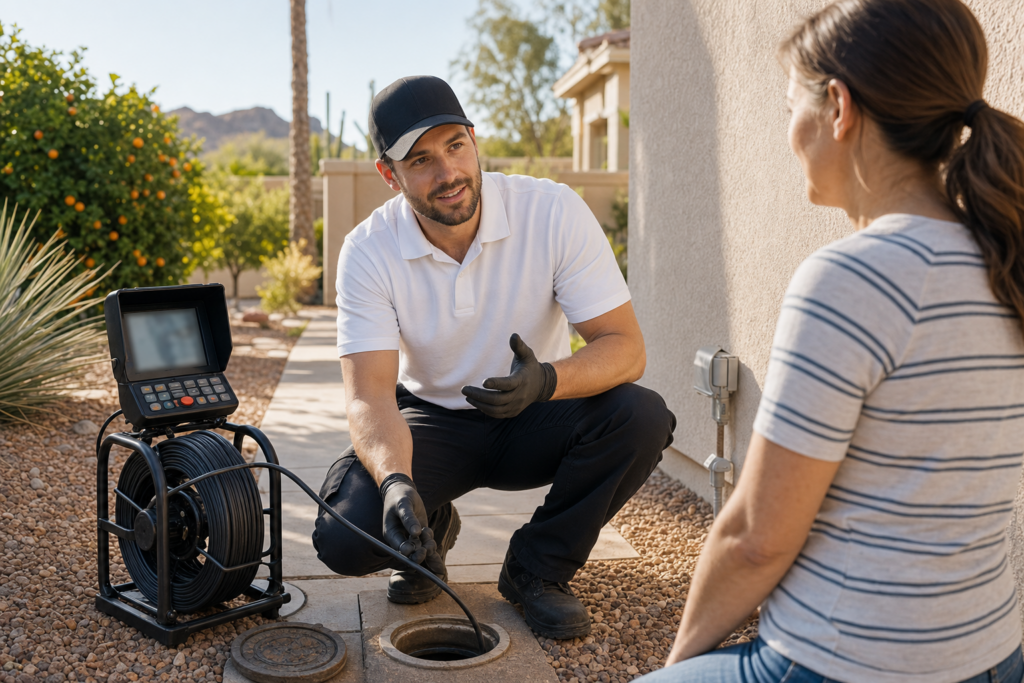
A sewer camera inspection lets the technician see inside the pipe to identify the cause and location of a blockage — and to check the condition of the line after clearing it. Without a camera, the technician is working based on feel and experience, which is often enough for straightforward clogs. But for recurring problems, older pipes, or main sewer line issues, a camera inspection provides information that guessing cannot.
What a Clear Answer Sounds Like
Ask whether a camera inspection is included in the flat rate, available as an add-on, or recommended based on the situation. A plumber who is transparent about this will explain when a camera inspection adds value and when it may not be necessary — rather than either always including it or never mentioning it.
Phoenix Context: Cast-Iron Pipes in Older Neighborhoods
Many Phoenix homes built from the 1950s through the 1980s have cast-iron drain and sewer pipes. Cast iron is durable, but after decades of use it can develop internal corrosion, scale buildup, and cracks that contribute to recurring clogs. A camera inspection can reveal whether a clog is caused by a simple obstruction or by a pipe condition that cleaning alone may not resolve. If your home is in an older Phoenix neighborhood and you are dealing with repeat drain issues, asking about a camera inspection is especially worthwhile.
What Happens If the Clog Cannot Be Cleared?
Will You Still Owe the Flat Rate?
Sometimes a clog cannot be cleared with standard snaking — because the blockage is caused by a collapsed pipe, heavy root intrusion, or a structural issue deeper in the line. This is not common, but it happens. Understanding what you owe if the technician is unable to resolve the clog helps you avoid frustration and unexpected charges.
Can Any Portion Be Applied Toward Additional Work?
If the drain cleaning reveals a more serious issue that requires repair rather than clearing, some companies will apply the drain cleaning charge toward the cost of the larger repair. Others treat them as separate charges. Asking this question before the work starts gives you a clear picture of how the pricing works if the scope changes.
What a Clear Answer Sounds Like
A trustworthy plumber will explain their policy on this before starting — not after the attempt has been made. A clear answer addresses whether the flat rate applies regardless of outcome, and what options are available if the problem turns out to be more than a standard clog.
Is There a Warranty on the Work?
What a Reasonable Warranty Covers
A drain cleaning warranty typically means that if the same drain clogs again within a certain period, the company will return and clear it at no additional charge. Warranty terms and coverage windows differ from one company to another. Some warranties apply only to the specific drain that was serviced, while others may exclude clogs caused by root intrusion, foreign objects, or problems unrelated to the original blockage.
What to Listen For
Ask how long the warranty lasts, what it covers, and what it does not cover. A company that offers a warranty and explains the terms clearly is giving you something you can rely on. A company that is vague about the warranty terms or avoids the question entirely is harder to evaluate.
What a Clear Answer Sounds Like
A good answer names the warranty length, explains what is included, and honestly states any exclusions. You should be able to walk away from that conversation knowing exactly what the warranty means for your situation — without needing to read fine print or guess at the terms.
Are There Any Additional Fees Beyond the Flat Rate?
Service Call, Dispatch, and Diagnostic Fees
Some companies charge a separate fee just for sending a technician to your home, on top of the flat-rate drain cleaning price. Others include the trip in the flat rate. This is one of the simplest questions to ask, and one of the easiest ways to avoid a surprise on the final bill.
After-Hours, Weekend, and Holiday Surcharges
Drain problems do not always happen during business hours. If you are scheduling service in the evening, on a weekend, or on a holiday, ask whether the flat rate changes. Some companies hold the same price regardless of timing. Others apply a surcharge for non-standard hours. Either approach is fair — as long as it is communicated before you approve the work.
Equipment, Disposal, or Travel Fees
Less common, but worth asking: are there any charges for specific equipment use, disposal of debris from the line, or travel to your location? Most reputable companies include these in their pricing, but confirming it costs you nothing and takes ten seconds.
What a Clear Answer Sounds Like
A clear answer lists every charge you can expect before the work begins. A plumber who is upfront about pricing will welcome this question, not dodge it. If the answer is that the quoted price covers everything with nothing added on top, that is the best kind of simple.
Phoenix-Specific Conditions That Can Affect Flat-Rate Pricing
Hard Water and Mineral Scale Buildup
Phoenix water is among the hardest in the country. Calcium and mineral deposits settle inside pipes over the years, slowly restricting flow and leading to clogs that reappear even after the line has been cleared. A standard drain cleaning may resolve the immediate blockage, but if hard water scale is the underlying issue, the clog may return. Understanding this helps you have a more informed conversation with your plumber about what the cleaning accomplished and what to watch for afterward.
Cast-Iron Pipes in Older Valley Neighborhoods
Homes built in Phoenix from the mid-twentieth century through the early 1980s often have cast-iron drain lines. These pipes corrode from the inside over time, developing rough interior surfaces that catch debris and promote buildup. A drain cleaning on a cast-iron line may involve more resistance and more complexity than the same job on a newer PVC line. If your home has cast-iron pipes, mentioning that when you call can help the plumber prepare with the right equipment and give you a more accurate quote.
Tree Root Intrusion in Mature-Tree Neighborhoods
Older Phoenix neighborhoods with established trees — particularly areas with large ficus, ash, or citrus trees near sewer lines — can experience root intrusion into drain and sewer pipes. Roots seek moisture and can enter pipes through small cracks or joints. A flat-rate drain cleaning can clear roots temporarily, but root intrusion is often a recurring issue that may eventually require repair. If your technician finds roots in the line, ask what they recommend for longer-term management.
Before the Technician Starts: A Simple Way to Confirm the Price and Scope
Once the technician arrives and evaluates your drain, take a moment to confirm the details before authorizing the work. You do not need a formal script — just a brief, direct conversation.
Cover these points:
- What the flat rate covers for your specific situation
- Which drain line will be serviced
- Which method will be used
- Whether any additional charges apply
- What happens if the clog cannot be cleared or the scope needs to change
A plumber who values honest communication will walk through this with you willingly. At Fast Layne Plumbing, this kind of upfront conversation is part of how we work — explaining the situation in plain English, confirming the price before the work begins, and making sure you understand your options before you approve anything.
What to Do If You Get Evasive or Unclear Answers
If a plumber cannot clearly answer these questions — or seems reluctant to commit to a price, scope, or warranty term before starting — that is useful information. It does not necessarily mean the company is dishonest, but it does mean you do not have enough clarity to make a confident decision.
You are always allowed to pause, get a second opinion, or reach out to another plumber. A trustworthy company will respect that. Feeling pressured to approve work before understanding what you are paying for is a reason to slow down, not speed up.
A Quick Checklist: Seven Questions to Ask Before Approving Flat-Rate Drain Cleaning
- What method is included — snaking, hydro jetting, or something else?
- Does the flat rate assume cleanout access, and what changes if there is no accessible cleanout?
- Is this for a branch line or the main sewer line, and are there footage limits?
- Is a camera inspection included, available as an add-on, or recommended?
- What happens if the clog cannot be cleared — do I still owe the flat rate?
- What warranty comes with the work, and what does it cover?
- Are there any additional fees beyond the flat rate — service call, after-hours, equipment, or otherwise?
Asking these questions does not make you a difficult customer. It makes you an informed one. Any plumber worth hiring will appreciate a homeowner who wants to understand the service before approving it.
Frequently Asked Questions
Does flat-rate drain cleaning include hydro jetting?
Usually not. Most flat-rate drain cleaning quotes cover snaking with a motorized cable. Hydro jetting is a more involved process that typically carries separate pricing. Ask your plumber directly whether hydro jetting is included or priced separately so there are no surprises.
What is a cleanout and does my Phoenix home have one?
A cleanout is a capped pipe fitting, usually near ground level on the exterior of your home, that gives a plumber direct access to your drain or sewer line. Most Phoenix homes have at least one, but in older homes the cleanout may be buried, covered, or missing entirely. Walk the perimeter of your home and look for a round or square cap on a short pipe near the foundation.
How long should a drain cleaning warranty last?
Warranty terms vary by company. Some offer coverage for 30 days, others for 90 days or longer. The length matters, but so do the terms — specifically what type of clog is covered and whether any conditions are excluded. Ask for the details in plain language before the work starts.
What should I do if a plumber will not answer these questions clearly?
If a plumber is unable or unwilling to explain what the flat rate includes, what could change the price, or what warranty applies, you have every right to pause and seek a second opinion. Getting clear answers before the work starts is a reasonable expectation, and a company that values transparency will welcome your questions.
Why does Phoenix hard water affect drain cleaning?
Phoenix has some of the hardest water in the country. Over time, dissolved minerals in the water leave calcium and scale deposits inside drain pipes, gradually narrowing the pipe and making clogs more likely. Standard drain cleaning can clear the immediate blockage, but mineral scale buildup may contribute to recurring issues that a technician can evaluate further.
What is the difference between snaking and hydro jetting?
Snaking uses a motorized cable to physically break through or remove a clog. Hydro jetting uses high-pressure water to scour the entire interior of the pipe, removing buildup along the pipe walls. Snaking addresses the immediate blockage. Hydro jetting addresses both the blockage and the buildup that may be contributing to it. Your plumber can help you understand which approach fits your situation.
Honest Answers Start with the Right Plumber
Flat-rate drain cleaning is a fair and useful pricing model when the terms are clear. The questions above are not designed to catch anyone — they are designed to help you understand what you are paying for and feel confident about the service before it starts.
At Fast Layne Plumbing, we believe every homeowner deserves a straight answer. We explain what we find, describe your options in plain English, confirm pricing before the work begins, and do not recommend services you do not need. We are a family-owned Phoenix plumbing company, and we treat your home the way we would treat our own.
If you have a clogged drain or want to understand your options for drain cleaning in Phoenix, we are here to help.
Call Fast Layne Plumbing at 480.485.4659 to schedule service or ask us anything about flat-rate drain cleaning.