How to Choose a Hydro Jetting Company in Phoenix: What to Check, Ask, and Require Before You Hire
If a plumber has recommended hydro jetting for your main sewer line, or you have been dealing with recurring backups that snaking has not resolved, you are probably trying to figure out which Phoenix company to trust with the job. That is the right instinct. Hydro jetting uses water pressure between 3,000 and 4,000 PSI to scour the inside of your sewer line, and when it is done correctly on a pipe that can handle it, the results are thorough. When it is done carelessly, on a pipe that cannot handle it, you can end up with a much bigger problem than the one you started with.
This guide covers exactly what to verify, what to ask, and what to watch out for before you hire anyone in the Phoenix area. It is written from the perspective of a local plumbing team that handles hydro jetting as part of sewer cleaning and sewer line repair work every week — not from a marketing department trying to rank for a keyword.
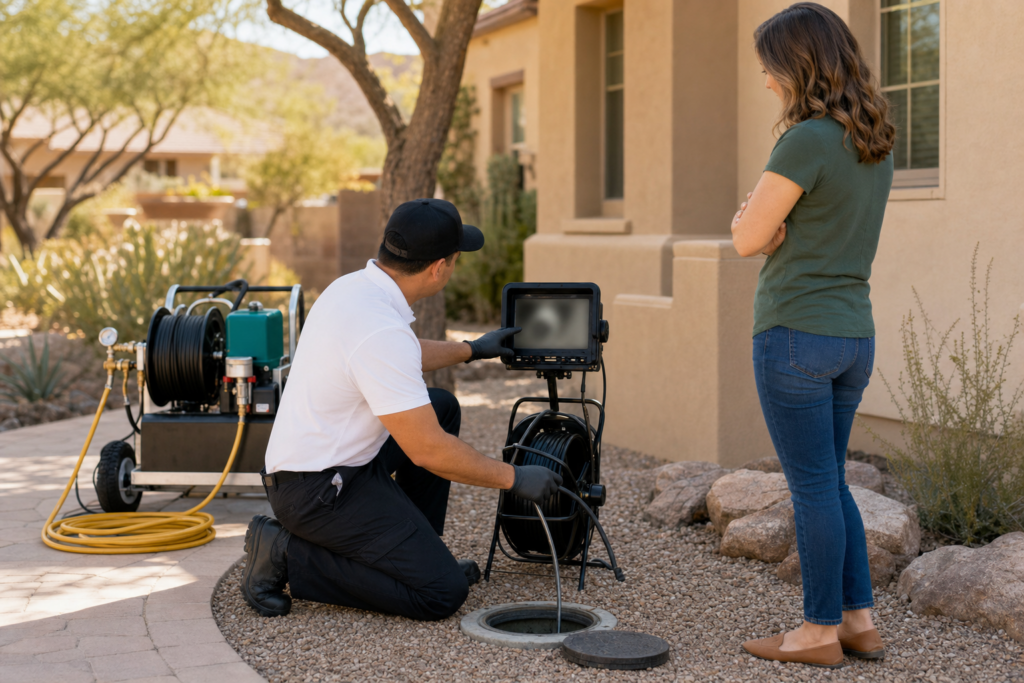
Require a Camera Inspection Before Any Jetting Begins
This is the single most important criterion when choosing a hydro jetting company, and it is non-negotiable. A reputable company will not blast 3,000-plus PSI of water into your main sewer line without first looking inside it.
What the Camera Inspection Reveals
A sewer camera inspection shows the technician the interior condition of your pipe in real time. It identifies what is actually causing the blockage — whether that is grease buildup, root intrusion, mineral scale, or a combination. Just as importantly, it reveals the condition of the pipe itself: cracks, joint separations, bellied sections, or material deterioration that may not be visible from the surface.
In Phoenix, many homes built between the 1950s and 1980s have clay or cast iron sewer lines. Both materials can develop cracks, root damage, or corrosion over decades. If a technician jets a cracked clay pipe at full pressure without knowing the crack is there, the force of the water can shatter the damaged section and collapse the line. What started as a blockage becomes a sewer line replacement.
What Can Go Wrong Without a Camera Inspection
Picture a clay sewer pipe with a hairline crack near a joint. From the cleanout, it looks like a standard blockage. A technician who skips the camera sends a high-pressure nozzle down the line. The water hits the weakened section at thousands of pounds per square inch. The crack opens. The pipe separates. Soil pushes in. Now the homeowner is looking at excavation, repair, and a significantly larger bill — all because the company did not take fifteen minutes to check the pipe first.
This is not a scare tactic. It is the practical reason why experienced hydro jetting companies treat the camera inspection as a standard first step, not an optional add-on.
The Post-Jetting Inspection and Why It Matters
A thorough company will also run the camera through the line after jetting. This post-jetting inspection confirms that the blockage was fully cleared, shows you the clean interior of the pipe, and documents the current condition of the line for your records. If the camera reveals a problem that was hidden behind the buildup — like root intrusion through a joint or an early-stage crack — the technician can explain your options before it becomes an emergency.
Ask the company whether they provide the camera footage to you. A company that is confident in its work will have no hesitation sharing it.
Verify the License Before Anyone Touches Your Pipes
In Arizona, plumbing contractors are required to hold an active license through the Arizona Registrar of Contractors, commonly known as the AZ ROC. This is not a formality. The ROC license means the contractor has met bonding and insurance requirements, and it gives you a path to file a complaint if something goes wrong.
How to Look Up an AZ ROC License
You can verify a contractor’s license directly on the Arizona Registrar of Contractors website. Search by the company name or license number. The listing will show you:
- Whether the license is active or expired
- The license classification (plumbing should be listed)
- Whether there are complaints, violations, or disciplinary actions on record
- The bonding status
This takes about two minutes and can save you from hiring an unlicensed operator who has no accountability if the work goes wrong.
What Bonding and Insurance Actually Protect
A bonded contractor has a financial guarantee in place through their bond. If they fail to complete the work properly, the bond provides a recovery path. General liability insurance protects you if the work causes property damage — which matters when you are talking about high-pressure equipment operating inside your sewer line. Ask the company directly whether they carry both, and do not assume the answer is yes just because they have a website.
Licensed Plumber Versus Licensed Contractor
Not every person who shows up in a truck with a jetter is a licensed plumbing contractor. Some operators work under another company’s license, and some work with no license at all. Ask the company: Is the technician who will be at my home working under your active AZ ROC license? A straightforward company will answer that question without hesitation.
Phoenix-Specific Factors That Should Shape How a Company Approaches Your Line
Phoenix is not a generic plumbing market. The climate, the water, the soil, the landscaping, and the housing stock all create conditions that affect sewer lines in specific ways. A company that does this work locally should understand these factors without having to be told about them.
Your Home’s Age and What That Likely Means for Your Pipes
The material inside your main sewer line depends largely on when your home was built:
- 1950s through early 1970s: Clay pipe is common. Clay is durable but brittle. Joints can separate over time, and the material does not flex. Root intrusion through joints is a frequent issue.
- 1960s through 1980s: Cast iron pipe appears in many Phoenix homes from this era. Cast iron corrodes from the inside over decades, and heavy scale buildup can narrow the interior diameter significantly.
- 1970s through early 1990s: Some homes in this window may have Orangeburg pipe, a tar-impregnated fiber material that was inexpensive and easy to install. Orangeburg deteriorates badly over time and often cannot withstand hydro jetting pressure.
- 1990s and newer: PVC pipe is standard in most newer construction. PVC handles hydro jetting well when the pipe is in good condition and properly connected.
If you do not know what material your sewer line is made of, a camera inspection will answer that question. A trustworthy company will factor the pipe material into their approach and adjust the pressure accordingly — or recommend a different solution if jetting is not appropriate for your line.
Tree Roots in the Valley
Phoenix landscaping includes several tree species with aggressive root systems that commonly invade sewer lines. Mesquite trees send deep taproots that seek moisture. Ficus trees produce dense, spreading root networks. Palm trees, while their roots are less invasive, can still cause problems at shallow pipe joints.
Root intrusion is one of the most common reasons Phoenix homeowners need hydro jetting in the first place. But if roots have already cracked or displaced sections of the pipe, jetting may clear the roots temporarily without addressing the structural damage that allowed them in. A company that understands this will tell you honestly whether jetting alone is enough or whether a repair is also needed.
Hard Water Calcium Scale
Phoenix has some of the hardest water in the country. Over years, calcium and mineral deposits can build up inside drain and sewer lines, narrowing the pipe and creating rough surfaces that catch grease, hair, and debris. This buildup is especially common in cast iron pipes.
Hydro jetting is one of the most effective ways to remove heavy mineral scale, but not every company accounts for it. A company that works in Phoenix regularly will recognize scale buildup on the camera inspection and adjust their jetting approach accordingly. If a company does not mention hard water scale as a factor in your line, they may not be looking closely enough.
Equipment That Can Handle a Main Sewer Line
There is a meaningful difference between the equipment used for branch drain cleaning and the equipment needed for a main sewer line. For a main line, a truck-mounted or trailer-mounted hydro jetter with a high-capacity water supply and consistent pressure output is the standard. Smaller electric units designed for kitchen and bathroom drains do not deliver the sustained pressure or water volume needed to clean a four-inch or six-inch main sewer line thoroughly.
You can ask the company directly: Is your jetter truck-mounted or trailer-mounted, and what PSI range does it operate at? A company equipped for main sewer line work will answer this confidently.
Understanding the Price: What a Fair Quote Includes and What to Watch For
Hydro jetting a main sewer line in the Phoenix area typically falls in a range that depends on the length of the line, the severity of the blockage, the accessibility of the cleanout, and whether a camera inspection is included. Rather than focusing on a single number, focus on what the quote covers.
What a Complete Written Estimate Should Itemize
Before you agree to any work, ask for a written estimate that breaks down what is included. A complete estimate for main sewer line hydro jetting should address:
- Camera inspection before jetting (is it included or billed separately?)
- The jetting service itself, including the scope of the line being cleaned
- Post-jetting camera inspection to confirm the line is clear
- Whether the camera footage will be shared with you
- Any cleanout access work if the existing cleanout is buried or inaccessible
- Trip charge or service call fee, if applicable
- What happens if the camera inspection reveals damage that makes jetting inadvisable — is there an additional charge to pivot to a different recommendation?
If the estimate is a single lump number with no breakdown, ask the company to itemize it. You deserve to understand what you are paying for.
Red Flags in Pricing
Watch for these patterns:
- An extremely low quote with no camera inspection included. This may mean the company is skipping the diagnostic step that protects your pipes and your investment.
- A quote that jumps significantly once the technician arrives. This often signals that the initial price was a hook, not a real estimate. Upfront pricing means the number should not change unless the scope of the work genuinely changes — and you should be told why before any additional work begins.
- Vague line items or a refusal to provide a written estimate. A company that will not put the price in writing before starting work is not a company you want in your sewer line.
- A quote that includes services you did not ask for or that have not been justified by an inspection. If a company recommends additional work, they should be able to show you why on the camera and explain the reasoning in plain terms.
How to Read Local Reviews for This Specific Job
General star ratings are a starting point, but they do not tell you much about how a company handles hydro jetting specifically. A company might have excellent reviews for faucet repairs and mediocre results on sewer work. Here is how to dig deeper.
Search Within Reviews for Relevant Terms
On Google or Yelp, use the search function within the company’s review page to look for terms like hydro jetting, sewer line, main line, camera inspection, or sewer cleaning. This filters the reviews to the ones most relevant to the job you need done.
Pay Attention to How the Company Responds to Complaints
Every company gets a negative review eventually. What matters is how they handle it. Look for responses that are calm, professional, and solution-oriented. A company that gets defensive, dismissive, or argumentative in public is showing you how they handle conflict — and sewer work sometimes involves unexpected findings that require honest, respectful communication.
Look for Patterns, Not Perfection
A few five-star reviews do not tell you much. A consistent pattern of reviewers mentioning clear communication, honest pricing, and respectful service tells you a lot. Look for repeat themes in the language customers use: explained everything, showed me the camera footage, no surprises on the bill, showed up when they said they would.
Questions to Ask Before You Book
When you call a hydro jetting company, the conversation itself is a diagnostic tool. The way a company answers these questions tells you a great deal about how they will treat you and your home.
-
Do you run a camera inspection before you start jetting?
A good answer is a clear yes, with an explanation that the camera helps them understand the pipe condition and blockage type before choosing the right approach. A concerning answer is any version of we usually just go ahead and jet it. -
Will you run the camera again after jetting to confirm the line is clear?
A good answer is yes. A company that is confident in its work will want to show you the results. -
Can I see the camera footage?
A good answer is yes, without hesitation. A company that will not share the footage may be making recommendations you cannot independently evaluate. -
Is your hydro jetter truck-mounted or trailer-mounted?
For a main sewer line, you want a company using commercial-grade equipment, not a small electric unit designed for branch drains. -
What does the written estimate include, and will you itemize it?
A good answer is a clear breakdown of the camera inspection, jetting, post-jetting inspection, and any other charges. A vague answer is a red flag. -
What happens if the camera inspection shows damage that makes jetting inadvisable?
A good answer is an honest explanation that they will show you the footage, explain the issue, and discuss options — without pressuring you to commit to additional work on the spot. -
Are you licensed with the AZ ROC, and can you provide your license number?
A good answer is an immediate yes with a license number. Any hesitation or deflection is a signal to move on. -
Do you carry general liability insurance?
This protects you if something goes wrong during the work. The answer should be yes. -
How long does the job typically take for a main sewer line?
A good answer gives you a realistic range and explains that timing depends on the line length, condition, and what the camera reveals. A company that promises an exact timeline without knowing anything about your line may not be accounting for real-world variables.
What Happens If Hydro Jetting Is Not the Right Solution
One of the clearest signs of a trustworthy company is their willingness to tell you when hydro jetting is not the answer. If the camera inspection reveals a collapsed section, severely deteriorated pipe material, a belly in the line that traps waste regardless of how clean the pipe walls are, or Orangeburg pipe that cannot handle the pressure, the honest recommendation is a repair — not jetting.
A company that pushes hydro jetting regardless of what the camera shows is prioritizing the sale over the solution. A company that explains the findings clearly, shows you the footage, and walks you through the options is prioritizing your home.
Frequently Asked Questions
Do I need a camera inspection before hydro jetting?
Yes. A camera inspection reveals the condition of your pipe and the type of blockage before any high-pressure water enters the line. Without it, there is no way to know whether the pipe can safely handle jetting pressure. A reputable company will treat this as a standard step, not an upgrade.
Can hydro jetting damage my pipes?
Hydro jetting is safe for pipes that are in good structural condition, including most PVC lines and sound cast iron or clay lines. However, pipes that are already cracked, corroded, or made of fragile material like Orangeburg can be damaged by high-pressure jetting. This is why the camera inspection matters — it identifies pipe condition before the technician decides whether jetting is appropriate.
What is the difference between hydro jetting and snaking a drain?
Snaking, also called augering, pushes a cable through the blockage to punch a hole and restore flow. It works well for simple clogs in branch drains. Hydro jetting uses high-pressure water to scour the full interior surface of the pipe, removing grease, scale, roots, and buildup along the entire wall — not just creating a channel through the middle. For recurring main sewer line blockages, hydro jetting typically provides a more thorough and longer-lasting result.
How long does hydro jetting a main sewer line take?
The jetting itself often takes between one and two hours, but the total appointment may be longer when you factor in the pre-jetting camera inspection, setup, post-jetting inspection, and discussion of findings. The timeline depends on the length of the sewer line, the severity of the blockage, and what the camera reveals.
Is hydro jetting safe for older Phoenix homes?
It depends on the pipe material and condition, not the age of the home alone. Many older Phoenix homes have clay or cast iron sewer lines that are still structurally sound and can be safely jetted. Others have pipes that have deteriorated to the point where jetting could cause further damage. A camera inspection before jetting is the only way to make that determination for your specific line.
What is the AZ ROC and how do I verify a plumber’s license?
The AZ ROC is the Arizona Registrar of Contractors. It is the state agency that licenses, bonds, and regulates contractors in Arizona. You can verify any plumbing contractor’s license status, classification, bonding, and complaint history on the AZ ROC website by searching the company name or license number.
How do I know if hydro jetting actually worked?
The most reliable confirmation is a post-jetting camera inspection. The camera footage will show you the interior of your pipe after jetting, so you can see that the buildup, roots, or blockage has been removed. Ask your company to provide this footage before they leave. Improved drainage after the service is also a practical indicator, but the camera gives you visual proof.
How much does hydro jetting a main sewer line cost in Phoenix?
Pricing for main sewer line hydro jetting in the Phoenix area varies based on the length of the line, the severity of the blockage, accessibility of the cleanout, and whether a camera inspection is included. Typical ranges for Phoenix-area residential main lines generally fall between a few hundred and several hundred dollars, though complex situations can be higher. The most useful thing you can do is ask for a written, itemized estimate before work begins so you understand exactly what is included.
How Fast Layne Plumbing Approaches This Work
At Fast Layne Plumbing, we treat hydro jetting as part of a diagnostic process, not as a one-size-fits-all service. When a Phoenix homeowner calls us about recurring sewer backups, slow drains that snaking has not resolved, or a sewer smell that keeps coming back, we start with a camera inspection to understand what is actually happening inside the line.
If the pipe is in good condition and hydro jetting is the right solution, we explain what we found, what we recommend, and what the cost will be — before any jetting begins. If the camera reveals damage that makes jetting inadvisable, we tell you that honestly, show you the footage, and walk you through the options that make sense for your situation. We do not push services you do not need.
We are a family-owned Phoenix plumbing company, and the homeowners we serve are our neighbors. We show up when we say we will, we explain what we find in plain English, we provide upfront pricing with no surprises, and we treat your home the way we would treat our own. That is not a tagline. It is how we work.
If you are dealing with a recurring sewer line issue and want an honest evaluation from a local team that will put the camera in the line before making any recommendations, call Fast Layne Plumbing at 480.485.4659 to schedule service.