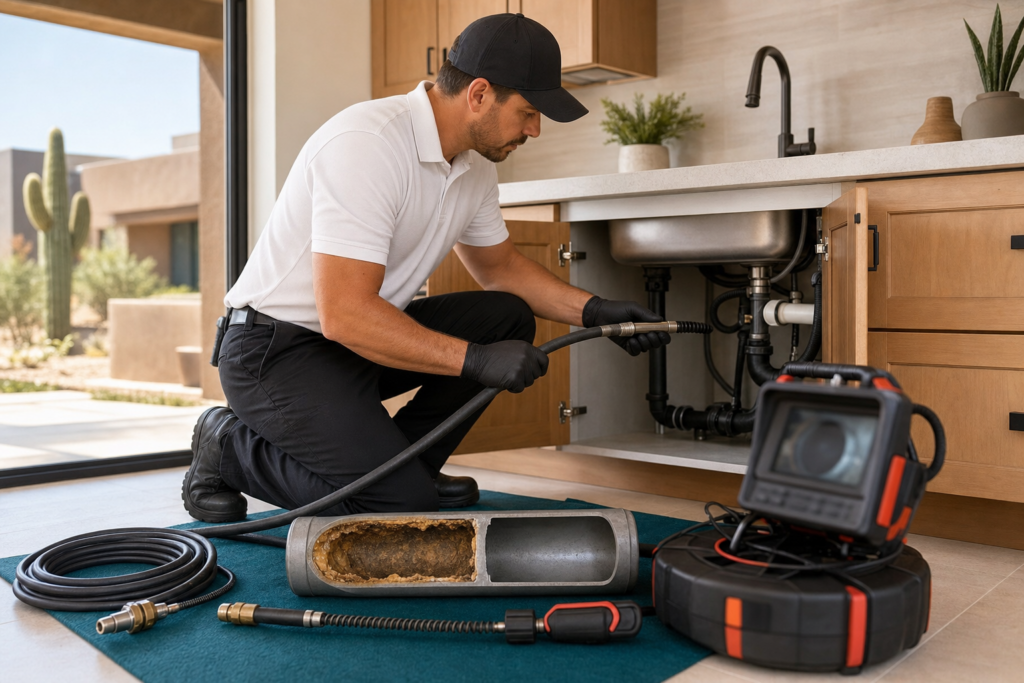
Hydro Jetting vs. Snaking for Grease Buildup: Why One Clears the Pipe and the Other Just Pokes a Hole Through It
For heavy grease buildup in a drain or sewer line, hydro jetting is the more effective method. A drain snake punches through the blockage and restores some flow, but it leaves the grease stuck to the pipe walls. Hydro jetting uses high-pressure water to scour grease off the full interior surface of the pipe, which is the difference between temporary relief and a thorough cleaning.
That said, snaking is not useless — and hydro jetting is not always the right call. The best approach depends on how severe the buildup is, what condition the pipes are in, and where the blockage sits in the line. This article explains how both methods work, why grease is a uniquely stubborn problem, and how a licensed plumber decides which tool fits the situation.
If you are a homeowner or business owner in Phoenix dealing with drains that keep slowing down no matter how many times they get cleared, this is the guide that explains what is actually happening inside the pipe — and what it takes to fix it for real.
What Grease Buildup Actually Does Inside a Drain or Sewer Line
How Grease Gets Into Pipes and Why It Hardens Over Time
Grease enters your plumbing as a warm liquid — cooking oil rinsed off a pan, bacon fat poured down the sink, butter residue washed off a plate. In liquid form, it flows right into the drain. But as it moves through the pipe and cools, it solidifies. It clings to the pipe walls the way wax sticks to the inside of a candle jar.
Over weeks and months, each new layer of grease adds to the coating already there. The pipe opening gradually narrows. Water still passes through — but slower, and with less room. Eventually, the buildup catches food particles, soap residue, and other debris, which accelerates the blockage.
In Phoenix, hard water can make this worse. The minerals in hard water can bond with grease and create a harder, more stubborn layer of scale and buildup that is more difficult to remove than grease alone. If you live in an older Phoenix home — especially one built between the 1950s and early 2000s — your pipes may have decades of accumulated residue that has slowly narrowed the interior diameter.
Why Grease Behaves Differently from Other Clogs
A hair clog in a bathroom drain is usually a concentrated mass in one spot. A root intrusion in a sewer line is a physical obstruction at a specific entry point. Both of these respond well to a drain snake because the snake can grab, break apart, or cut through the blockage.
Grease does not work like that. It is not sitting in one place — it coats the entire circumference of the pipe, sometimes for several feet or more. There is no single mass to grab or break through. That is why grease clogs keep coming back after snaking. The snake clears the center, water flows again, and the homeowner thinks the problem is solved. But the grease on the walls is still there, and it starts narrowing the pipe again almost immediately.
Signs That May Indicate Grease Buildup Specifically
Not every slow drain is grease. But the following patterns could suggest grease is the primary issue:
- The kitchen sink drains slowly, especially after washing dishes or cooking
- You notice a greasy or rancid odor near the kitchen drain
- Drains have been snaked before and the problem returned within weeks or a few months
- Multiple drains on the same line are backing up or slowing down
- The issue gets worse during or after periods of heavy cooking
These signs do not confirm a diagnosis on their own — a licensed plumber can evaluate the situation with a camera inspection to see what is actually happening inside the pipe. But they are useful signals that the problem may go beyond a simple clog.
How Drain Snaking Works and Where It Falls Short with Grease
What a Drain Snake Physically Does Inside the Pipe
A drain snake — also called a drain auger — is a long, flexible metal cable with a cutting or corkscrew-shaped tip. A plumber feeds it into the drain, and as it rotates, the tip either breaks through the blockage or hooks onto it so it can be pulled out.
For localized clogs — a wad of hair, a buildup of soap scum in one spot, a small object stuck in the line — snaking works well. It is fast, it is effective, and it clears the immediate obstruction without putting excessive stress on the pipe.
Why Snaking Gives Temporary Relief but Leaves Grease Behind
When the problem is grease, the snake does exactly what it is designed to do: it pushes through the narrowest point and opens up a channel for water to flow. But it only opens a channel through the center. The grease lining the pipe walls stays in place.
Think of it this way: if the inside of a pipe were a tunnel, snaking clears the road but does not clean the walls. Water can pass through the tunnel again, but the walls are still coated, and the tunnel is still narrower than it should be. Over time, the grease continues to accumulate, and the clog returns.
This is the core reason homeowners get frustrated. They call for drain cleaning, the snake clears the line, everything works for a few weeks, and then the same sink starts backing up again. It is not that the first plumber did something wrong — it is that snaking is the wrong tool for that specific problem.
When Snaking Is Still the Right Call
Snaking is not an inferior method — it is a different tool for a different situation. It is often the right choice when:
- The clog is localized to one fixture and caused by hair, soap, or a small object
- The blockage is in a short branch line rather than the main sewer line
- The pipes are older or fragile and high-pressure water could pose a risk
- A quick clearing is needed as a first step before a camera inspection can be performed
A responsible plumber does not default to the most expensive option every time. Sometimes snaking is all you need. The key is knowing which situation you are in — and that is where an honest assessment matters more than a sales pitch.
How Hydro Jetting Works and Why It Handles Grease Differently
What Happens Inside the Pipe During Hydro Jetting
Hydro jetting uses a specialized nozzle attached to a high-pressure water line. The nozzle is inserted into the pipe and propels water at very high pressure — typically thousands of pounds per square inch — in multiple directions at once. The water hits the pipe walls from all angles, breaking up and flushing out whatever is coating the surface.
Where a snake works in one direction — forward — a hydro jetting nozzle cleans the full circumference of the pipe as it moves. It acts like a pressure washer for the inside of your plumbing. Grease, mineral scale, soap buildup, and even some root intrusions can be scoured away and flushed out of the system.
Why High-Pressure Water Removes Grease from the Walls
Grease clings to pipe walls because of surface adhesion — the same reason oil sticks to a pan. A drain snake cannot break that bond because it only contacts a small area in the center of the pipe. High-pressure water, on the other hand, hits the grease directly, breaks the bond with the pipe wall, emulsifies the grease into smaller particles, and flushes everything downstream.
The result is a pipe that is restored to something close to its original interior diameter. Water flows freely, and the conditions that caused the recurring clog are meaningfully addressed — not just temporarily pushed aside.
What Restoring the Pipe Actually Means
When plumbers describe hydro jetting as returning a pipe to near-original condition, they are referring to cleaning the interior surface down to the pipe material itself. The layers of grease, scale, and debris that were narrowing the pipe are removed. This does not mean the pipe is brand new — if there are cracks, corrosion, or structural damage, hydro jetting does not repair those. But for a pipe that is structurally sound and clogged with grease, the cleaning is thorough and long-lasting.
It is worth being honest here: hydro jetting does not guarantee the pipe will never accumulate grease again. If cooking habits do not change, grease will start building up again over time. But a thorough hydro jetting cleaning resets the clock much further back than snaking does, and it may extend the time before buildup recurs.
Head-to-Head Comparison: Grease Buildup Specifically
This comparison is specific to heavy grease buildup in a drain or sewer line. For other types of clogs, the assessment may be different.
| Factor | Drain Snaking | Hydro Jetting |
|---|---|---|
| How it clears grease | Pushes through the center of the blockage | Scours grease off the full pipe wall |
| Cleaning scope | Opens a channel; walls remain coated | Cleans the full interior circumference |
| How long relief typically lasts | Weeks to a few months with heavy grease | Typically longer-lasting than snaking for grease — duration varies based on pipe condition and habits |
| Risk to pipes | Low risk in most pipe types | Requires inspection first — may not be safe for severely damaged or deteriorated pipes |
| Cost | Generally lower per visit | Higher per visit, but may reduce frequency of repeat service |
| Best suited for | Localized, non-grease clogs or as a first-step clearing | Heavy grease coating, recurring grease clogs, full-line cleaning |
| What happens if you choose the wrong method | Clog returns quickly; you pay for multiple service calls without solving the root issue | If used on damaged pipes without inspection, could worsen existing pipe problems |
The comparison is clear for heavy grease: hydro jetting addresses the actual problem, while snaking addresses the symptom. But hydro jetting requires that the pipe be in sound enough condition to handle the pressure — which is why the next step matters.
Why a Camera Inspection Should Come Before Hydro Jetting
What a Plumber Actually Looks for During a Camera Inspection
A sewer camera inspection involves feeding a small waterproof camera through the pipe on a flexible cable. The plumber watches a live video feed of the pipe interior. This is not guesswork — it is a direct look at what is going on inside the line.
During the inspection, the plumber is looking for:
- The type and severity of the buildup — is it grease, mineral scale, roots, or a combination?
- The location of the blockage — is it in a branch line near one fixture or deeper in the main sewer line?
- The pipe material — PVC, cast iron, clay, or Orangeburg all respond differently to high-pressure cleaning
- The structural condition of the pipe — are there cracks, breaks, joint separations, or signs of deterioration?
- Whether any sections have bellied or sagged, which can trap grease and debris regardless of cleaning method
This information directly changes the recommendation. A structurally sound PVC line with heavy grease coating is an excellent candidate for hydro jetting. An older cast iron line with visible corrosion and joint damage may need a different approach — or a repair before any cleaning is done.
How Inspection Findings Change the Recommendation
If the camera shows a pipe in good structural condition with heavy grease accumulation on the walls, hydro jetting is typically the most effective option. If the camera reveals cracks, separations, or significant deterioration, a responsible plumber may recommend a gentler clearing method first, or may recommend addressing the pipe damage before attempting a high-pressure cleaning.
This is one of the most important things to understand about working with an honest plumber: the right recommendation depends on what the inspection shows, not on which service costs more. A plumber who recommends hydro jetting before looking inside the pipe with a camera may be making assumptions that could lead to the wrong outcome.
How a Plumber Decides Which Method to Use
The Professional Workflow: Inspect, Then Decide
A typical diagnostic process for a suspected grease clog follows a practical sequence:
- Listen to the homeowner’s description — how long the problem has been happening, which fixtures are affected, whether the drain has been serviced before, and what symptoms are present
- Assess the immediate situation — if the line is completely backed up, a snake may be used first to restore basic flow so a camera can be run through the line
- Run a camera inspection — to see the pipe condition, identify the buildup type, and locate any structural issues
- Recommend the appropriate method — based on what the camera shows, the plumber explains the options and why one method fits the situation better than the other
This workflow protects the homeowner from paying for the wrong service. It also protects the plumber from using equipment that could cause damage in a compromised pipe. The inspection step is not an upsell — it is the responsible first move.
Questions Worth Asking Your Plumber
If you are scheduling service for a drain that keeps clogging, these questions can help you gauge whether the plumber is approaching the job honestly:
- Will you run a camera inspection before recommending a method?
- Can you show me what the camera finds?
- What is your recommendation based on the inspection — and why?
- What are the risks of each option for my specific pipe?
- If the problem comes back, what would that indicate?
A plumber who is comfortable answering these questions clearly and without pressure is the kind of plumber worth hiring.
Signs That May Indicate a Problem Beyond Grease
Sometimes what looks like a grease problem is actually something more involved. Warning signs that could point to a deeper issue include:
- Multiple fixtures in different parts of the house backing up at the same time
- Sewage odor outside the house near the sewer cleanout
- Wet spots in the yard that were not there before
- A drain that was recently cleared but backed up again within days — not weeks
These patterns may indicate a sewer line issue such as a break, a root intrusion, or a collapsed section. A camera inspection can help clarify what is going on so the plumber can recommend the appropriate repair rather than repeated cleanings that do not address the real cause.
Grease Buildup in Phoenix: What Local Homeowners and Businesses Should Know
Hard Water and Grease: A Compounding Problem in Phoenix
Phoenix has notably hard water, and that mineral content does not just affect your water heater and fixtures — it affects your drain lines too. Hard water minerals can bond with grease residue inside the pipe, creating a tougher, more calcite-like buildup that is harder to remove than grease alone.
For homeowners in older Phoenix neighborhoods, this combination is especially common. Homes built from the 1950s through the early 2000s may have cast iron, clay, or galvanized pipes that have been accumulating mineral-grease buildup for decades. If you have lived in your home for years and have never had the main line inspected, there may be more narrowing inside the pipe than you would expect.
Kitchen Drain Lines vs. Main Sewer Lines
Grease typically enters through the kitchen drain, so the kitchen branch line is usually the first section to develop heavy buildup. In many cases, snaking the kitchen line provides enough relief because the grease has not yet migrated into the main sewer line.
But if grease has been accumulating for a long time — or if the kitchen line is short and connects quickly to the main sewer — the buildup may extend further. When the main sewer line is affected, the scope of the problem is larger, the cleaning takes more effort, and hydro jetting becomes more important because the affected section is longer and harder to reach with a standard snake.
Preventive Habits That Reduce Grease Buildup Over Time
After any professional drain cleaning — whether snaking or hydro jetting — simple habits can help keep grease from building up as quickly:
- Wipe pans with a paper towel before washing to keep grease out of the drain
- Avoid pouring cooking oil, bacon fat, or butter directly down the sink
- Run hot water while the garbage disposal is running, but do not rely on hot water alone to clear grease — it just moves it further down the pipe before it cools
- Use a simple mesh drain strainer to catch food particles
- Consider scheduling periodic preventive drain cleaning if your kitchen sees heavy daily use
These habits do not eliminate grease accumulation entirely, but they slow it down meaningfully. Combined with a professional cleaning on a reasonable schedule, they help keep your kitchen drain and sewer line flowing properly for longer.
Frequently Asked Questions
Can a drain snake clear grease?
A drain snake can push through a grease blockage and restore water flow temporarily. However, it does not remove the grease coating from the pipe walls. For light grease buildup or an emergency clearing, snaking can be useful. For heavy or recurring grease problems, it typically provides only short-term relief because the underlying buildup remains in place.
Can hydro jetting damage sewer pipes?
Hydro jetting can damage pipes that are already cracked, deteriorated, or structurally compromised. That is why a camera inspection before hydro jetting is important — it allows the plumber to assess the pipe condition and determine whether the pipe can safely handle the water pressure. On structurally sound pipes, hydro jetting is a safe and effective cleaning method.
How do I know if my clog is grease or something else?
Grease clogs tend to develop gradually, affect kitchen drains specifically, produce a greasy or rancid odor, and come back repeatedly after snaking. A sudden blockage in a bathroom drain is more likely hair or soap scum. A backup that affects multiple fixtures at once could indicate a main sewer line issue. A licensed plumber can use a camera inspection to confirm the type and location of the problem.
Is hydro jetting worth the cost compared to snaking?
For a one-time, localized clog that is not grease-related, snaking is typically sufficient and more cost-effective. For heavy grease buildup or recurring clogs that have already been snaked multiple times, hydro jetting may be more cost-effective over time because it addresses the buildup instead of temporarily clearing a path through it. The right answer depends on the specific situation — a camera inspection helps clarify which approach makes sense.
Can I rent a hydro jetter and do it myself?
Consumer-grade hydro jetting equipment exists for rent, but professional hydro jetting operates at much higher pressures with specialized nozzles designed for different pipe sizes and conditions. Using high-pressure water in a pipe without first inspecting its condition can cause damage. This is a service best handled by a licensed plumber who can evaluate the pipe, select the right equipment and pressure settings, and ensure the cleaning is done safely.
What will dissolve grease in a sewer line?
Chemical drain cleaners and enzyme treatments may have some effect on minor grease deposits, but they are generally not strong enough to clear heavy grease buildup throughout a long pipe section. Hot water can soften grease temporarily but typically just moves it further downstream. For established grease accumulation, mechanical cleaning — especially hydro jetting — is the most effective way to remove the buildup from the pipe walls.
When to Call a Plumber About Recurring Grease Clogs
If your kitchen drain keeps clogging even after it has been snaked, or if you notice slow drainage, gurgling, or an unpleasant odor near the kitchen sink, the problem may be more than a simple blockage. Heavy grease buildup inside the pipe is a common cause of recurring drain issues in Phoenix homes, and it responds best to the right cleaning method applied after a proper inspection.
At Fast Layne Plumbing, we take the time to inspect the line, explain what we find in plain English, and recommend the method that actually fits the situation — whether that is a snake, hydro jetting, or something else. We give you upfront pricing before any work begins, we show up when we say we will, and we treat your home with respect.
If you are tired of calling for the same clog every few months and want to understand what is really going on in your pipes, give us a call. We are happy to take a look and walk you through your options honestly.
Call Fast Layne Plumbing at 480.485.4659 to schedule service.