How to Compare Sewer Main Line Clearing Prices in Phoenix Without Getting Burned
Sewer main line clearing quotes in the Phoenix area can range from roughly $200 to over $900 for what sounds like the same problem. That spread is not random. It reflects real differences in the method being quoted, how easy or difficult your line is to access, what is included in the price, and whether follow-up support comes with the work. The lowest number on a quote is not automatically the best deal, and the highest number is not automatically a rip-off.
Your job as a homeowner is not to find the cheapest option. It is to understand what each quote actually covers so you can make a confident decision. This guide walks through exactly what to look at, what to ask, and what should raise a concern when you are comparing sewer main line clearing prices from Phoenix-area plumbers.
What Sewer Main Line Clearing Typically Costs in Phoenix — and Why Prices Differ
Price Ranges by Service Type
These ranges reflect what Phoenix-area homeowners commonly encounter. Your actual price depends on conditions a technician can only assess on site, but these benchmarks give you a reasonable frame of reference.
| Service | Typical Phoenix-Area Range |
|---|---|
| Cable snaking (mechanical augering) | $200–$475 |
| Hydro jetting | $425–$900+ |
| Camera inspection (standalone) | $0–$250 (often included or discounted with clearing) |
| Service/diagnostic fee | $0–$75 (varies by company; some waive with service) |
These numbers are market ranges drawn from publicly available Phoenix-area data — they are not Fast Layne Plumbing’s specific pricing. The right price for your situation depends on what the inspection reveals.
Why the Same Problem Can Cost $300 or $900
When two companies quote you very different numbers for what sounds like the same blockage, the difference usually comes down to three things:
- Method: Snaking and hydro jetting are different services with different equipment, different labor, and different results. A quote for snaking and a quote for hydro jetting are not comparable even if the problem description sounds identical.
- Access: Whether your home has a usable exterior cleanout, or whether the plumber needs to access the line through a toilet pull or roof vent, affects the time and difficulty of the job.
- Scope of what is included: One quote may include a camera inspection after clearing; another may charge separately. One may include a warranty period; another may not. These differences change the total value even when the headline number looks similar.
Bottom line: you cannot compare two quotes unless you know the method, the access plan, and what is included in each one.
The Method Question — Snaking vs. Hydro Jetting
What Cable Snaking Does and When It Is Enough
Cable snaking (also called mechanical augering) uses a rotating metal cable to break through or pull out a blockage. It is effective for soft clogs like grease buildup, paper, or minor debris. For a straightforward blockage in a line with no structural issues, snaking is often the right tool, and it is the less expensive option.
Snaking punches through the obstruction but does not clean the pipe walls. That means if buildup has been accumulating over years, snaking may clear the immediate clog but not prevent the next one from forming in the same spot relatively soon.
What Hydro Jetting Does and When It Is Actually Needed
Hydro jetting directs pressurized water through the pipe to scrub buildup from the interior walls — addressing more than just the immediate blockage. It is more thorough and is typically recommended for heavy grease buildup, scale, or root intrusion that snaking cannot fully address.
Hydro jetting costs more because it requires specialized equipment, more time, and typically a camera inspection beforehand to confirm the pipe can handle the pressure safely. Not every clog needs hydro jetting, and a trustworthy plumber will tell you when snaking is sufficient rather than automatically recommending the more expensive service.
Phoenix-Specific Considerations
The Phoenix area has conditions that affect sewer lines in ways other parts of the country do not. Across many established Valley neighborhoods — particularly homes constructed between the 1950s and early 2000s — aging clay or cast iron sewer pipes remain in service. These pipe materials are far more vulnerable to cracking, joint separation, and root intrusion compared to the PVC pipe used in newer construction.
Certain desert-adapted trees common throughout the Phoenix metro, including Ficus, Oleander, and Mesquite, develop aggressive root systems that seek out moisture. When sewer pipes develop even small cracks or loose joints, those openings can draw in root growth that leads to repeated blockages. If your property has mature trees and an older pipe system, root intrusion could be contributing to recurring main line backups — and that shapes which clearing method is most appropriate.
A licensed technician can evaluate whether your situation calls for snaking, hydro jetting, or further inspection. The right answer depends on what the line looks like, not on a default upsell.
The Access Question — Does Your Home Have a Sewer Cleanout?
What a Cleanout Is and How to Find Yours
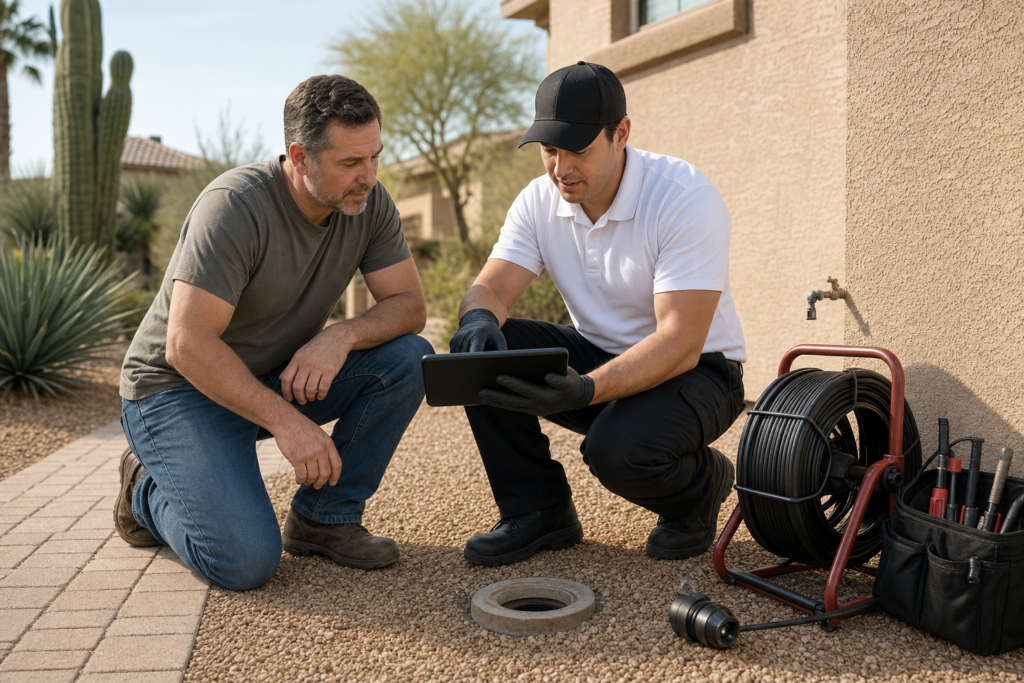
A sewer cleanout is a capped pipe fitting, usually about three to four inches in diameter, that provides direct access to your main sewer line. Most are located at ground level near the exterior of the home, often near a bathroom wall, close to where the sewer line exits the house toward the street.
In many Phoenix homes, the cleanout looks like a white or black PVC cap sitting flush with the ground or sticking up a few inches from the soil. In older homes, it may be a brass or cast iron cap that is harder to spot, especially if landscaping has grown over it.
Before you call for quotes, it is worth walking around the exterior of your home to see if you can locate your cleanout. Knowing where it is — or knowing that you cannot find one — is useful information for any plumber you call.
What Happens If You Do Not Have One
If your home does not have an accessible exterior cleanout, the plumber may need to access your sewer line through a toilet pull (removing the toilet to reach the line) or through a roof vent. Both options add time and labor to the job, which affects the price.
Some companies quote a standard rate assuming cleanout access and then adjust the price on arrival if no cleanout is available. Others ask about access before quoting. When you are comparing prices, make sure each company is quoting based on the same access assumption — otherwise you are comparing different jobs.
What to Ask Before You Agree to Any Quote
The most reliable way to compare quotes fairly is to ask each company the same set of questions. This puts every quote on the same footing so you are comparing the actual scope of work, not just the dollar amount.
| Question to Ask | Why It Matters |
|---|---|
| What method will you use — snaking or hydro jetting? | Different methods have different costs, results, and appropriate use cases. |
| Is that a flat rate, or is the price hourly? | Flat-rate pricing gives you cost certainty. Hourly pricing can escalate if the job takes longer than expected. |
| Does the quote include a camera inspection? | Some companies include it; others charge separately. This affects both total cost and the quality of the diagnosis. |
| What are you assuming about access to the line? | A quote based on cleanout access and a quote based on a toilet pull are two different jobs at two different price points. |
| Is there a warranty or callback period? What does it cover? | A warranty on clearing means the company will return if the line backs up again within that window, at no extra cost. Terms differ by company, so ask what is covered and for how long. |
| Are there additional charges for after-hours, weekends, or emergency service? | Some companies charge a premium outside regular business hours. Knowing this upfront prevents a surprise on the bill. |
| Will I receive a written estimate before work begins? | A written estimate protects both you and the plumber. If a company resists putting the price in writing, that is worth noting. |
When each company answers these questions, you will be able to see what you are actually comparing. Two quotes that looked very different on the surface may turn out to cover different scopes of work — and once you adjust for that, the real difference may be smaller or larger than it first appeared.
The Camera Inspection Question
Why a Camera Matters After Clearing
A camera inspection (also called a video inspection) sends a small waterproof camera through the sewer line after clearing to show the condition of the pipe. It can reveal cracks, root intrusion, bellies (low spots where water pools), joint separations, or buildup that could cause future problems.
For a simple, one-time clog, a camera inspection may not always be necessary. But if you have had recurring backups, if you live in an older Phoenix home with clay or cast iron pipe, or if the clog was severe enough to require hydro jetting, a camera inspection gives you and the plumber a clear picture of what is happening inside the line.
Whether It Should Be Included or Is an Add-On
Some companies include a camera inspection with their clearing service. Others treat it as a separate line item — these are general market observations, not Fast Layne Plumbing’s specific pricing, but standalone camera inspections are commonly offered as an add-on. When comparing quotes, ask specifically whether a camera inspection is included. If one company bundles it in and another does not, the overall value of those quotes differs even when the headline numbers look alike.
Ask for the Footage
If a camera inspection is performed, you can and should request a copy of the footage. A reputable plumber will be glad to walk you through what the camera found and explain it in plain language. If a company recommends costly follow-up work — like sewer line repair or replacement — but declines to share the camera footage behind that recommendation, treat that as a red flag.
Warranty and Follow-Up — What to Ask and What to Expect
Many companies offer a warranty on sewer main line clearing, meaning they will return at no additional cost if the line backs up again within a set period — though terms differ by company, so it is worth asking specifically what is covered and for how long.
What a warranty usually covers: the same blockage recurring in the same section of line within the warranty window.
What a warranty usually does not cover: new blockages in different sections, structural damage discovered after the initial clearing, or root regrowth that happens after the warranty period ends. Roots grow back. Clearing removes them temporarily. If root intrusion is an ongoing problem, the longer-term solution may involve a different kind of service — but that is a separate conversation, and a trustworthy plumber will be honest about it.
When comparing quotes, ask each company what their warranty period is and what it specifically includes. A slightly higher quote that includes a warranty period may be a better value than a lower quote with no follow-up coverage at all.
Red Flags When Comparing Quotes
Most plumbing companies in the Phoenix area are honest and professional. But it is worth knowing what to watch for when a quote does not feel right.
- A very low initial price that jumps dramatically after arrival. Some companies advertise an attention-grabbing low price and then add charges once the technician is at your home. Upfront pricing means the price you are quoted should be the price you pay, barring a genuinely unexpected complication that is explained to you before additional work is done.
- A recommendation to replace the sewer line without showing you camera footage. Sewer line replacement is a significant expense. If someone recommends it based on clearing alone — without a camera inspection to document the damage — that recommendation deserves a second opinion.
- No written estimate before work begins. You should know the price and the scope of work before giving the go-ahead.
- No Arizona ROC license. The Arizona Registrar of Contractors (ROC) licenses plumbing contractors in the state. Confirming a company’s license status through the ROC website is straightforward and takes only a few minutes. A licensed contractor carries accountability that an unlicensed one does not.
- Pressure to decide immediately. A backed-up sewer line is urgent, but no reputable company should pressure you into a decision before you understand the options. A straightforward explanation, a written estimate, and a moment to think are reasonable expectations.
When Quotes Differ Dramatically — What That Usually Means
If you get one quote for $300 and another for $850 for what sounds like the same problem, it does not necessarily mean one company is cheating you. It often means the two companies are quoting different things.
Common reasons for a large gap:
- Different methods: The $300 quote may be for snaking. The $850 quote may be for hydro jetting. These are different services.
- Different access assumptions: One company may assume cleanout access. The other may be pricing a toilet pull because you mentioned there is no visible cleanout.
- Different inclusions: The higher quote may include a camera inspection and a warranty period. The lower quote may cover clearing only with no follow-up.
- Different assessments of the problem: If one company believes the clog is a simple soft blockage and another suspects root intrusion based on your description, they may recommend different approaches at different price points.
Before concluding that one quote is too high or too low, go back to your comparison questions. Ask each company to confirm the method, the access plan, and what is included. Once you have those details side by side, the gap usually makes more sense — and it becomes clearer which quote reflects the scope of work that actually fits your situation.
The Difference Between a Main Line Clog and a Branch Line Backup
One detail worth understanding before you compare main line clearing prices: not every drain backup is a main line problem.
Your main sewer line is the primary pipe that carries wastewater from your home to the city sewer or septic system. Branch lines (also called secondary lines) connect individual fixtures — a toilet, a shower, a kitchen sink — to the main line.
If only one fixture is backing up, the clog may be in the branch line serving that fixture, not in the main sewer line. Branch line clearing is typically less expensive and less involved.
If multiple fixtures are backing up at the same time, or if water is coming up through floor drains or the lowest fixtures in the house, that is more likely a main line issue.
A licensed plumber can evaluate which line is affected and recommend the appropriate service. If a company quotes you for main line clearing when the issue is actually in a single branch line, you may be paying for more service than you need.
Frequently Asked Questions
How much does it cost to clear a main sewer line in Phoenix?
Prices in the Phoenix area generally range from $200 to $475 for cable snaking and $425 to $900 or more for hydro jetting. The actual cost depends on the method, access to the line, and what is included in the quote. A camera inspection may be bundled in or charged separately.
What is the difference between snaking and hydro jetting?
Snaking uses a rotating cable to break through a blockage. Hydro jetting sends pressurized water through the pipe to scrub buildup from the interior walls. Snaking is less expensive and is often sufficient for straightforward clogs. Hydro jetting is more thorough and is typically recommended for heavy buildup or root intrusion.
Is a camera inspection necessary every time?
Not always. For a simple, first-time clog that clears easily, a camera inspection may not be needed. However, for recurring backups, older homes with aging pipe materials, or situations where root intrusion is suspected, a camera inspection helps identify whether there is a structural issue in the line that could cause future problems.
Why do sewer line clearing quotes vary so much?
Quotes vary because the method, access, inclusions, and warranty terms differ from company to company. A lower quote may cover snaking only with no follow-up. A higher quote may cover hydro jetting, a camera inspection, and a warranty period. Comparing the scope of work — not just the price — is the only way to evaluate whether a quote is fair.
What should I do if a plumber recommends sewer line replacement after clearing?
Ask to see the camera footage that supports the recommendation. If the plumber can show you documented damage — cracks, collapses, severe root intrusion, or pipe deterioration — the recommendation may be warranted. If no camera evidence is offered, consider getting a second opinion before committing to a major expense.
How do I verify that a Phoenix plumber is licensed?
Arizona plumbing contractors are licensed through the Arizona Registrar of Contractors (ROC). Using the ROC website, you can look up any company by name or license number to check whether their license is current and in good standing.
How Fast Layne Plumbing Approaches Main Line Clearing in Phoenix
At Fast Layne Plumbing, we believe the best way to earn your trust is to be straightforward about what we find and what it will cost to fix — before any work begins.
When you call us for a main line issue, here is what to expect:
- We answer the phone and schedule promptly. We know a backed-up sewer line disrupts your home, and we do not leave you waiting.
- We evaluate the situation first. Our technician assesses the problem, checks for cleanout access, and determines the right approach before giving you a price.
- We explain what we find in plain English. No jargon, no confusing technical language. You will understand what is going on with your line and why we are recommending a specific approach.
- We provide upfront pricing before work begins. You will know the cost and the scope of work before you say yes. No surprise charges after the fact.
- We recommend what you actually need. If snaking will solve the problem, we will not push hydro jetting. If a camera inspection would be valuable, we will explain why. We do not upsell services that are not necessary.
- We clean up and leave your home the way we found it. Respectful service means treating your property with care, start to finish.
We are a family-owned plumbing company serving Phoenix, and we treat every home the way we would want our own home treated. That is not a slogan — it is how we operate on every service call.
The Real Goal When Comparing Quotes
Comparing sewer main line clearing prices is not about finding the lowest number. It is about understanding what you are paying for, knowing what questions to ask, and choosing a plumber whose approach gives you confidence that the problem will be handled honestly and correctly.
Ask about the method. Ask about access. Ask what is included. Ask about the warranty. Look at the camera footage if one is done. And pay attention to whether the person on the other end of the phone takes the time to answer your questions clearly.
If you are dealing with a main line backup in Phoenix or you have quotes you are not sure about, we are happy to talk it through.
Call Fast Layne Plumbing at 480.485.4659 to schedule service or ask questions about your sewer line. We will give you a straight answer.