When Hydro Jetting Is Not the Right Choice for an Older Sewer Line
Hydro jetting is not automatically unsafe for older sewer lines — but it is not automatically safe, either. What actually determines whether hydro jetting is appropriate has less to do with how old the pipe is and more to do with what condition the pipe is in right now. A structurally sound cast iron line from 1965 may handle jetting without any issue. A deteriorated line from 1990 may not.
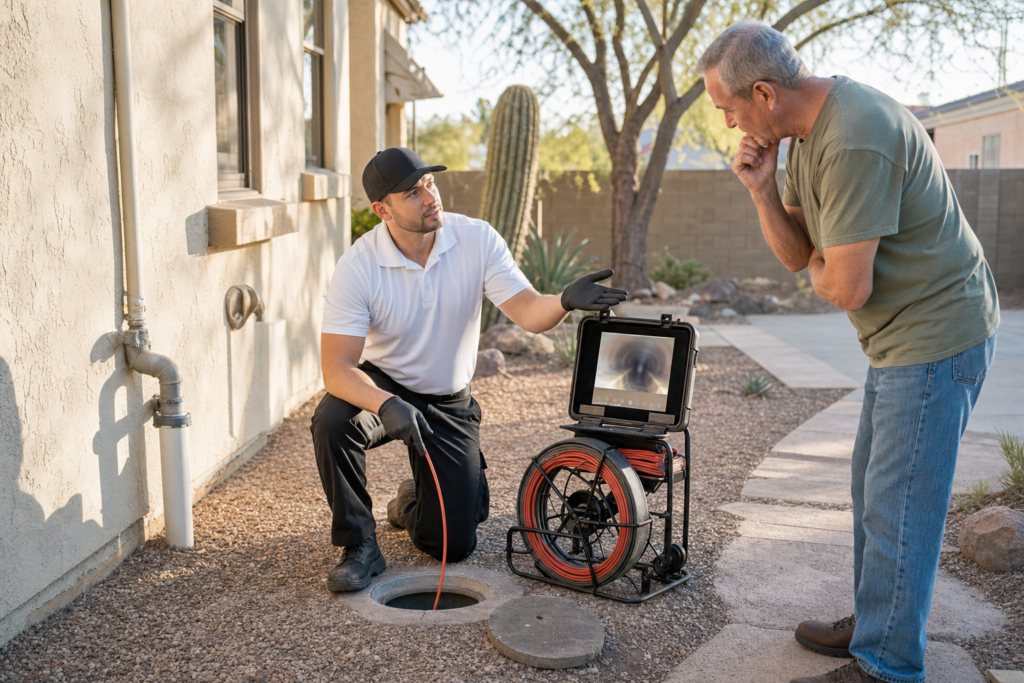
The only reliable way to know is a camera inspection before any high-pressure cleaning begins. Without that step, there is no way to confirm whether the pipe walls, joints, and overall structure can handle the force involved.
This article explains the specific conditions that make hydro jetting a poor fit for an older sewer line, why each one matters, what alternatives exist, and what Phoenix homeowners with older homes should ask their plumber before agreeing to the service.
Why Pipe Condition Matters More Than Pipe Age
It is easy to assume that older automatically means fragile, but that is not always the case. Plenty of sewer lines installed decades ago are still structurally intact. The pipe walls are solid, the joints are holding, and the line can handle professional cleaning without any problem.
On the other hand, a pipe that is relatively newer but has been exposed to root intrusion, soil movement, poor installation, or years of corrosion may already be compromised in ways that are not visible from above ground.
Age is a useful signal, but condition is the actual deciding factor. A responsible plumber does not decide whether to hydro jet based on when the house was built. They decide based on what the camera shows inside the pipe.
This distinction matters because it changes the conversation. Instead of asking whether the pipe is too old for hydro jetting, the more useful question is whether anyone has actually looked inside the pipe to confirm it is capable of handling the pressure.
Pipe Conditions That Make Hydro Jetting a Poor Choice
Hydro jetting uses high-pressure water — typically thousands of pounds per square inch — to clear buildup, grease, scale, and roots from sewer lines. On a healthy pipe, this is an effective and thorough cleaning method. On a compromised pipe, that same pressure can cause real damage.
Here are the specific conditions where hydro jetting becomes risky or inappropriate.
Existing Cracks, Fractures, or Holes in the Pipe Wall
When a sewer pipe already has a crack or fracture, high-pressure water can enter that opening and push outward against the surrounding soil. This can widen the crack, cause a section of pipe to break apart, or wash away the soil that supports the line. What started as a partial crack can become a full break — and what started as a cleaning job can become a repair job.
A camera inspection can reveal whether cracks or fractures are present before any cleaning begins. If the camera shows damage in the pipe wall, hydro jetting is typically not the right approach for that section of the line.
Severely Corroded or Thinned Cast Iron
Cast iron pipe was widely used in residential sewer lines for decades, including in many older Phoenix homes. Over time, cast iron corrodes — sometimes from the inside due to contact with waste and water, and sometimes from the outside due to soil chemistry and moisture.
When corrosion has thinned the pipe walls significantly, the remaining material may not be strong enough to withstand jetting pressure. In severe cases, corroded cast iron can flake, crack, or collapse under force that a healthy pipe would handle easily.
The challenge is that corrosion is often uneven. One section of the line may be in reasonable shape while another is paper-thin. A camera inspection helps a plumber identify where the worst deterioration is and whether jetting is a safe option for the line as a whole.
Orangeburg Pipe
Orangeburg pipe — sometimes called bituminized fiber pipe — was made from compressed wood fibers and tar. It was used in residential sewer construction primarily from the 1940s through the 1970s, which means it can still be found in some older Phoenix-area homes from that era.
Orangeburg was never designed to handle high-pressure water. The material is soft, lightweight, and degrades over time. Many Orangeburg lines have already begun to deform, collapse, or lose structural shape. Hydro jetting an Orangeburg pipe can crush or puncture the line because the material simply cannot resist the force.
Orangeburg pipe is generally considered a no-go for hydro jetting. If a camera inspection reveals Orangeburg, the conversation usually shifts from cleaning to replacement, because the material itself has reached the end of its useful life.
Clay Tile Pipe with Offset or Separated Joints
Clay tile pipe — also called vitrified clay — was a common sewer line material in homes built before the widespread adoption of PVC. Clay tile is durable in many conditions, but its joints are a known vulnerability. Over time, soil movement, root pressure, settling, and the natural shifting of the ground can push joint sections out of alignment.
When joints are offset or separated, high-pressure water can force its way through those gaps. This can wash out surrounding soil, destabilize the pipe further, and create voids underground that lead to additional sinking or misalignment.
A camera inspection can show whether the joints are intact and aligned. If they are, hydro jetting may still be appropriate. If they are offset or pulling apart, a gentler approach — or a repair — is usually the better path.
Collapsed or Bellied Sections
A pipe belly is a low spot or sag in the sewer line where the pipe has settled downward, usually due to soil conditions or inadequate bedding during the original installation. Water and waste collect in the belly, and over time the area can accumulate heavy buildup.
Hydro jetting can clear the buildup sitting in a bellied section, but it cannot fix the structural problem. The belly itself is a slope issue — the pipe is no longer pitched correctly to allow waste to flow by gravity. Jetting may temporarily improve flow, but the belly will continue to collect material and create future blockages.
When a camera inspection reveals a belly, the appropriate response is usually a repair to correct the pipe’s slope, not repeated cleaning of a section that will keep collecting waste.
What a Camera Inspection Reveals and Why It Changes the Decision
A sewer camera inspection is not just a formality. It is the step that separates a responsible evaluation from a guess.
During a camera inspection, a plumber feeds a small, waterproof camera through the sewer line and watches a live video feed of the pipe’s interior. This process can reveal:
- The pipe material — cast iron, clay tile, Orangeburg, PVC, or a combination
- The condition of the pipe walls — whether they are intact, corroded, cracked, or thinning
- The condition of the joints — whether they are aligned, offset, or separated
- The presence of root intrusion and how far roots have penetrated
- Whether the pipe has any collapsed, bellied, or deformed sections
- The overall structural integrity of the line from cleanout to the main
This information tells the plumber whether the pipe can safely handle jetting pressure, whether a lower-pressure approach is better, or whether the pipe needs repair rather than cleaning.
Skipping the camera inspection on an older sewer line means making a decision without knowing the most important variable. A plumber who recommends hydro jetting on an older line without first running a camera is making a judgment without the information needed to make it well.
What Happens When Hydro Jetting Is Not Appropriate
When a camera inspection shows that hydro jetting is not a safe option, there are other ways to address the problem. The right method depends on what the camera reveals and what the homeowner actually needs.
Mechanical Snaking
A motorized drain snake uses a rotating cable with a cutting head to break through blockages and clear the line. It operates at much lower force than hydro jetting and is often a safer choice for older pipes that cannot handle high pressure. Snaking is effective for many common blockages, though it may not remove heavy scale, grease buildup, or root mass as thoroughly as jetting.
Descaling
For heavily scaled cast iron lines where corrosion has created thick buildup on the pipe walls, descaling tools can remove the scale without the full force of hydro jetting. This is a more targeted approach for a specific condition.
Pipe Relining
When the camera reveals cracks, joint separation, or moderate deterioration, pipe relining — sometimes called CIPP or cured-in-place pipe lining — may be an option. The process works by placing a flexible liner inside the existing pipe, expanding it against the pipe walls, and allowing it to harden in position so that it forms a new interior surface within the original pipe structure. Because no excavation is required, this approach can often be completed without disturbing the yard.
Pipe Repair or Replacement
When a section of pipe is collapsed, severely deteriorated, or made of material that has reached the end of its life — such as Orangeburg — the appropriate step is repair or replacement. This could mean replacing only the damaged section or, when the overall line is compromised, replacing the full sewer line. Trenchless methods such as pipe bursting may reduce disruption in some cases.
The point is not that hydro jetting is bad or that alternatives are always better. The point is matching the method to what the pipe actually needs based on what the inspection shows.
What Phoenix Homeowners with Older Homes Should Know
Phoenix has a wide range of residential housing stock, including many homes built from the 1950s through the early 2000s. The pipe materials used in those homes changed over the decades.
Homes built before the late 1970s or early 1980s are more likely to have cast iron or clay tile sewer lines. Some mid-century homes may still have Orangeburg pipe. Homes built later typically have PVC, which generally handles hydro jetting well when the pipe is in good condition.
Phoenix’s soil conditions can also affect how older sewer lines hold up over time. Expansive clay soils and caliche layers — both common in parts of the Phoenix area — can shift and settle in ways that stress pipe joints and create low spots. Mature trees in older neighborhoods can send roots toward sewer lines seeking moisture, and root intrusion is one of the most common reasons homeowners call for sewer cleaning in the first place.
None of this means that every older Phoenix home has a sewer line that cannot handle hydro jetting. Many can. But it does mean that a camera inspection before jetting is especially important for homes in this age range, because the pipe material and the conditions it has been exposed to over the decades create real variables that affect the decision.
Questions to Ask Before Agreeing to Hydro Jetting on an Older Line
If a plumber recommends hydro jetting for your older sewer line, these are reasonable questions to ask before the work begins:
- Has a camera inspection been done? If not, ask for one before any high-pressure cleaning starts.
- What did the camera show about the pipe material and condition? You should be able to get a plain-English explanation of what the pipe is made of and whether there are any areas of concern.
- Are there any cracks, joint issues, or thinning that could make jetting risky? A plumber who has run a camera should be able to answer this clearly.
- Is the pressure being adjusted for the pipe’s condition? Experienced plumbers can adjust jetting pressure based on what the pipe can handle.
- What is the alternative if hydro jetting is not appropriate? A trustworthy plumber will have a recommendation ready, not a pressure tactic.
You should not feel rushed into a decision, and you should not feel uncomfortable asking these questions. A plumber who takes the time to explain clearly and honestly is one worth trusting.
Common Questions About Hydro Jetting and Older Sewer Lines
Is hydro jetting safe for old pipes?
It can be, depending on the pipe’s condition. An older pipe that is structurally intact — with solid walls and aligned joints — may handle hydro jetting without any problem. An older pipe that is cracked, corroded, or made of a fragile material like Orangeburg may not. A camera inspection before jetting is the most reliable way to determine whether the pipe can safely handle the pressure.
Can hydro jetting break a pipe?
If the pipe is already compromised — cracked, severely corroded, or made of a material that cannot withstand high pressure — hydro jetting can worsen existing damage. On a healthy pipe, jetting is an effective cleaning method that does not cause harm. The risk comes from applying pressure to a pipe that is already weakened.
What is Orangeburg pipe?
Orangeburg pipe is a type of sewer pipe made from compressed wood fibers and tar. It was used primarily from the 1940s through the 1970s. Orangeburg is soft, lightweight, and prone to deformation and collapse over time. It is generally not a candidate for hydro jetting because the material cannot withstand high-pressure water.
Is snaking always safer than hydro jetting for old pipes?
Snaking operates at lower force than hydro jetting, which makes it gentler on older pipes in most situations. However, aggressive snaking on a severely deteriorated pipe can also cause problems. The safest approach is a camera inspection first, followed by the cleaning method that matches the pipe’s actual condition.
How do I know what my sewer line is made of?
Most homeowners do not know their sewer line material until a plumber runs a camera inspection. The camera can identify whether the pipe is cast iron, clay tile, Orangeburg, PVC, or a combination of materials. If your home was built before the 1980s in Phoenix, there is a reasonable chance the sewer line is cast iron or clay tile.
What should a plumber do before hydro jetting an older sewer line?
A plumber should run a camera inspection to assess the pipe material, wall condition, joint alignment, and overall structural integrity before recommending hydro jetting on an older line. The camera findings should guide the decision about whether jetting is appropriate, whether a different cleaning method is better, or whether the pipe needs repair rather than cleaning.
The Right Approach Starts with an Honest Look
Hydro jetting is a valuable tool for sewer line cleaning — when the pipe can handle it. On older lines, the question is not whether the pipe is too old but whether the pipe is too damaged. The only way to answer that honestly is to look inside the line first.
At Fast Layne Plumbing, we start with a camera inspection on older lines so we can see what we are working with before we recommend anything. If jetting is appropriate, we move forward. If it is not, we explain what the camera showed and what options make sense for the pipe’s actual condition. Either way, you get a clear explanation in plain English and honest guidance about what your sewer line needs — not a sales pitch.
If you have an older home in Phoenix and you are not sure whether your sewer line can handle hydro jetting, we are happy to take a look and give you a straight answer.
Call Fast Layne Plumbing at 480.485.4659 to schedule a camera inspection or sewer cleaning.