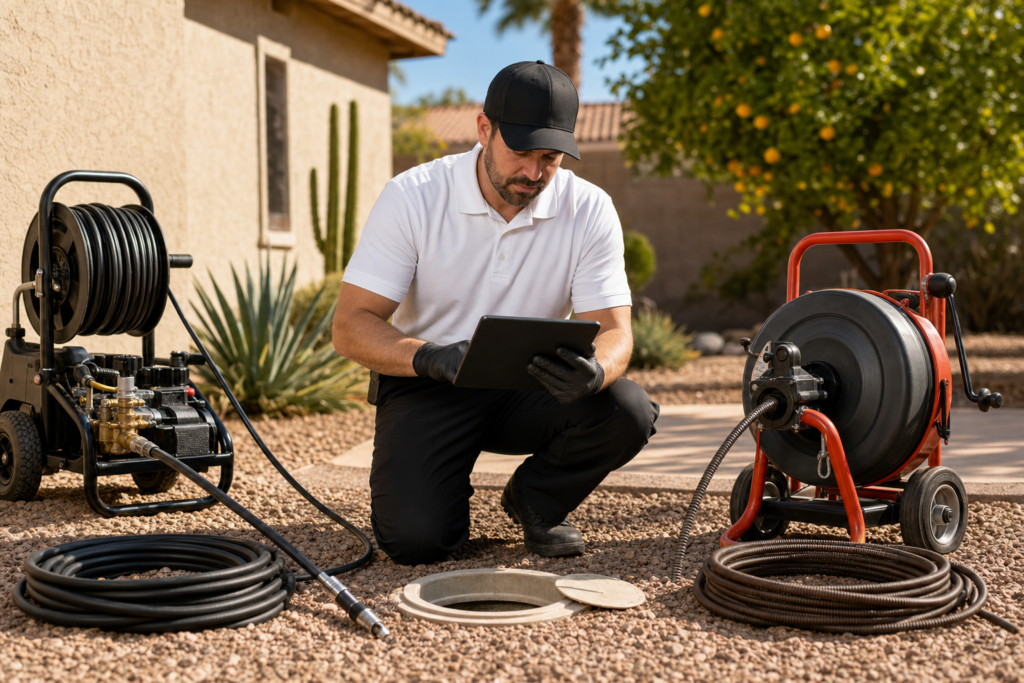
Hydro Jetting vs. Drain Snaking in Phoenix: Real Costs, Honest Differences, and How to Choose
In Phoenix, traditional drain snaking typically costs between $100 and $300 for a single fixture drain, and $200 to $500 when the main sewer line is involved. Hydro jetting runs higher — most residential jobs fall between $350 and $850, depending on access, severity, and pipe length. But the upfront price difference only tells part of the story. The right method depends on what is actually causing the clog, what your pipes are made of, how old your plumbing is, and whether this is a one-time blockage or a pattern that keeps coming back.
This guide breaks down what each method actually does, what drives the cost in Phoenix specifically, and how to make a confident decision — or at least know the right questions to ask before you approve a recommendation.
What Each Method Actually Does — and What It Leaves Behind
Before comparing cost, it helps to understand what each service accomplishes inside the pipe. These are not two versions of the same solution. Each one operates on a different principle, targets different problems, and produces a different result once the work is done.
Traditional Drain Snaking
A drain snake — also referred to as a mechanical auger — consists of a flexible metal cable fitted with a cutting or corkscrew-style tip. The technician inserts the cable into the drain opening and advances it through the line until it contacts and breaks apart the obstruction. Once the blockage is cleared, flow is restored and the immediate issue is resolved.
What snaking does well: it clears a path through the clog. For a straightforward blockage — hair buildup, a food clog in the kitchen line, a single obstruction in a fixture drain — snaking often solves the problem completely. Many homeowners snake a drain once and do not need service again for years.
What snaking leaves behind: the material coating the pipe walls. Snaking punches through the middle of the blockage, but it does not clean the interior surface of the pipe. If grease, mineral scale, or organic buildup has narrowed the inside diameter over time, that buildup stays in place after snaking. The path is open, but the conditions that caused the clog may still be there.
Hydro Jetting
Hydro jetting uses a specialized nozzle that sprays high-pressure water in multiple directions inside the pipe. Instead of punching a hole through a blockage, it scours the interior walls of the pipe, removing grease, mineral deposits, scale, soap buildup, and — in many cases — tree root intrusions.
What hydro jetting does well: it restores the pipe closer to its original interior diameter. For recurring clogs caused by buildup along the pipe walls, hydro jetting addresses the underlying condition rather than just the immediate symptom. In many situations, this can keep drains clear significantly longer than snaking alone.
What hydro jetting does not do: it does not repair cracked, collapsed, or structurally damaged pipes. It does not permanently eliminate tree roots — roots can regrow over time. And it is not appropriate for every pipe. Older pipes in poor condition, including certain cast iron or Orangeburg pipes found in some Phoenix neighborhoods, may not be good candidates for high-pressure cleaning. A professional assessment of the pipe’s condition should come before hydro jetting is recommended.
Phoenix Cost Breakdown: What You Are Actually Paying For
Cost ranges for both services vary based on real factors — not just which company you call. Understanding what moves the price helps you evaluate whether a quote is reasonable.
Snaking Costs in Phoenix by Drain Type
| Drain Type | Typical Phoenix Cost Range |
|---|---|
| Single fixture drain (sink, shower, tub) | $100 – $300 |
| Floor drain or laundry drain | $150 – $350 |
| Main sewer line | $200 – $500 |
What drives the price: how deep the blockage is, which drain is affected, how accessible the cleanout is, and whether the technician needs specialized equipment beyond a standard cable machine. A simple kitchen sink clog near the trap is a very different job than a main sewer line blockage 80 feet from the cleanout.
Hydro Jetting Costs in Phoenix: What Moves the Price
| Scenario | Typical Phoenix Cost Range |
|---|---|
| Standard residential sewer line | $350 – $600 |
| Difficult main line (long runs, heavy root intrusion, deep buildup) | $500 – $850+ |
What drives the price: the length of pipe being cleaned, the severity of the buildup or root intrusion, the size and type of nozzle required, and whether a camera inspection is included or performed separately. Difficult access — such as homes without a ground-level cleanout — can also increase cost because the plumber may need to access the line through a different point.
Additional Costs to Know About
Camera inspection: Many plumbers recommend a camera inspection before hydro jetting, and for good reason. A sewer camera lets the technician see what is inside the pipe — the type of buildup, whether there is root intrusion, and critically, whether the pipe is structurally sound enough for high-pressure cleaning. Camera inspections in Phoenix typically run $100 to $300 as a standalone service, though some companies include them as part of a hydro jetting package.
Cleanout access: If your home does not have an accessible sewer cleanout — or if the cleanout cap is buried, corroded, or damaged — there may be additional cost or steps involved. In some cases, the plumber may need to pull a toilet to access the main line, which adds time and cost to the visit.
A straightforward quote should account for these factors upfront. If a price feels unclear, it is completely reasonable to ask what is included before the work begins.
The Phoenix Factor: Why Local Conditions Change the Math
Most comparison articles about hydro jetting and snaking are written for a national audience. But Phoenix is not a generic plumbing market. Several local conditions make this decision different here than in many other cities.
Hard Water and Mineral Scale
Phoenix has some of the hardest water in the country. Elevated levels of calcium and magnesium naturally present in the local water supply cause mineral buildup to accumulate along the inside of pipes over time. These deposits — often called scale — gradually narrow the interior diameter of the pipe, which means water flows more slowly and debris catches more easily.
For homeowners dealing with recurring slow drains or repeat clogs, hard water scale may be a contributing factor that snaking alone cannot address. Snaking punches through the blockage, but the scale along the pipe walls remains. Hydro jetting can remove much of that scale and restore flow closer to normal — which is one reason hydro jetting tends to provide longer-lasting results in hard water areas like Phoenix.
Tree Roots in the Valley
Mesquite trees, citrus trees, and other desert-adapted species send roots deep and wide in search of moisture. Sewer lines, which carry water constantly, are natural targets. Root intrusion into sewer pipes is one of the most common causes of recurring main line clogs in Phoenix.
Snaking can cut through roots and restore flow temporarily, but the roots grow back. Hydro jetting can clear roots more thoroughly and clean the surrounding buildup at the same time. However, hydro jetting does not prevent root regrowth — if root intrusion is the underlying issue, the pipe may need periodic maintenance regardless of which method is used, and in some cases, sewer line repair may be the better long-term solution.
Pipe Age Across Phoenix Neighborhoods
Phoenix has a wide range of housing stock. Properties constructed between the 1950s and 1970s often contain cast iron or clay tile sewer lines. Some older homes may still have Orangeburg pipe — a tar-paper-based material that deteriorates over time. Homes built from the 1980s onward typically have PVC.
Pipe material and condition matter for this decision. Hydro jetting is generally safe for pipes in good structural condition, including most PVC and sound cast iron. But pipes that are already cracked, corroded, or deteriorating may not tolerate high-pressure cleaning. A camera inspection before hydro jetting helps a qualified plumber assess whether the pipe can handle the process safely.
If you own an older Phoenix home and you are unsure about your pipe material, a licensed plumber can evaluate your system and recommend the right approach.
When Snaking Is the Right Call
Snaking is not a lesser service — it is the right tool for many situations. Consider snaking when:
- You have a single clog in a fixture drain (kitchen sink, bathroom sink, shower, tub) and it is not a recurring problem.
- The blockage is close to the drain opening and likely caused by hair, soap, food waste, or a foreign object.
- Your pipes are older and you are unsure of their condition — snaking is gentler on fragile pipes.
- This is the first time the drain has clogged, and there is no reason to suspect a deeper issue.
- You want the drain cleared quickly and affordably, and the plumber’s assessment confirms a straightforward blockage.
Many clogs are genuinely one-time problems, and snaking resolves them completely. Not every clogged drain needs the most powerful method available.
When Hydro Jetting May Be Worth the Higher Cost
Hydro jetting costs more because the equipment is more specialized, the process takes longer, and the result is more thorough. It may be worth considering when:
- You have had the same drain snaked multiple times and the clog keeps returning.
- Multiple drains in the home are slow or backing up, which may indicate buildup in the main sewer line.
- A camera inspection reveals grease, scale, or root intrusion along the pipe walls.
- The plumber identifies heavy mineral scale — common in Phoenix — that snaking cannot remove.
- You want to clean the pipe thoroughly before a planned inspection, sale, or long-term maintenance program.
The key distinction: snaking solves the immediate clog. Hydro jetting addresses the buildup that may be causing the clog to happen repeatedly. If the pattern is recurring, hydro jetting often provides longer-lasting results — but the right recommendation depends on what a technician finds during an inspection.
Is Hydro Jetting an Upsell? How to Know the Difference
This is one of the most common concerns homeowners bring up, and it is a fair question. Hydro jetting costs two to three times more than snaking, so it is reasonable to wonder whether a plumber recommending it is genuinely trying to solve your problem or trying to sell a more expensive service.
Here is a practical way to evaluate the recommendation:
- Did the plumber inspect the line first? A legitimate hydro jetting recommendation should be based on what the plumber actually found — ideally through a camera inspection or at minimum through a professional assessment of the drain’s behavior and history. If someone recommends hydro jetting before looking at your system, that is worth questioning.
- Can they explain why snaking would not work? A good plumber should be able to tell you in plain English what is in the pipe and why snaking alone may not resolve it long-term.
- Are they willing to start with snaking? In some cases, starting with a snake and seeing how the drain responds is reasonable. A plumber who is honest about the options should be open to that conversation.
- Did they explain what hydro jetting will and will not accomplish? If someone promises hydro jetting will permanently eliminate your drain problems, that is a red flag. An honest plumber will tell you what it fixes, what it cannot fix, and what to expect going forward.
At Fast Layne Plumbing, we approach drain problems by finding the real issue first — not by defaulting to the most expensive option. If snaking will solve the problem, we say so. If hydro jetting is the better path, we explain exactly why and what you can expect. You should never feel pressured into a service you do not understand.
Long-Term Cost: An Honest Look at the Math
You may have seen the comparison framed this way: if you snake a drain three times a year at $200 each visit, that is $600 per year, while one hydro jetting service at $500 to $600 could keep the drain clear for two to three years — making hydro jetting cheaper over time.
That math can be accurate in specific situations, but it is not universal. Here is a more honest version:
- If the clog is a one-time event: Snaking costs less and may resolve the issue permanently. No further service needed. Total cost: one snaking visit.
- If the clog recurs once every year or two: Periodic snaking may still be the most practical option, especially for minor fixture drain clogs. The total cost over several years stays manageable.
- If the clog recurs multiple times per year: Repeated snaking visits add up, and each visit only provides temporary relief. In this pattern, hydro jetting is more likely to provide lasting improvement — and the long-term cost may genuinely be lower.
- If the problem is structural: Neither method fixes cracked or collapsed pipes. If the pipe itself is damaged, spending money on repeated cleaning of any kind delays the real repair. A camera inspection can help determine whether the issue is buildup or damage.
The honest answer is that the long-term math depends on your specific situation. A plumber who takes the time to inspect your system and explain what they find can help you understand which approach makes sense financially — not just today, but over time.
What to Expect When You Call a Plumber for a Clogged Drain
If you are comparing hydro jetting and snaking and you are not sure which one you need, that is completely normal. Most homeowners cannot tell from symptoms alone whether they need a basic snake or a more thorough cleaning. That is the plumber’s job to assess.
Here is what a good service visit should look like:
- The plumber arrives, listens to what you are experiencing, and asks about the history of the drain — how long it has been slow, whether it has been serviced before, and whether other drains in the home are affected.
- They assess the drain and, when appropriate, use a camera inspection to see what is happening inside the pipe.
- They explain what they found — in plain English — and recommend a method based on the actual condition of the line.
- They provide upfront pricing before starting work, so you know exactly what you are approving.
- They complete the service, confirm the drain is flowing properly, and clean up the work area.
At Fast Layne Plumbing, this is the standard for every drain service call. We believe you deserve to know what is going on with your plumbing, what your options are, and what each option costs — before any work begins.
Frequently Asked Questions
When should I choose hydro jetting over snaking?
Hydro jetting is typically a better fit when clogs keep coming back, when a camera inspection reveals buildup along the pipe walls, or when root intrusion or mineral scale is narrowing the line. If you have had the same drain snaked more than once and the problem returns, hydro jetting may address the underlying cause rather than just the immediate blockage. A licensed plumber can evaluate your system and recommend the right approach.
Is hydro jetting worth the extra cost?
It depends on the situation. For a one-time clog in a fixture drain, snaking is usually sufficient and more cost-effective. For recurring main line clogs caused by grease, roots, or hard water scale, hydro jetting often provides longer-lasting results and can reduce the total cost of service over time. The best way to know is to have the line inspected so the recommendation is based on what is actually in the pipe.
Can hydro jetting damage my pipes?
Hydro jetting is generally safe for pipes in good structural condition, including PVC and sound cast iron. However, pipes that are already cracked, corroded, or deteriorating — including some older materials found in Phoenix homes from the 1950s and 1960s — may not be suitable. This is why a camera inspection before hydro jetting is important. It lets the plumber confirm the pipe can handle the process safely.
How long does hydro jetting last?
Results vary depending on what caused the buildup. In many cases, hydro jetting can keep a drain flowing well for one to several years. However, conditions like root intrusion and hard water scale can cause buildup to return over time. Hydro jetting is not a permanent cure — it is a thorough cleaning that lasts significantly longer than snaking in situations where buildup is the root cause.
Do I need a camera inspection before hydro jetting?
A camera inspection is strongly recommended. It allows the plumber to see the condition of the pipe, identify the type and location of the blockage, and confirm that the pipe is structurally sound enough for high-pressure cleaning. Skipping this step increases the risk of using the wrong method or applying high pressure to a pipe that cannot handle it.
The Right Answer Depends on What the Inspection Shows
Choosing between snaking and hydro jetting is not about picking the cheapest option or the most powerful one. It is about matching the method to the actual problem — and that requires someone who will take the time to look at your system, explain what they find, and give you clear options with honest pricing.
Fast Layne Plumbing is a family-owned plumbing company serving Phoenix, AZ. We specialize in drain cleaning, sewer cleaning, hydro jetting, camera inspections, and sewer line repair. We answer the phone, show up when we say we will, explain the issue in plain English, and provide upfront pricing before any work begins. No pressure, no unnecessary upsells — just honest service from a team that treats your home with respect.
If you are dealing with a stubborn drain, a recurring clog, or a recommendation you are not sure about, we are happy to take a look and give you a straight answer.
Call Fast Layne Plumbing at 480.485.4659 to schedule service.